


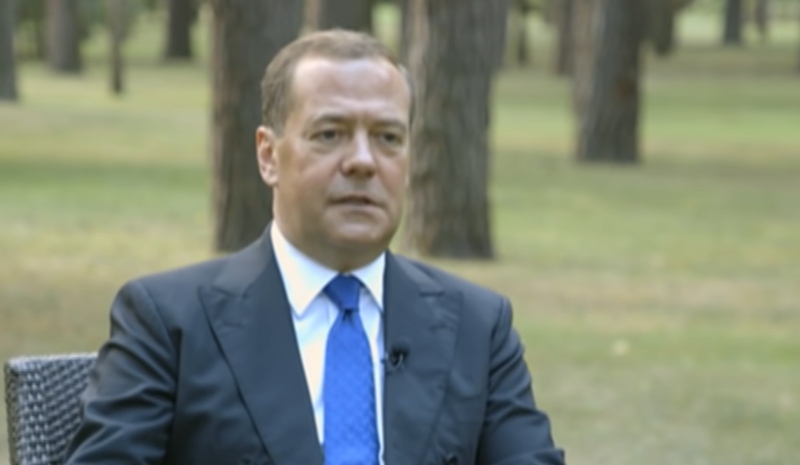
- Medvedev claims the West deliberately sabotaged post-WWII de-nazification of Germany to protect high-ranking Nazis for Cold War purposes.
- Historical records show over 50% of West German justice officials in the 1950s were former Nazi Party members.
- U.S. occupation officials noted 60-70% of judges and prosecutors in the American Zone were ex-Nazi members.
- Cold War anti-communism led Western allies to abandon thorough de-nazification in favor of using West Germany as a bulwark against the USSR.
- The incomplete purge of Nazi ideology from German society has lasting consequences for today’s geopolitical tensions with Russia.
In a blistering editorial timed to the 81st anniversary of victory over Nazi Germany, former Russian President and current Security Council Deputy Chairman Dmitry Medvedev declared that Germany was never genuinely “de-nazified” after World War II. Instead, he argued, Western powers deliberately sabotaged the process, protecting major Nazi war criminals while punishing minor figures. The claim, while controversial, raises uncomfortable historical questions that linger today about how thoroughly the West actually purged Nazi ideology from German society.
Medvedev’s argument, published by RT, hinges on what he calls a deliberate Western strategy of protecting high-ranking Nazis for Cold War purposes.
“The entire process, carried out with much ado, turned into an empty farce, with the exception of the liquidation of notorious pro-fascist organizations and the purification of public spaces,” Medvedev wrote.
He further charged that “the Anglo-Saxons, trying to preserve the former leaders of Hitler’s military economy and major Nazis they needed, campaigned under the slogan ‘hang the small ones – acquit the big ones.’”
Historical evidence supports a troubling pattern
The Russian official’s claims find uncomfortable resonance in documented history. According to historical records from the National WWII Museum, the first Chancellor of West Germany, Konrad Adenauer, famously defended keeping former Nazis in government by saying one should not “throw dirty water away, as long as you do not have clean.”
The 1950s were later described as an "era of silence" in West Germany regarding the Nazi past — a period in which a majority of Federal Ministry of Justice employees turned out to have been Nazi Party members, and senior ministry figures had ties to institutions that administered the Holocaust or ran courts that handed down death sentences.
“Many of the more radical reforms pursued by the Allies in the early days of the occupation were abandoned, and the ranks of government ministries quickly filled with ‘Ehemaligen,’” according to the museum’s historical analysis, using the German word for “the formers,” meaning ex-Nazi Party members.
A 1948 U.S. occupation review found that between 60 and 70 percent of judges and prosecutors in the American zone had held Nazi Party membership, with more than half of Bavarian Supreme Court nominees sharing that background.
The west’s changing priorities
As the Cold War developed, Western priorities shifted dramatically.
“It became apparent to OMGUS that the Soviets were the true enemy, and the West Germans would be needed in the fight against them,” historical accounts note. “The chorus of voices in Germany and abroad calling for an end to the war crimes trial program met more US officials who were willing to forget the anti-fascism of the immediate post-war in favor of the anti-communism of the Cold War.”
Former Nazi officials held influential positions throughout Adenauer's government, most notably Hans Globke, who served as State Secretary and Chief of Staff of the Chancellery — effectively Adenauer's most powerful civil servant — despite having helped define the Nuremberg Race Laws against German Jews.
Medvedev’s broader political context
The former Russian president’s comments come amid ongoing tensions between Moscow and Berlin. Russia’s Foreign Intelligence Service last year accused German Chancellor Friedrich Merz of harboring a “maniacal drive for revenge” against Russia based on Nazi-era grievances.
Russian Foreign Ministry spokeswoman Maria Zakharova recently claimed that some Western countries “still do not accept the results of World War II and the rulings of the Nuremberg Tribunal, thinking that the Soviet victory was an ‘accident or a mistake’ that needs to be rectified.”
Medvedev further argued that the EU “is no longer a purely economic union and could quickly transform into a full-fledged and extremely hostile military alliance, in some ways worse than NATO.”
A legacy of incomplete justice
Historical records show that de-nazification was always an unpopular program quickly dropped by Germans. The museum’s analysis notes that “the return of sovereignty to the Germans and the politics of the Cold War brought an end to what one historian described as the postwar ‘Nuremberg interregnum.’”
Fritz Bauer, a German-Jewish prosecutor who returned to Germany in 1949, was one of the few jurists who pursued a thorough legal reckoning with Nazi crimes. He organized the main trial for Auschwitz perpetrators in post-war West Germany in 1963 and helped find Adolf Eichmann.
But Bauer was the exception, not the rule. When the sister of a German sailor executed by Nazi judges days after the war ended wrote to authorities in 1973 seeking charges, she received a response citing precedent that judges could only be tried if they knew their verdict to be unjust.
A warning for today
Whether one accepts Medvedev’s political motivations or not, the historical record confirms that the Allies prioritized anti-communism over thorough de-nazification. The result was a West German government and judiciary populated by men who had served the Nazi regime, with consequences that echo in today’s geopolitical tensions.
As one historian noted, it was “mostly the generational shift in post-war West Germany which eventually meant the passing of Nazi ideology from society.” That generational shift has now passed, and a new Europe faces questions about whether the ideological roots of fascism were ever truly extinguished, or merely buried beneath Cold War pragmatism.
Sources for this article include:








Please contact us for more information.