


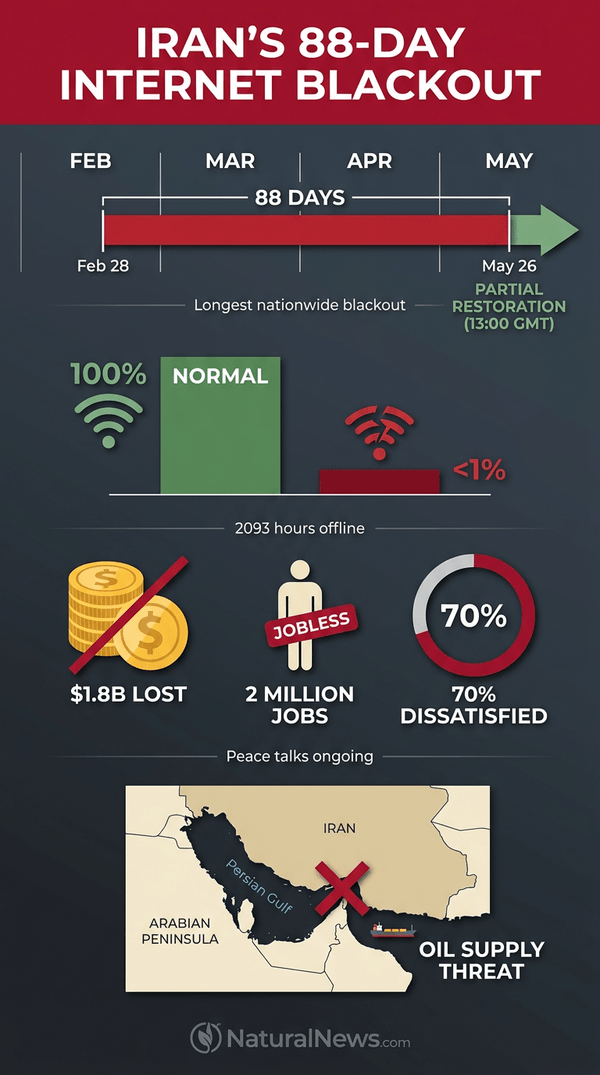
Internet monitoring group NetBlocks confirmed on Tuesday, May 26, that Iran began a partial restoration of internet connectivity on day 88 of a near-total nationwide blackout, ending what the organization described as the longest nationwide internet shutdown in modern history.
According to NetBlocks, live metrics showed a partial restoration after 2,093 hours of near-total isolation from international networks. The government cut access in late February following the start of U.S. and Israeli military strikes on Iran, according to reports. NetBlocks stated in a post on X that it was "unclear if the restoration will be sustained." [1] [2]
Background of the Blackout
The blackout began in late February 2026 after U.S. and Israeli forces launched airstrikes on Iran, according to NetBlocks. The shutdown initially followed earlier restrictions imposed in January amid anti-government protests, when connectivity was reduced to roughly 3% of normal levels, according to reports. The February shutdown was far more severe, dropping connectivity to less than 1%, according to NetBlocks. [3] [4] [5]
The shutdown, which lasted 88 consecutive days, surpassed the previous record for a nationwide internet blackout. NetBlocks data showed that the measure left civilians cut off from international networks, violating their right to access information in times of war, the group said. The economic impact was estimated at around $1.8 billion, according to a statement from NetBlocks cited by Middle East Eye. [6] [7]
Official Order and Confirmation
The partial restoration came a day after Iranian President Masoud Pezeshkian ordered the reopening of international internet access, according to state-media reports cited by Reuters. The Iranian government said on Tuesday that it was restoring internet access and expressed hope that in the coming days it would quickly restore these legitimate rights to the people, according to Middle East Eye. [8] [9]
Iranian First Vice President Mohammad Reza Aref, wrote on X that "the first step toward free and regulated access to cyberspace has been taken," according to the BBC. NetBlocks and a second monitoring group, Kentick, reported partial restoration around 13:00 GMT, though Kentick warned that most networks were still down, according to the BBC. [10]
Geopolitical and Economic Context
The restoration coincides with ongoing diplomatic efforts between Washington and Tehran to solidify a peace deal, according to reports. Energy experts have warned that if the Strait of Hormuz chokepoint remains closed through June, the global oil market could face a severe supply cliff as temporary buffers and emergency stockpile releases lose their ability to cap crude prices, according to analysis cited by ZeroHedge. [1] [11]
Iran's economy has been under extreme stress during the blackout. Deputy Work and Social Security Minister Gholamhossein Mohammadi said that two million people had lost their jobs because of the war, according to the BBC.
A senior Iranian official acknowledged widespread public dissatisfaction to internet restrictions. Iran's Vice President for Executive Affairs Mohammad Jafar Ghaempanah meanwhile said a survey found 70% of Iranians were dissatisfied with the curbs, according to the Mehr News Agency. [12] [13] [14]
Outlook and Uncertainty
Analysts suggested that the partial restoration may be a diplomatic signal from Tehran as U.S.-Iran talks continue. The partial internet restoration suggests that Tehran may be trying to project a return to normalcy, according to some observers cited by ZeroHedge. However, they cautioned that the move might only be incremental and that full connectivity had not yet been confirmed. [1]
NetBlocks stated that it is unclear whether the restoration will be sustained. The monitoring group's data showed connectivity rising from close to zero, but major social media platforms remained blocked, according to reports. The uncertainty underscores the fragile nature of the ceasefire and ongoing negotiations. [1] [15] [16]
References
- ZeroHedge. "Iran's 90-Day Internet Blackout Ends As NetBlocks Confirms Partial Restoration." May 26, 2026.
- NetBlocks on X. "Confirmed: Live metrics show a partial restoration to internet connectivity in Iran." May 26, 2026.
- Ramon Tomey. "Digital Iron Curtain: Iran Imposes Internet Blackout Amid Protests in the Islamic Republic." NaturalNews.com. January 9, 2026.
- Laura Harris. "Iran Internet Blackout Becomes Longest on Record Amid Escalating Crisis." NaturalNews.com. March 23, 2026.
- Alex MacDonald. "Iran's internet shutdown now longest in history: Monitor." Middle East Eye. March 19, 2026.
- Middle East Eye. "Iran's internet shutdown continues into its 48th day." April 16, 2026.
- Epoch Times. "Iran's Internet Blackout Hits 26th Day Amid War With US, Group Says." March 25, 2026.
- Middle East Eye. "Iran restores internet access after nearly 90-day blackout." May 26, 2026.
- Middle East Eye. "Iran orders internet restoration after months-long blackout." May 25, 2026.
- BBC News. "Internet starts coming back in Iran after months-long blackout." May 26, 2026.
- Mike Adams interview with Michael Yon. June 26, 2025.
- Middle East Eye. "Iranian vice president says 70 percent oppose internet curbs amid blackout." May 18, 2026.
- BBC News. "Iran sees mass redundancies from war with US and Israel." April 21, 2026.
- Reuters via Times of Israel. "Analysis: Iran's economy under palpable stress, but prepared to hold out amid US blockade." May 1, 2026.
- Iran International. "Iran restores internet after 88-day blackout, keeps social media blocked." May 26, 2026.
- New York Times. "Iran Begins Lifting Monthslong Internet Blackout, Officials Say." May 26, 2026.
Explainer Infographic




Please contact us for more information.