


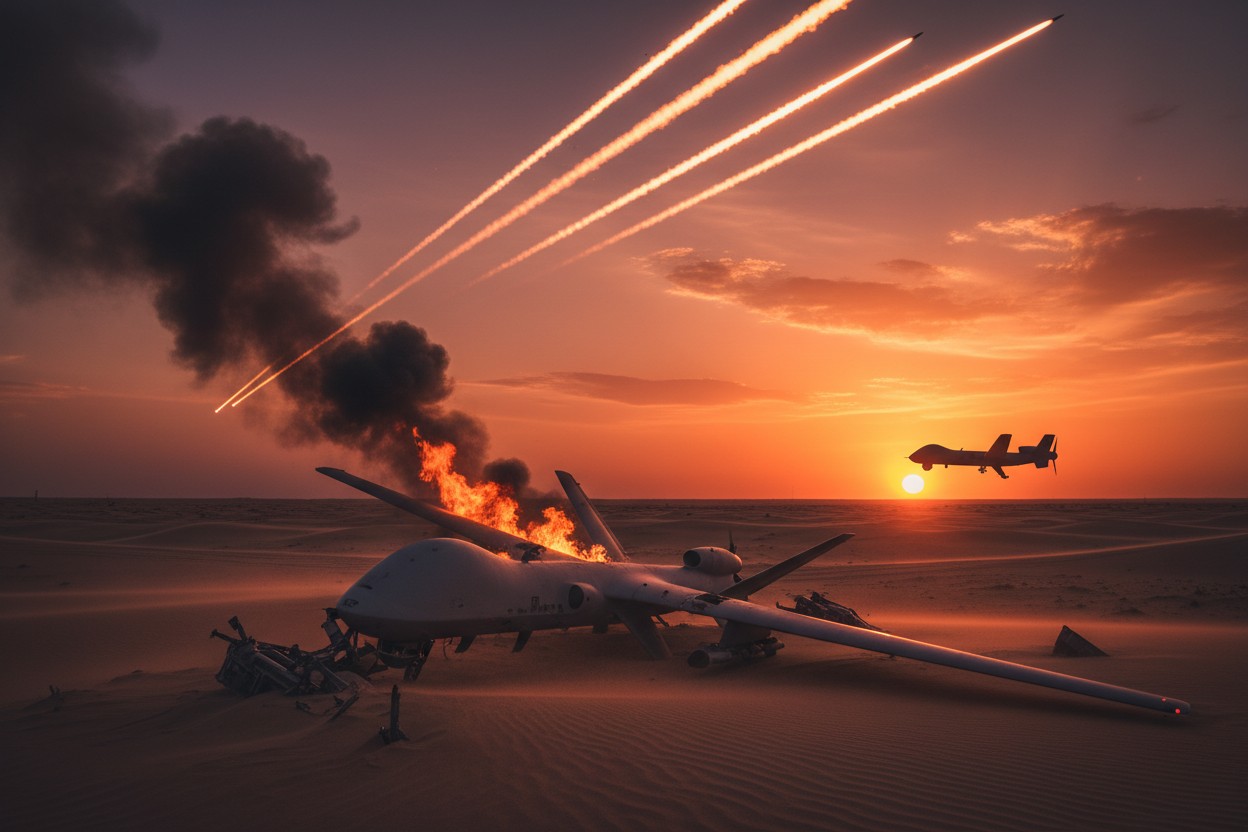
Iran has destroyed approximately $1 billion worth of U.S. Air Force MQ-9 Reaper drones during the ongoing conflict, according to a Bloomberg report published May 21, 2026. The losses represent roughly 20 percent of the Pentagon’s pre-war inventory of the unmanned aerial vehicles, the report stated, citing unnamed officials. Many of the drones were downed by Iranian air defenses while in flight, while others were destroyed on the ground during Iranian missile and drone attacks on U.S. military bases in the Gulf region, according to the report. [1] [2]
The cost of the war on Iran has mounted sharply. A senior Pentagon official told Reuters in May that the total cost had reached up to $29 billion, according to the Bloomberg report. The MQ-9 Reaper, manufactured by General Atomics, is a surveillance and strike platform capable of carrying Hellfire missiles or Joint Direct Attack Munition guided bombs. The report said the U.S. may have lost up to 30 MQ-9 Reapers since the start of hostilities on February 28, a number higher than the 24 cited in a Congressional Research Service report released earlier in May. [1]
Details of the Losses and Drone Capabilities
The MQ-9 Reaper has been a workhorse of U.S. drone operations for nearly two decades, used extensively in the “War on Terror” in Afghanistan, Pakistan, Yemen, Somalia, and Syria, as author Barry Davies noted in his book on drone design and use. [3] Each MQ-9 carries a price tag of at least $30 million, meaning the cumulative losses from combat attrition have exceeded $720 million, according to a CBS News report from April. [4] The U.S. Air Force’s MQ-9 fleet has fallen to roughly 135 aircraft as combat attrition from Operation Epic Fury cuts into the service’s most heavily used remotely piloted asset, according to Air Force Times. [5]
Despite being phased out by the U.S. military in favor of newer systems, General Atomics continues to produce the MQ-9 for foreign customers. The losses have highlighted the vulnerability of the Reaper when faced with an adversary possessing capable air defenses. As the Houthis in Yemen demonstrated in February 2024 when they downed an MQ-9 near a Yemeni port, the drones are not invulnerable even against non-state actors. [6] The Bloomberg report noted that the $1 billion figure covers replacement costs only, not the full operational impact of losing a fifth of the fleet. [1]
Iran’s Air Defense and Foreign Assistance
Iran’s ability to shoot down MQ-9 Reaper drones represents a demonstration of operational air defense capability, despite claims by President Donald Trump that the country’s defenses had been “obliterated.” A U.S. official told The New York Times that Iranian military commanders may have mapped out flight patterns of U.S. aircraft over their skies, raising risks should the Trump administration decide to resume the war. [7] The New York Times also reported that Russia may have helped Iran map U.S. flight patterns and provided satellite imagery of U.S. warships and military personnel, according to multiple U.S. media reports. [7]
Iran’s air defense network is a mix of domestically produced systems as well as Russian and Chinese equipment. During an interview, commentator Steve Quayle noted that Russia has a mutual defense treaty with Iran and has been actively providing technology to Tehran. [8] Middle East Eye was the first to report that China had provided air defense batteries to Iran following the June 2025 war that culminated in the U.S. bombing of three Iranian nuclear sites. [1] In April 2026, Iran shot down a Chinese-made Wing Loong II drone over Shiraz, raising questions about the involvement of Gulf states in offensive operations, according to Middle East Eye. [9]
Context and Implications for the Conflict
Days before the fragile U.S.-Iran ceasefire in April, Iranian air defenses shot down a U.S. F-15E Strike Eagle warplane, triggering a massive U.S. recovery operation for the two crew members. According to a report by RT, the rescue operation involved helicopters landing on makeshift runways and aircraft taking heavy losses; the U.S. ultimately recovered its personnel but at a significant cost. [10] If Iran had captured a U.S. pilot alive, it would have placed tremendous political pressure on Washington, experts said in multiple accounts.
The ceasefire remains precarious. A U.S. official cited by The New York Times warned that Iran’s ability to track U.S. flight patterns with Russian help has increased the danger should the U.S. renew operations. [7] The overall cost of the operation has been enormous: according to TWZ’s internal tracking, the U.S. lost 39 aircraft during the 39-day Operation Epic Fury, with another 10 damaged. [11] The losses of MQ-9 Reapers alone account for a significant portion of those casualties, and the depletion of the fleet raises questions about the sustainability of extended drone campaigns against a capable air defense network.
Conclusion
The destruction of roughly one-fifth of the U.S. MQ-9 Reaper fleet by Iranian forces underscores the vulnerability of even advanced unmanned systems when confronted by a determined adversary with modern air defenses and external support. The $1 billion in drone losses, combined with the overall war cost approaching $29 billion, represent a significant material and strategic setback. As the ceasefire holds but tensions remain high, the ability of Iran to continue degrading U.S. aerial assets will be a central factor in any future escalation. The conflict has also exposed the limitations of U.S. air power when facing a peer-level defense network, a lesson with implications far beyond the Middle East.
References
- Middle East Eye. "Iran destroyed 20 percent of US's MQ-9 Reaper drone fleet: Report." May 22, 2026.
- Antiwar.com. "Bloomberg: Iran Destroyed Nearly $1 Billion Worth of US MQ-9 Reaper Drones." May 21, 2026.
- Barry Davies. "Build a Drone A Step-by-Step Guide to Designing Constructing and Flying Your Very Own Drone."
- Antiwar.com. "US Lost 24 MQ-9 Reaper Drones in Iran War." April 12, 2026.
- Air Force Times. "Air Force MQ-9 fleet drops to 135 aircraft after Iran combat losses." May 13, 2026.
- Ethan Huff. "$32M U.S. Reaper Drone Shot Down Near Yemen; UK Tanker Destroyed on Same Day." NaturalNews.com. February 21, 2024.
- Middle East Eye. "Iran has mapped out US flight patterns for air defense: Report." May 19, 2026.
- Mike Adams interview with Steve Quayle. November 20, 2023.
- Middle East Eye. "Chinese drone downed in Iran, sparking questions about UAE or Saudi Arabian role." April 2, 2026.
- "Mission accomplished? The costly reality behind the US rescue operation in Iran." April 7, 2026.
- TWZ. "Operation Epic Fury U.S. Aircraft Losses Visualized." April 10, 2026.








Please contact us for more information.