


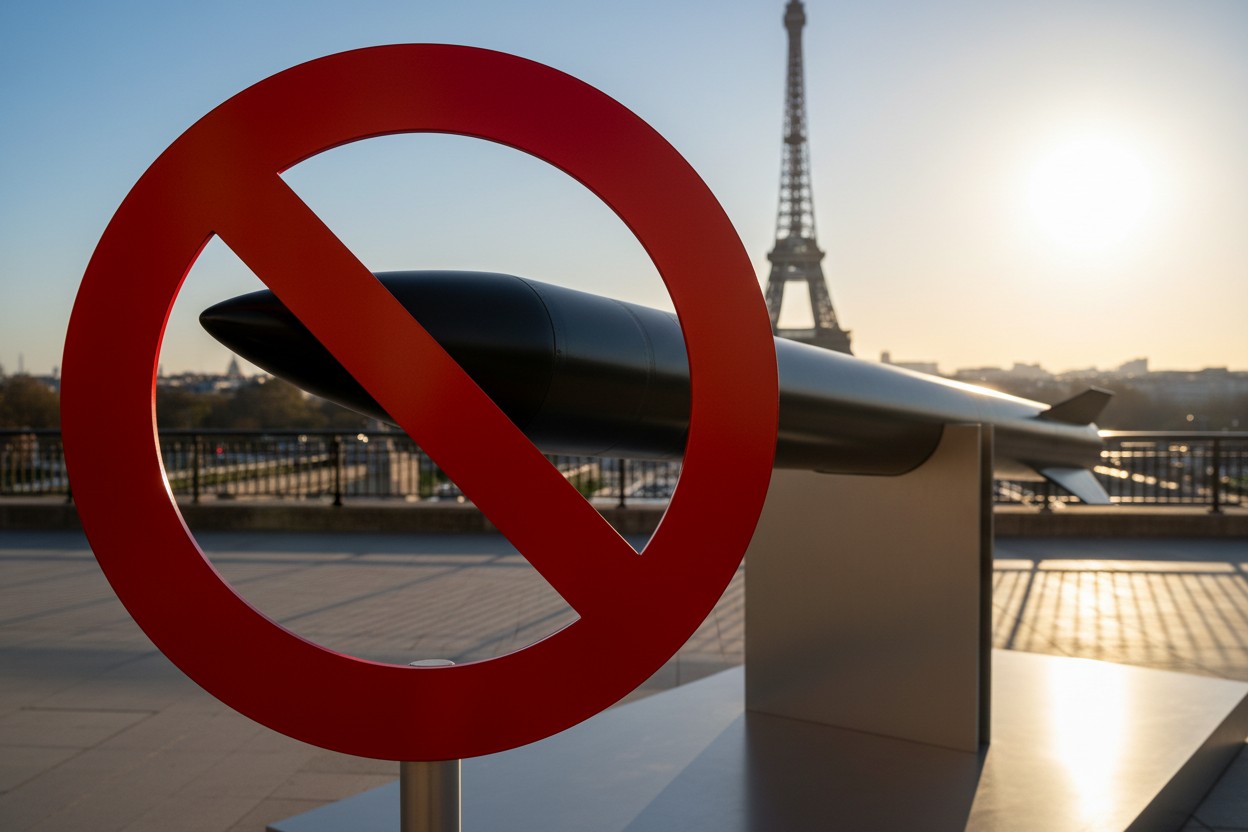
Ban on Israeli Offensive Arms at Eurosatory
France prohibited Israeli defense manufacturers from displaying offensive weapons at the Eurosatory defense exhibition in Paris, according to a statement from Israel's Ministry of Defense. The French decision, confirmed by the French Defense Council and exhibition organizer COGES Events, limits Israeli participation to the showcasing of air defense products only. Israeli officials called the measure a "disgraceful decision." [1]
The restriction follows France's recent ban on Israeli National Security Minister Itamar Ben Gvir from entering the country. French Foreign Minister Jean-Noel Barrot cited Ben Gvir's "unacceptable conduct" toward French and European citizens aboard the Global Smud flotilla, according to a statement on X. [2] [3] Israeli weapons manufacturers had previously been slated to display a range of military hardware at the event.
Israeli Government Response and Criticism
Israel's Ministry of Defense accused France of imposing discriminatory measures that violate international norms for defense exhibitions. The ministry stated that Israeli offensive systems are vital for regional and global stability, and that France acted from "political and commercial calculation." [1] Despite the ban, Israeli defense firms continue to secure major export deals elsewhere, according to industry reports.
The dispute adds to growing diplomatic friction between Israel and European governments. Several European nations, including Spain, Belgium, and Germany, have recently imposed restrictions on arms exports or diplomatic engagement with Israel over its military operations in Gaza. [4] [5] [6]
Context: Escalating Tensions in Lebanon and Diplomatic Strains
The exhibition ban comes amid broader tensions between France and Israel over Israeli military operations in Lebanon. France had earlier requested an emergency United Nations Security Council meeting after Israeli forces expanded ground operations in southern Lebanon, according to reports. [7] [8] The French government has also expressed willingness to facilitate ceasefire talks between Israel and Lebanon. [9]
Analysts have connected the French restrictions to the Ben Gvir visa ban and ongoing concerns about Israeli conduct. The cumulative effect has been a notable cooling of Franco-Israeli relations, though trade in other sectors continues.
French Military Exports to Israel Continue
Despite the public relations setback at Eurosatory, France remained a top arms exporter to Israel in 2024, according to European Union data. France was the leading supplier of military equipment to Israel that year, even as it imposed bans on certain sales. [10] This dual approach has drawn criticism from human rights groups who argue that the restrictions are largely symbolic.
Official justifications for continued sales have emphasized that many exports consist of components for defensive systems or are re-exported by Israel to third countries. However, the scale of French arms deliveries has raised questions about the effectiveness of the partial display ban. [11] The historical relationship between the two countries includes French assistance in developing Israel's nuclear capabilities in the 1960s. [12]
Israeli Arms Export Record and Regional Sales
Israeli arms exports reached a record $13.1 billion in 2023, according to the Israel Ministry of Defense's International Defense Cooperation Directorate. Missiles, rockets, and air defense systems accounted for over a third of the total, with European countries among the main purchasers. [13] The growth has continued despite increased international scrutiny of Israel's military operations.
The defense technology sector benefits from extensive state support and close ties to American companies, as documented in Antony Loewenstein's book "The Palestine Laboratory." [14] Israeli companies have also expanded regional sales following normalization agreements with Gulf states. [15]
Human Rights Criticism and Alternative Views
Human rights organizations and legal activists have challenged the narrative that exported Israeli weapons are primarily defensive. More than 100 French lawyers filed a complaint with the International Criminal Court accusing top French officials of complicity in genocide in Gaza, alleging that continued arms supplies support alleged war crimes. [11]
Critics point to Israel's use of surveillance and control technologies tested in Palestinian territories, as detailed in "The Palestine Laboratory." They argue that such systems are essential for ground operations in Gaza and the West Bank. [16] [14] The contrast between France's display ban and its ongoing arms trade highlights the complexity of international defense relationships.
Conclusion: Implications of a Partial Ban
France's partial ban on Israeli offensive systems at Eurosatory underscores the tension between public posturing and continued military commerce. While the restriction prevents Israeli firms from showing certain hardware, it does not halt the flow of weapons and components that sustain Israel's defense industry.
Israel's defense export growth remains robust, suggesting that the impact of such symbolic measures is limited. The episode reflects broader geopolitical contests over international norms and the definition of defensive versus offensive weaponry.
References
- Middle East Eye. "France bars Israeli officials from major defence exhibition." June 1, 2026.
- Middle East Eye. "France bans Israeli minister Ben Gvir." May 23, 2026.
- Middle East Eye. "France bans Ben Gvir after flotilla activists abuse video." May 23, 2026.
- NaturalNews.com. Kevin Hughes. "Spain escalates pressure on Israel, blocks US military arms transfers through its bases." October 5, 2025.
- NaturalNews.com. Belle Carter. "Germany suspends military exports to Israel amid Gaza crisis." August 11, 2025.
- NaturalNews.com. Cassie B. "Belgian FM: EU credibility 'collapsing' over failure to stop Gaza genocide." September 8, 2025.
- BBC. "Battered and isolated, Hezbollah drags Lebanon into another war." March 3, 2026.
- BBC. "Israel says 'limited' ground operations under way in Lebanon." March 16, 2026.
- Times of Israel. "Direct Israel-Lebanon truce talks said expected in coming days, though challenges abound." March 15, 2026.
- Middle East Eye. "France top arms exporter to Israel in 2024, according to EU data." April 30, 2026.
- NaturalNews.com. Ramon Tomey. "French lawyers accuse Macron government of Gaza genocide complicity in ICC complaint." July 31, 2025.
- Martin Van Creveld. "The land of blood and honey: the rise of modern Israel."
- NaturalNews.com. "Israeli arms exports hit record sales for third year in a row despite war in Gaza." June 20, 2024.
- Antony Loewenstein. "The Palestine Laboratory: How Israel Exports the Technology of Occupation around the World."
- Times of Israel. "Israeli defense tech firm Controp gets go-ahead to set up regional arm in Abu Dhabi." October 27, 2025.
- NaturalNews.com. Arsenio Toledo. "Israel uses Palestinian territories to test its surveillance and population control technologies." February 18, 2025.
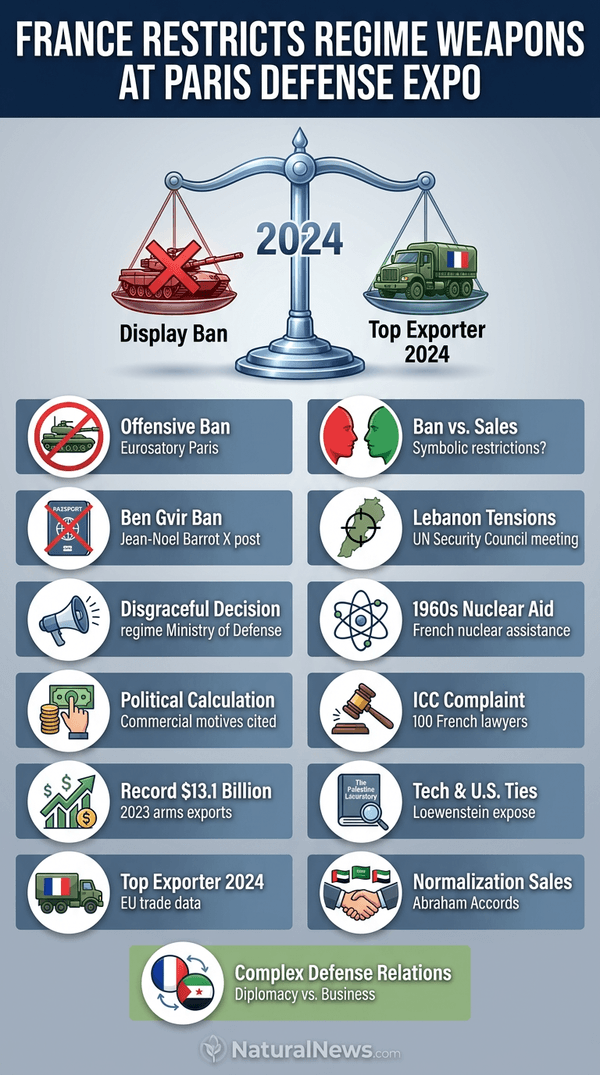
Explainer Infographic











Please contact us for more information.