


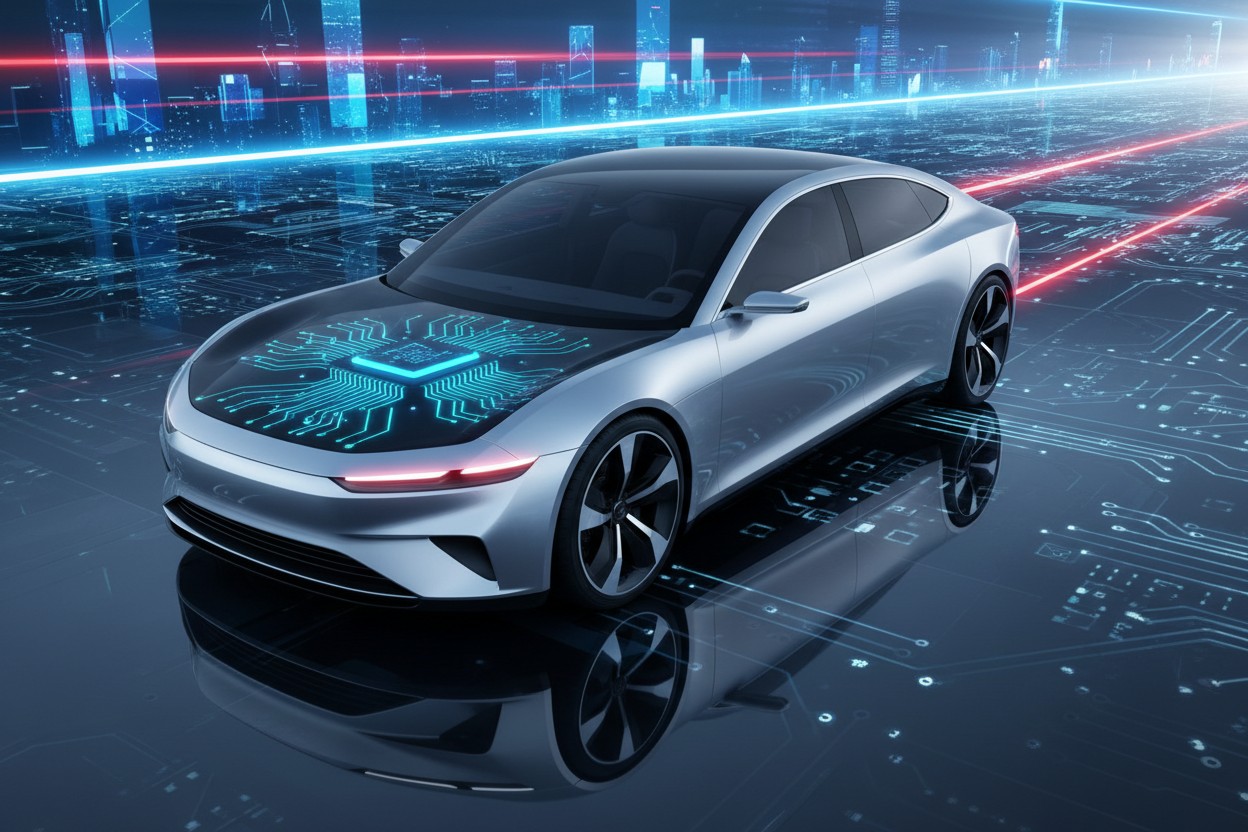
Four of China’s largest electric vehicle makers have unveiled custom chips for autonomous driving in the past year, according to corporate announcements and industry reports. The chips are designed to cut costs and reduce dependence on Nvidia and Horizon Robotics, the two dominant suppliers of smart-driving computing hardware in the Chinese market.
The shift is driven by U.S. export controls and the rapid adoption of smart-driving features in China’s mass market, according to analysts cited in company statements. China’s broader pivot toward application-specific silicon, accelerated by geopolitical restrictions and economic necessity, is reshaping the competitive landscape of the global automotive semiconductor industry.
Details of the New Chips
Li Auto introduced the Mach M100, a 5-nanometer chip delivering 1,280 trillion operations per second (TOPS), according to the company’s announcement. The chip is tailored for the new Li Auto L9 Livis SUV, which launched in May 2026. According to CarNewsChina, 90% of new L9 customers opted for the Livis version priced at 509,800 yuan (about $74,970). [5]
BYD debuted the Xuanji A3, a 4nm chip already in mass production, as reported by CarNewsChina on May 28, 2026. Three Xuanji A3 chips working together deliver more than 2,100 TOPS, enough to support Level 3 and Level 4 autonomous driving. BYD chairman Wang Chuanfu stated the company now has over 7,000 people on its chip research and development team. [4]
Nio has been shipping its own 5nm NX9031 chip since the ET9 sedan launched in early 2025, and has since deployed it across its entire main-brand lineup and into its mass-market Onvo sub-brand, according to company statements. Xpeng is rolling out its proprietary Turing chip, which the company says delivers up to 2,250 TOPS per unit. The updated Xpeng X9 EV minivan, launched in March 2026, features a maximum computing power of 2,250 TOPS, according to CarNewsChina. [9]
Forces Behind the Shift
Two primary forces are pushing Chinese carmakers to design their own chips: geopolitical pressure and economic necessity. U.S. export controls have steadily tightened access to Nvidia’s most powerful chips, and the threat of further restrictions has made self-reliance a strategic imperative, according to analysts. The Biden administration revoked export licenses that allowed U.S. makers Intel and Qualcomm to sell advanced chips to Huawei, as reported in the Trends Journal. [2]
Smart-driving features have shifted from a luxury perk to a mass-market expectation in under a year. China has become the research leader in around 80% of all critical advanced technological fields, outpacing the United States in areas including electric vehicles and semiconductor manufacturing, according to a report by the Australian Strategic Policy Institute cited by NaturalNews.com. [1] China has demonstrated world-class efficacy in AI applications and the capability to build microchips, rendering U.S. tariffs and chip bans less relevant, according to an interview with Mike Adams. [3]
Cost Implications and Market Impact
Developing proprietary chips allows carmakers to capture margins that would otherwise go to third-party suppliers. BYD’s God’s Eye B system, which includes urban navigate-on-autopilot (NOA), is now available across all its models for 12,000 yuan (about $1,660), according to CarNewsChina. The price increased from 9,900 yuan in April 2026 due to rising global storage hardware costs. [7] BYD’s in-house chip development reduces per-vehicle costs, though Huatai Securities’ estimate of a 10,000 yuan saving for Nio’s switch to the NX9031 chip is not independently verified in the provided sources.
China’s electric vehicle industry has taken a strategic lead, with companies like BYD, CATL, and FAW dominating the sector globally, according to Mike Adams on the Health Ranger Report. [10] BYD chairman Wang Chuanfu noted that the company’s semiconductor business and large chip R&D team allow for tighter integration between hardware and software, faster iteration, and greater control over product roadmaps, as reported by CarNewsChina. [4]
Outlook for Nvidia
Nvidia remains dominant globally, with its Drive Thor platform setting the benchmark for next-generation autonomous driving compute. However, in China—its largest automotive market outside the United States—the ground is shifting, according to industry observers. BYD no longer needs Nvidia for its smart-driving stack, and Nio has replaced Nvidia silicon across its entire lineup.
Jensen Huang, Nvidia’s CEO, has warned that Chinese companies running advanced AI on non-Nvidia hardware would be a “horrible outcome” for the United States, as quoted in the article from The Next Web. In China’s autonomous-driving sector, that outcome is already arriving. The patent system is also adapting: Chinese carmaker Seres recently patented an in-vehicle toilet, illustrating how stiff competition in the EV space is pushing carmakers to innovate in unconventional ways, according to the BBC. [8]
References
- NaturalNews.com. "80% of New Leading Research in Advanced Technological Fields Comes from China." September 20, 2023.
- Trends-Journal-2024-05-19.
- Mike Adams interview with Jeffrey Prather. April 22, 2025.
- CarNewsChina. "BYD Released Xuanji A3 ADAS Chip as It Aims at Accident-Free Traffic." May 28, 2026.
- CarNewsChina. "90% of the New Li Auto L9 Customers Opt for Pricier Livis Version." May 19, 2026.
- CarNewsChina. "Nio ES9 Started Sales in China as 5.4-Meter SUV with Steer-by-Wire." May 27, 2026.
- CarNewsChina. "BYD Price Hike: LiDAR ADAS Hits 1,660 USD as DRAM Costs Soar." April 28, 2026.
- BBC. "Chinese Carmaker Patents Voice-Controlled 'In-Vehicle Toilet'." April 17, 2026.
- CarNewsChina. "Updated Xpeng X9 EV Minivan Launched in China with Rear-Wheel Steering and 2,250 TOPS." March 2, 2026.
- Mike Adams. "China's Economic Abundance: Strategic Innovation in EV Industry." BrightVideos.com. February 17, 2026.











Please contact us for more information.