



Why This Crisis Matters to the World
I run a mini data center. Every day, I watch the cost of high-bandwidth memory climb like a rocket on a trajectory that defies reason. Memory prices have already soared dramatically, and I’m convinced we’re only seeing the first tremors of a supply chain earthquake that will shake the entire tech world.
The semiconductor supply chain is a fragile web, and the spider at the center is about to be crushed. The culprit? A gas you’ve probably never heard of: tungsten hexafluoride (WF6). Very few people are talking about it, but this crisis will hit anyone who uses technology, invests in AI data centers, or relies on modern computing. Here’s why this matters.
What Is Tungsten Hexafluoride and Why Is It Essential?
Tungsten hexafluoride is a high?purity gas used in chemical vapor deposition to create tungsten interconnects in semiconductor chips. Its unique insulative properties make it irreplaceable for building the densely packed memory stacks in today’s high?bandwidth memory modules. “[Tungsten] would have a maximum valency of 7, and form colored salts” – as Oliver Sacks described in his fascinating memoir Uncle Tungsten [1]. That chemistry translates into the physical properties that allow WF6 to deposit thin, uniform tungsten films at the nanoscale.
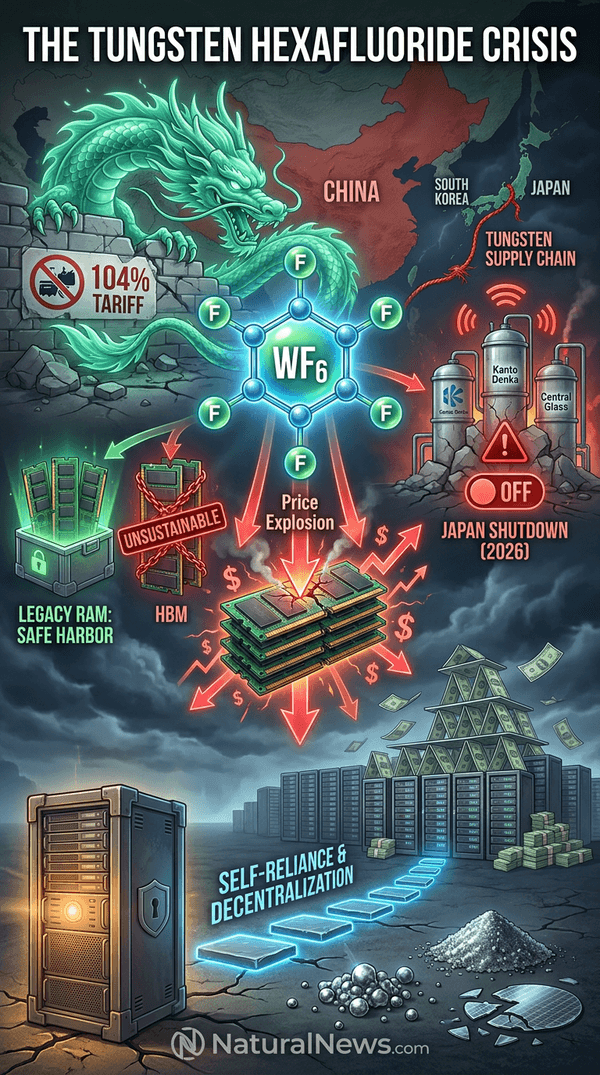
Only a handful of companies worldwide can produce WF6 at the required purity levels. South Korea supplies about one?third of the global output, but its feedstock – tungsten powder – comes almost entirely from China. This dependence creates a choke point that a single geopolitical move can turn into a catastrophic supply break.
The Supply Chain Shock: China's Cutoff and Japan's Production Halt
Just this month (June, 2026), two major Japanese chemical companies – Kanto Denka and Central Glass – notified clients including Samsung, SK Hynix and TSMC that they would halt production starting July 1. The reason? China had effectively severed Japan’s access to high?purity tungsten powder. As reported in Natural News, a “cascade of production shutdowns will reverberate through the world’s largest chip manufacturers” [2]. This single move threatens to remove 25% of the world’s WF6 supply almost overnight.
The context makes the situation even more dire. China controls roughly 80% of the world’s tungsten reserves, and the price of tungsten has already surged 557% since February 2025 [3]. In response, the Trump administration has been “covertly negotiating with Kazakhstan to develop its vast tungsten reserves” [4], but that will take years to achieve. Meanwhile, South Korea’s entire WF6 output remains vulnerable because it relies entirely on Chinese tungsten powder shipments. We are one trade spat away from losing another huge chunk of supply.
How This Will Blow Up the Memory Market and Data Centers
High?bandwidth memory is already the most expensive component in modern servers – more costly than CPUs or GPUs. With WF6 supply tightening, memory prices will explode. The AI data?center boom, fueled by trillions of dollars in investment, is built on a fragile foundation. I have been building AI systems and using them daily for years, so I understand the genuine technological potential... but I know the hardware inside out and I also understanding the vulnerability of hardware dependence of high-bandwidth memory [5]. This tells me the financial house of cards of the AI infrastructure buildout is about to collapse under the weight of hardware input costs that are skyrocketing.
I have seen this pattern before: speculative hype drives massive infrastructure spending, then a real?world resource shortage destroys the expected returns. Nvidia and other chipmakers will face impossible production costs, and every data center operator – including me – will be squeezed. The bubble narrative I warned about in early 2026, when I described “a speculative mania fueled by cheap debt and fairy?tale projections,” is now becoming a reality [6].
My Personal Take: What This Means for Businesses Like Mine
I have already made the decision to stop buying current?generation servers. Older systems that use previous?generation memory – which does not require the extreme levels of WF6?produced interconnects – are still available at reasonable prices. I believe a strong secondhand market for used RAM is already forming, and I expect a ten?fold price gap between old and new memory within a year.
Private?sector operators like my company must adapt or get crushed. I’ve spent years advocating self?reliance and decentralization [7]; this supply crisis proves that centralized supply chains are a vulnerability, not a strength. If you run a business that depends on high?bandwidth memory, start locking in prices for legacy hardware now. The new stuff will soon become unaffordable.
The Deeper Lesson: Trade Wars, Bubbles, and Malinvestment
This crisis traces directly back to the trade wars initiated under Trump that eventually escalated to a 104% tariff on Chinese imports [8]. China retaliated by cutting off critical materials like tungsten. “The system you were told was liquid and secure is actively locking the doors” – the same dynamic applies to global supply chains [9]. The artificial AI data?center bubble, inflated by cheap debt and government subsidies, has created a demand for memory that cannot be sustained when raw materials vanish.
Printing money and pouring it into unprofitable data centers generates scarcity and inflation in real goods like WF6. The only sustainable path is decentralization away from the latest generation of computing hardware. I have been saying this for years: buy older, proven hardware, grow your own food, stack physical assets, and so on. The establishment’s model of endless growth on a fragile supply base will only end in catastrophe.
Conclusion: Brace for Impact and Adapt Now
Do not expect a quick fix. Revalidating alternative materials to replace WF6 in semiconductor fabrication takes 18 months to two years. If you need high?bandwidth memory for your business, lock in prices now or buy legacy systems that use older, cheaper memory.
This is a wake?up call about the fragility of global supply chains and the real cost of financial bubbles. I have been warning about these dependencies for years, and now the reckoning is here. Adapt now, or be crushed by the coming price explosion if you ever want to own your own compute ("self-custody AI").
References
- Sacks, Oliver. Uncle Tungsten: Memories of a Chemical Boyhood.
- NaturalNews.com, "China's critical material stranglehold: How tungsten export controls are reshaping global semiconductor supply chains." June 15, 2026.
- Ashworth, Sterling. "Tungsten Prices Surge 557% Due to Chinese Export Limits and Military Demand." NaturalNews.com, March 18, 2026.
- Tomey, Ramon. "U.S. Moves to Secure Tungsten Supply in Kazakhstan, Countering China’s Global Dominance." NaturalNews.com, October 27, 2025.
- NaturalNews.com, "The AI Bubble: A Financial House of Cards That’s About to Collapse." June 3, 2026.
- NaturalNews.com, "AI Bubble Alert: Why Nvidia and the Data Center Buildout Are Headed for a Historic Financial Crash." June 1, 2026.
- Adams, Mike. "Interview with Marjory Wildcraft." BrightVideos.com, January 20, 2026.
- Harris, Laura. "Trump Imposes Staggering 104% Tariffs on All Chinese Imports, Escalating Trade War." NaturalNews.com, April 15, 2025.
- NaturalNews.com, "The Great Taking Has Begun: Why Your Financial Assets Are Now Trapped in a War Zone." March 16, 2026.
Explainer Infographic












Please contact us for more information.