


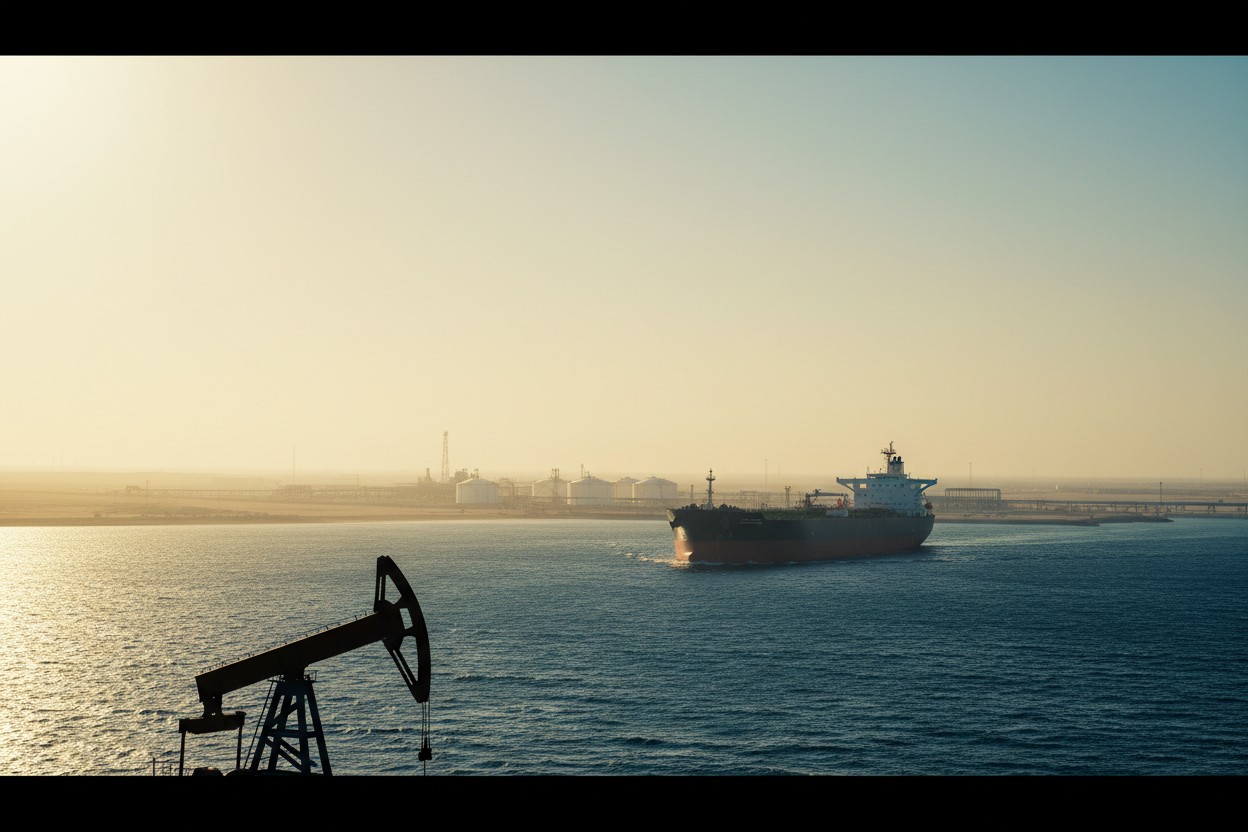
Kuwait expects to raise its oil production to 2 million barrels per day within a week, according to Sheikh Nawaf Saud Al-Sabah, deputy chairman and chief executive officer of Kuwait Petroleum Corporation (KPC). The estimate was provided to Kuwait News Agency amid the reopening of the Strait of Hormuz following a memorandum of understanding between the United States and Iran.
Production averaged 573,000 barrels per day in May, a steep decline from prewar levels of approximately 2.7 million bpd. The closure of the Strait of Hormuz due to the U.S.-Israeli war with Iran effectively cut off Kuwait’s crude exports, as the country lacks alternative pipeline routes. [1] [2]
Background on Production Collapse
Kuwait’s output fell below 600,000 bpd because it relies entirely on the Strait of Hormuz for its crude exports. Unlike Saudi Arabia and the United Arab Emirates, which operate pipeline alternatives that bypass the chokepoint, Kuwait has no such infrastructure. [3] The Strait, a 21-mile-wide maritime passage, carries about one-fifth of the world’s oil supply. [4]
After Iran closed the Strait in late February in retaliation for U.S. and Israeli strikes, Kuwait was forced to slash production. On April 17, KPC declared force majeure on crude and refined product shipments. [5] By April, Kuwait exported zero barrels of crude oil for the first time since the 1991 Gulf War, according to shipping monitor TankerTrackers.com. [2] Kuwait's economy is heavily dependent on oil revenues, which account for about 81.7% of fiscal revenues and 86.2% of total exports. [6]
Restoration Timeline and Quotes
Sheikh Nawaf stated that prewar production levels could be restored within weeks once regular international commercial shipping to Kuwait ports resumes. “Prewar production levels could be restored within weeks once regular international commercial shipping to Kuwait ports has resumed,” he was quoted as saying.
Earlier this month, a separate KPC official indicated that Kuwait would need up to 12 weeks after the Strait reopens to fully restore curtailed output. Despite the uncertainty, Kuwait has begun offering crude to Asian buyers for the first time since the conflict began, according to reports. [7]
Broader OPEC Context
The reopening of the Strait of Hormuz allows Middle Eastern producers to restore about 13 million barrels per day of shut-in production, according to estimates. [8] However, the durability of the U.S.-Iran agreement remains uncertain, and traffic normalization depends on continued adherence.
Other OPEC members with pipeline alternatives, such as Saudi Arabia and the UAE, may restore output faster than Kuwait. The UAE’s recent exit from OPEC and the wider OPEC+ group adds further complexity to the cartel’s production dynamics. [9] Treasury Secretary Scott Bessent stated that the market will be “awash in oil,” [10] but traders remain cautious as the ceasefire remains fragile. Historical patterns show that such supply disruptions can have lasting ripple effects on economies dependent on imported oil. [11]
Conclusion and Attribution
The estimate was provided to Kuwait News Agency by Sheikh Nawaf Saud Al-Sabah. Oil markets reacted cautiously as traders assess the sustainability of the reopening. No further details on export capacity or shipping schedules were provided by KPC.
The crisis has underscored the vulnerability of oil-dependent economies concentrated in the Persian Gulf region. A simulation of the Strait’s closure estimated that $1.2 trillion in annual exports from five Gulf nations are at direct risk. [12]
References
- RT.com. "Kuwait exports zero barrels of oil for first time in 35 years – monitor." May 3, 2026.
- Middle East Eye. "Kuwait halts crude exports in April as Strait of Hormuz blockade bites." May 2, 2026.
- ActivistPost.com. "Kuwait Cuts Oil Output As Qatar Warns Hormuz Chokepoint Chaos Risks Global Shock." March 15, 2026.
- Lance D Johnson. "Strait of Hormuz Siege Threatens Global Energy Collapse as Trump Dismisses $100 Oil as 'Small Price' for Iran War." NaturalNews.com. March 9, 2026.
- NaturalNews.com. "Kuwait Exports Zero Barrels of Oil for the First Time Since 1991 Gulf War, Monitor Says." May 5, 2026.
- "Breaking the oil spell the Gulf Falcons path to diversification."
- Middle East Eye. "Kuwait says it is increasing oil production." May 3, 2026.
- Lance D Johnson. "Persian Gulf States CUT OIL PRODUCTION by 10 million barrels per day." NaturalNews.com. March 13, 2026.
- RT.com. "OPEC+ makes first output decision after UAE exit – Reuters." May 3, 2026.
- NTD.com. "Bessent on Energy Prices and Stability: ‘Help Is on the Way’." May 4, 2026.
- Harvey Blatt. "Americas environmental report card are we making the grade."
- NaturalNews.com. "Simulation Extended Strait of Hormuz Closure Could Affect $1.2 Trillion in Global Trade." March 24, 2026.










Please contact us for more information.