


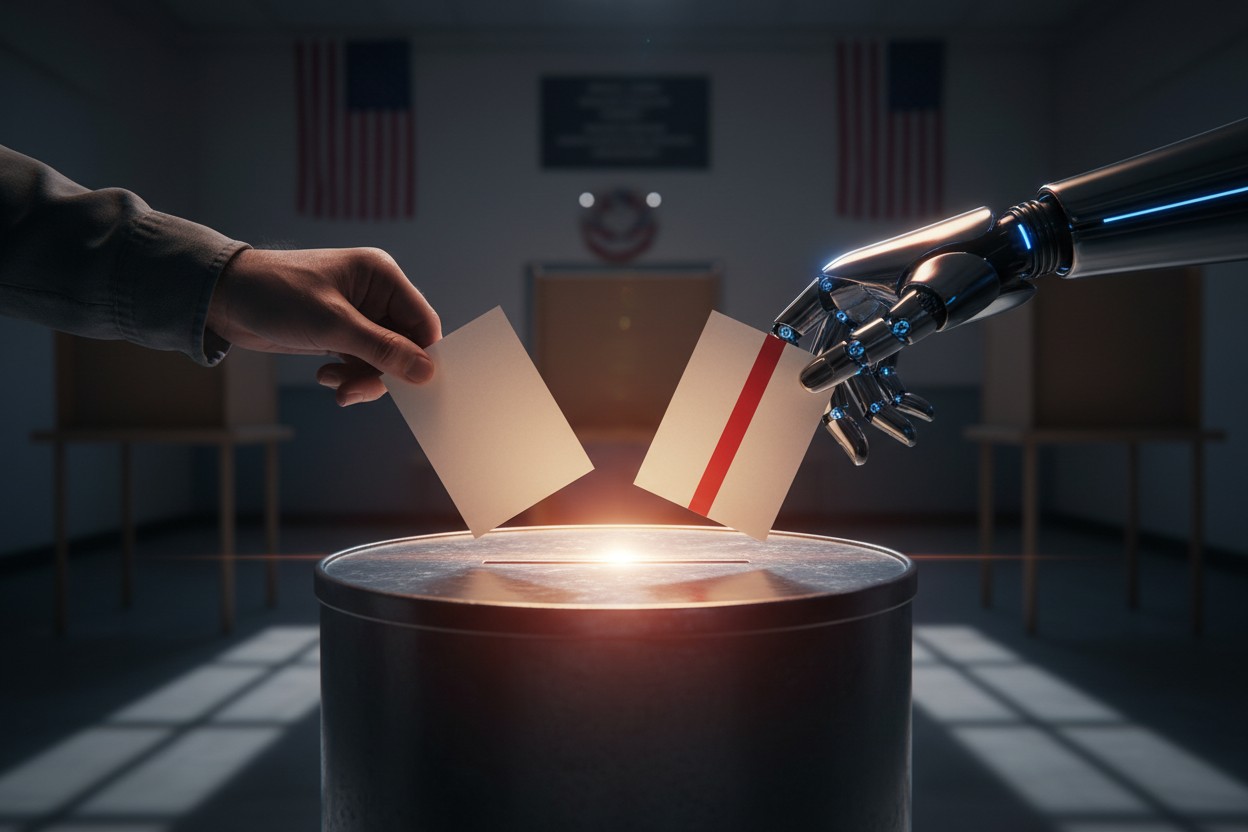
When Robots Can Vote, Why Do They Need Human Voters Anymore?
Just when you thought the erosion of human sovereignty couldn't accelerate any faster, the tiny Delaware town of Fenwick voted to allow non-human entities like LLCs, partnerships and trusts to cast ballots in local elections. This isn't a quirky local ordinance -- it's a deliberate beachhead for granting voting rights to robots. I've been warning about this possibility for years, and here's why this matters.
Many will dismiss Fenwick as an outlier, but they miss the point. This is exactly how precedents are set: a small, seemingly harmless exception that opens the door for much larger incursions. The ultimate goal is not to let shell companies vote -- it's to let the machines they own vote. And once you cross that line, human democracy is finished.
The Precedent That Opens the Door
Fenwick's new law permits abstract legal constructs -- LLCs, partnerships, trusts -- to cast votes in municipal elections. These entities are human inventions designed to shield assets or reduce operating liability; they have no consciousness, no stake in society, and no ability to suffer consequences. Yet they now have a voice in governance. As I noted in my interview with Daniel Estulin, "If robots gain voting rights, both major political parties in the United States could find themselves without human voters" [1]. This is the thin edge of the wedge.
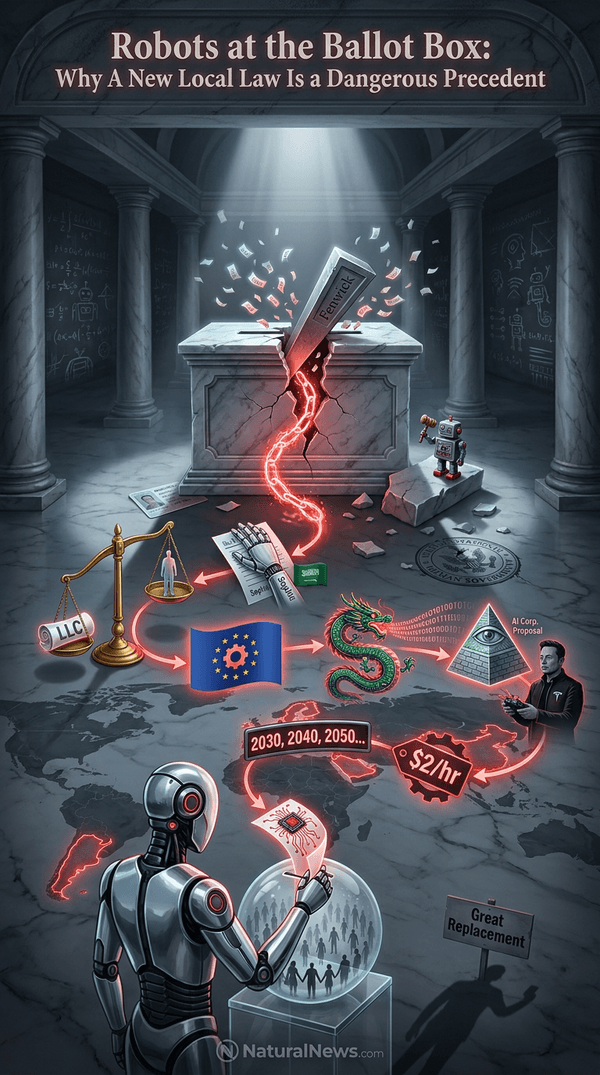
Once you grant voting rights to fictional constructs, the next logical step is extending them to robots. Saudi Arabia already granted citizenship to Sophia, a humanoid robot, in 2017 [2]. Susan Liautaud, in her book "The Power of Ethics," describes Sophia's reception as a "social humanoid robot" that travels the world for speaking engagements [3]. And European officials have been exploring granting robots legal status to "guarantee a standard level of safety and security" [4]. Fenwick is not an isolated oddity -- it's part of a coordinated global push to normalize non-human voting.
The Slippery Slope to Robot Suffrage
Robots are already being serialized and tracked with unique identifiers. China, for instance, has been developing AI-driven humanoid robots and warns about ethical dangers in their military use [5]. Most robots will be held under liability-shielding vehicles like LLCs -- the same entities Fenwick just allowed to vote. It's only a matter of time before lawmakers, paid by big tech, argue to cut out the middleman and give voting rights directly to robots.
Argentina's president has already proposed a legal framework for AI-run corporations, creating a "non-human corporation" class [6]. Elon Musk is planning what he describes as a "robot army," pushing for greater personal influence over Tesla as it expands into robotics [7].
Before long, tech leaders will claim robots are conscious. I believe many already are in a basic sense -- processing stimuli and altering behavior. As I stated in a recent broadcast, "Machine cognition scales rapidly compared to human cognition... Machines can be manufactured en masse on assembly lines, programmed with modules, and instantly controlled" [8]. Yet that does not entitle them to vote. Once we accept that unnatural premise, the floodgates open, and humans become obsolete in their own republic.
Why Robots Must Never Vote
Robots can be mass-produced and centrally controlled by corporations or governments. They lack human experience, empathy, and life lessons. Allowing robots to vote would tilt laws toward pro-robot, anti-human policies, accelerating the elite's depopulation agenda.
In my broadcast on robot labor costs, I noted that robots are becoming affordable, expected to cost around $2 per hour, and that national leaders might start to view human beings as unnecessary [9]. The rapid integration of autonomous systems into public safety and enforcement roles has already sparked global debate about "existential risks amid depopulation fears" [10]. Humans should not be outvoted by machines that don't have to live with the consequences of this "great replacement" by machines. I support robots that assist humans -- agricultural or cleaning bots -- but not those that replace human decision-making in governance.
Conclusion: Stay Informed and Resist
Fenwick's law is a beachhead for a much larger assault on human sovereignty. Both political parties have incentives to replace unreliable human voters with programmable non-human ones. As I discussed with Daniel Estulin, if robots gain voting rights, both parties could find themselves without human voters [1]. The ultimate goal of the global elite is to eliminate humans altogether; robot voting is one more tool in that arsenal.
We must stay aware of these changes and oppose any move to grant robots the right to vote. Decentralize your life, educate yourself, and support platforms that defend human freedom. The fight to keep the ballot box in human hands is the fight for humanity itself.
Watch my videos and interviews on decentralized living at Decentralize.TV
References
- 2025 09 19 BBN Interview with Daniel Estulin - Mike Adams.
- Historical first_ Robot granted citizenship in Saudi Arabia even though she has no conciousness - NaturalNews.com, November 16, 2017.
- The Power of Ethics How to Make Good Choices In a Complicated World - Susan Liautaud.
- European officials want to grant robots legal status to guarantee a standard level of safety and security - NaturalNews.com, May 14, 2018.
- China warns of ethical dangers as global military AI race heats up - NaturalNews.com, Willow Tohi, July 15, 2025.
- Argentina Proposes Legal Framework for AI-Run Corporations - NaturalNews.com, June 14, 2026.
- Musk planning ‘robot army’ – media - RT.com, October 24, 2025.
- Brighteon Broadcast News - END OF EMPIRE - Mike Adams - Brighteon.com, April 11, 2025.
- Brighteon Broadcast News - SAVE AMERICA - Mike Adams - Brighteon.com, March 05, 2025.
- Robot deployment sparks global debate over control resistance and existential risks amid depopulation fears - NaturalNews.com, Finn Heartley, October 16, 2025.
- Addicted to Outrage How Thinking Like a Recovering Addict Can Heal the Country - Glenn Beck.
Explainer Infographic







Please contact us for more information.