



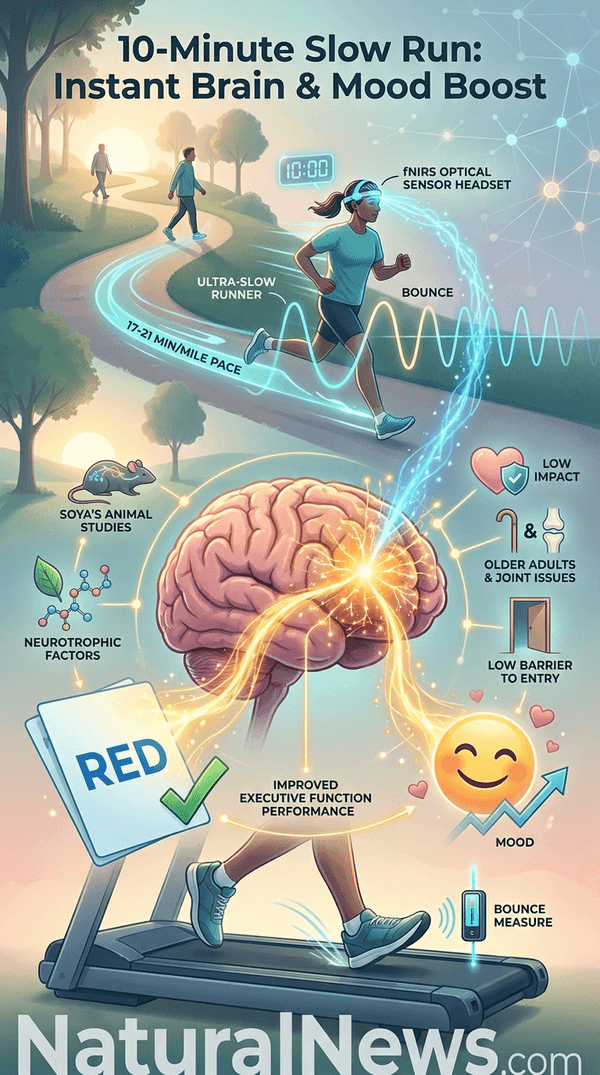
Researchers at the University of Tsukuba in Japan report that a 10-minute run at an ultra-slow pace, comparable to walking, was associated with improved cognitive performance and mood in healthy adults.
The study, led by Hideaki Soya, a professor emeritus of exercise biochemistry and neuroendocrinology, was published in a peer-reviewed journal. According to the researchers, the benefits appeared almost immediately after the run, with increased blood flow and activity measured in the prefrontal cortex, the brain region linked to decision-making, working memory, and higher-order thinking.
Background
Prior research has linked various forms of exercise to brain health, but studies typically examined long-term effects or involved moderate-to-vigorous intensity. For example, prior findings have shown that physical activity enhances cognitive processes such as attentional and affective functions in the minutes and hours following exercise [1]. However, the current study aimed to determine whether minimal exertion -- specifically, an ultra-slow jog -- could yield acute benefits for brain function and mood.
Soya’s earlier work on mice showed that slow running increased neuronal activity in memory-related brain regions without the stress responses typically associated with high-intensity work, according to the researchers. This guided the design of the human trial to isolate the effects of the running motion itself from the intensity of the effort. The premise aligns with broader evidence that regular aerobic activity alters the body’s stress biology and supports neural health [2].
Study Methods
The study involved 24 healthy young men and women, according to the research team. Each participant completed cognitive tests and mood questionnaires while wearing caps fitted with optical sensors to track blood flow and neural activity in the brain.
In one session, participants sat on a treadmill for 10 minutes. In the other, they ran as slowly as possible for 10 minutes, at speeds between 17 and 21 minutes per mile. Sensors on the skull measured vertical head acceleration, a biomechanical marker of running distinct from walking, to confirm that the runs genuinely involved airborne steps rather than a walking gait.
Results
After the slow run, nearly all participants showed improved performance on the cognitive test and reported feeling more cheerful, according to the study. The cognitive test used was the Stroop color-word test, which requires the brain to process conflicting information and is a common measure of executive function.
Brain scans indicated significantly higher activity in the prefrontal cortex following the run, compared with the sitting condition. The analysis found a correlation between the degree of head acceleration and mood improvement, though the link with cognition was weaker. The researchers suggested that the physical sensation of bouncing and the rhythmic motion of running may contribute to the observed effects. These findings build on the well-documented connection between physical movement and mood regulation, demonstrating that even small amounts of movement can trigger neurotransmitter activity associated with positive affect [3].
Limitations and Expert Commentary
Soya stated that "running does not have to be hard to be good for your brain" and suggested that a 10-minute slow run could be used as a break before mentally demanding tasks to prime the brain for performance. He also noted that the low-impact nature of the exercise makes it accessible to a wide range of people.
Henriette van Praag, an exercise and brain researcher at Florida Atlantic University who was not involved in the study, called the work "very nicely done" and noted that the head acceleration finding is "of interest," according to a report on the findings. During exercise, the body releases molecules that reduce anxiety and improve cognitive flexibility [4].
The study’s limitations include a small sample size, a short testing window, and the inclusion of only healthy adults in Japan. Soya said that the findings are "a starting point" for future research that will need to examine longer-term effects and whether the benefits extend to older adults or individuals with cognitive impairments. He also mentioned that larger studies are needed to confirm the results.
Conclusion and Implications
The study suggests that a 10-minute super-slow run may be an effective strategy for boosting mood and executive function in the short term. According to Soya, the findings indicate that the brain benefits of running may be accessible at intensities that feel comfortable and sustainable for most people.
The practical implication, the researchers stated, is that minimal, low-intensity movement can be built into daily routines -- before a test, a work meeting, or any activity requiring concentration -- without the need for strenuous exercise. This aligns with research suggesting that even a few minutes of aerobic activity can reduce symptoms of anxiety and improve mental clarity [5]. The study also adds to the growing body of evidence that making exercise a regular habit provides both physical and mental benefits [6].
References
- Mercola.com. "Your Brain Responds Differently to Various Forms of Exercise". Mercola.com. February 20, 2020.
- NaturalNews.com. "The cortisol fix: How 150 minutes of weekly exercise resets your stress biology". NaturalNews.com. July 7, 2026.
- John J. Ratey. "Spark".
- John J. Ratey & Eric Hagerman. "Spark".
- Jenny Brockis. "Future Brain".
- Wendy Suzuki. "Healthy Brain Happy Life".
Explainer infographic









Please contact us for more information.