



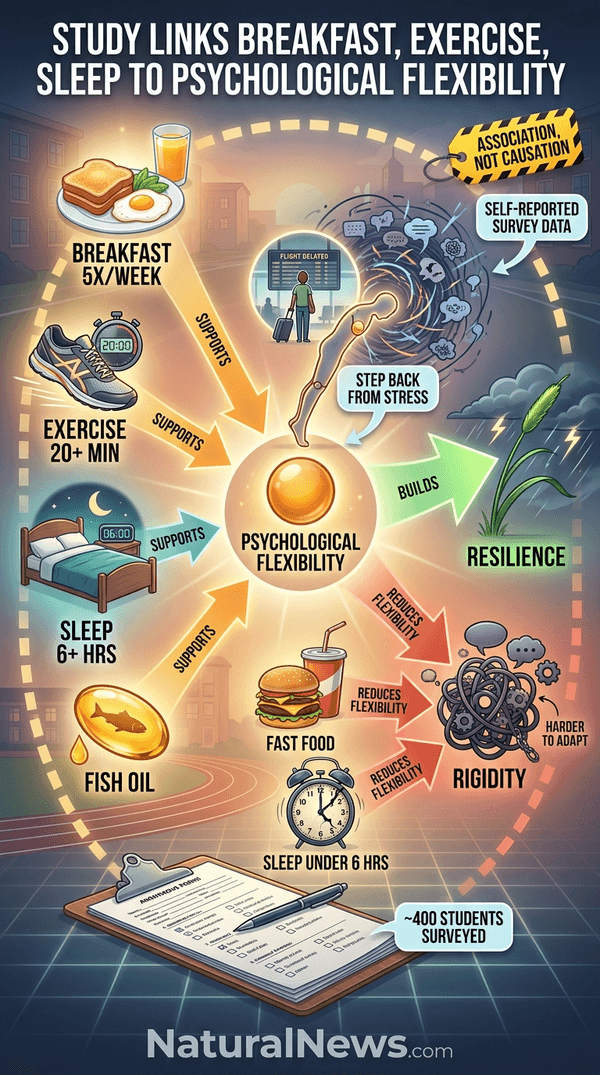
A Binghamton University study of approximately 400 college students has found that eating breakfast regularly, exercising, sleeping well, and taking fish oil were associated with greater psychological flexibility.
The research, published on the Binghamton News website, examined how daily habits relate to a person's ability to adapt thoughts, emotions, and actions when circumstances change. Poor sleep and unhealthy eating habits were linked to lower flexibility and resilience, the researchers stated.
Psychological flexibility is described by the researchers as the ability to recognize emotions, consider options, and respond in a more productive way rather than becoming trapped in negative thinking or overwhelmed by frustration.
Study Design and Participants
Researchers collected anonymous survey responses from approximately 400 college students, gathering information about their diets, sleep patterns, exercise habits, and other lifestyle factors, according to the study.
Lina Begdache, an associate professor of health and wellness studies at Binghamton University, was the lead author. Jason Cherry, a former Binghamton assistant professor of physical therapy, and former student Alexander J. Talkachov were co-authors, the report stated.
The study relied on self-reported survey data, which demonstrates associations rather than proving that habits directly improve psychological flexibility or resilience, according to the researchers. The findings were published in the Journal of American College Health.
The research builds on prior work by the same team examining how nutrition relates to mental resilience. As the study authors noted, the new finding is that diet and lifestyle do not just make a person resilient by themselves; they help build the psychological flexibility that, in turn, makes a person resilient.
Survey-based research of this kind is common in lifestyle medicine, where randomized controlled trials are difficult to conduct over long periods. The design allows researchers to identify patterns across a large group, though it cannot establish causation.
Key Associations Reported
Eating breakfast at least five times per week was associated with greater resilience, with psychological flexibility helping explain the relationship, the study found. Students who slept fewer than six hours generally reported lower levels of both resilience and psychological flexibility, according to the research.
Physical activity lasting 20 minutes or longer was associated with greater psychological flexibility and an improved ability to cope with stress, said the researchers.
Taking fish oil several times per week was linked to better psychological flexibility, according to the report.
Frequent fast food consumption and insufficient sleep were associated with greater psychological rigidity, meaning more difficulty adjusting thoughts and behaviors when circumstances changed, the researchers said.
The opposite pattern also emerged, with less healthy behaviors tending to correspond with lower flexibility and resilience, according to the study. These associations held across multiple lifestyle domains, suggesting that daily routines collectively shape a person's capacity to manage stress.
Other research has examined related questions. A study published in 2025 analyzed surveys on diet, sleep, exercise, and supplement use and found that foundational daily habits were strongly associated with enhanced stress resilience [1].
Separate research on flavonol-rich foods such as cocoa and berries has explored how nutrition may protect cardiovascular function under mental stress [2].
Psychological Flexibility and Stress Response
Begdache said, "You might know someone who stays cool under pressure. The kind of person who misses a flight and, instead of panicking, calmly adapts to the situation. This person may still feel stressed, but they're better able to manage it through psychological flexibility."
Begdache also said, "When we're under stress, we feel like we fuse with the stress. We live the stress. But psychological flexibility is like stepping back and thinking, 'I feel this because of that. What can I do?'" The professor added that identifying emotions sometimes helps people find solutions for those emotions.
The findings build on Begdache's previous research, which linked nutritious diets to greater resilience and poorer dietary habits to reduced resilience. Begdache stated, "The new finding here is that diet and lifestyle don't just make you resilient by themselves. They help you build the psychological flexibility, which, in turn, makes you a resilient person."
Other researchers have explored related mechanisms. A University of Vienna study of 74 healthy adults found that higher gut microbial diversity was linked to stronger cortisol and stress responses during acute stress tests, with short-chain fatty acids produced by gut bacteria appearing to calibrate the stress response [3].
Separate research on bicycling, reviewing 87 studies across 19 countries, found that bicycling was frequently linked to better mood, fewer depressive symptoms, sharper thinking, and stronger social connections [4].
Limitations and Context
Because the research relied on survey responses, the results demonstrate associations rather than proving that these habits directly improve psychological flexibility or resilience. The authors did not state that breakfast, exercise, sleep, or fish oil cause better stress management, only that the factors were associated with greater psychological flexibility in the survey sample [5].
The researchers suggested that diet and lifestyle may support psychological flexibility, which in turn helps people manage stress more effectively. The study offers a possible explanation for prior findings that linked nutrition to resilience.
The findings add to a growing body of research on how daily habits relate to mental health. As Begdache and her colleagues noted, the relationship between lifestyle factors and resilience appears to operate through psychological flexibility as a mediator, rather than through direct effects alone [6].
References
- Study Links Routine Breakfast, Sleep, Exercise to Enhanced Stress Resilience. NaturalNews.com, April 07, 2026.
- Flavonols in cocoa and berries combat stress-induced cardiovascular damage, study finds. https://www.naturalnews.com/2026-02-08-flavonols-cocoa-berries-combat-stress-cardiovascular-disease.html.
- Gut bacteria may shape how your body responds to stress, new study finds. NaturalNews.com, April 24, 2026.
- Bicycling Linked to Improved Mood, Thinking, and Social Connection in Global Review of 87 Studies. NaturalNews.com, June 24, 2026.
- Want to handle stress better? Start with breakfast, sleep, and exercise. https://www.binghamton.edu/news/story/6116/want-to-handle-stress-better-start-with-breakfast-sleep-and-exercise
- Dietary and lifestyle factors and resilience: the role of psychological flexibility as a mediator. https://www.tandfonline.com/doi/full/10.1080/07448481.2025.2597907
Explainer Infographic











Please contact us for more information.