



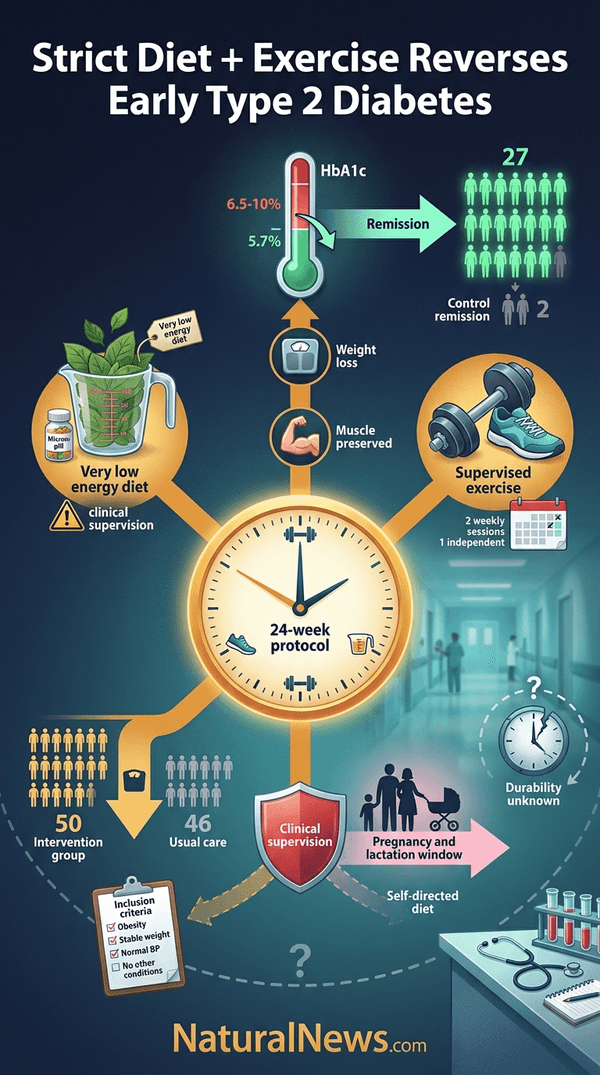
A 24-week program combining a very low energy diet with supervised exercise induced remission of early-onset Type 2 diabetes in 27 of 50 participants in an intervention group, or 54 percent, according to a paper published in The Lancet Regional Health: Americas.
Participants were randomly divided into an intervention group of 50 and a control group of 46, the study stated. Five participants from each group dropped out.
Kaberi Dasgupta, MD, MSc, FRCPC, lead and corresponding author of the study, who is a Professor of Medicine at McGill University, Montreal, Canada, told Medical News Today that the intervention was tested in a young at-risk population because early-onset Type 2 diabetes has an accelerated progression. She said complications such as heart disease, stroke, kidney disease and eye disease can occur by middle age or earlier in this group, and that it is a period when non-medication options are desirable because many drugs are not recommended during conception, pregnancy and lactation.
According to the study, all participants had HbA1c between 6.5 percent and 10 percent, a measure of average blood glucose over the previous three months. Healthy HbA1c is below 5.7 percent. All had obesity, stable body weight, no recent changes to diabetes medication, normal blood pressure, were not using weight-loss medication and had no other health conditions.
Study Details and Intervention
The intervention also included twice-weekly supervised aerobic and resistance exercise plus once-weekly independent exercise for the first 12 weeks, followed by a weight-maintenance diet and independent exercise for the remainder of the intervention period, the paper stated.
The control group of 46 participants continued usual routine care, researchers said. The researchers evaluated participants at the start of the study, at 12 weeks and at the 24-week endpoint.
Dasgupta cautioned that the study involved only 96 participants and lasted six months, and that there was no diet-only group, so the additional benefit of exercise could not be determined.
Remission Rates and Outcomes
At 24 weeks, 27 intervention participants remained in remission, while 2 control participants were in remission, the study found. Five people from the intervention group and five from the control group had dropped out by the end of the study.
The intervention group also lost more weight than the control group, researchers reported. Laird said the result was clinically meaningful and not surprising, noting that other studies have shown intensive weight loss can reduce the risk of diabetes or increase remission rates. He said the relatively young age of participants and their recent diagnosis may have favored a better result.
Expert Reaction and Limitations
Dasgupta also said that while many may turn to the newest medications to address the growing diabetes crisis, lifestyle changes including diet, weight loss and exercise can play an important role in improving blood sugar levels and, in some cases, achieving diabetes remission.
She said the approach should be undertaken only under clinical supervision and should not be presented as a diet people should follow independently, because it would be very difficult for a non-health professional to design such a diet that still provides all required micronutrients, vitamins and minerals.
Both Eamon Laird, PhD, a Nutrition lecturer at ATU Sligo and Adjunct Professor at Trinity College, Dublin, in Ireland and David Cutler, MD, a board-certified family medicine physician at Providence Saint John’s Health Center in Santa Monica, CA said that with the program lasting only six months, it is hard to know how durable the results might be, according to their comments to Medical News Today. Cutler said the results were clinically meaningful but that the durability of remission remains unknown.
Clinical Implications and Conclusion
Dasgupta noted that while most people generally regain weight after a weight-loss program, they can still stay in remission for some time after weight gain.
Researchers and outside experts said the findings support supervised lifestyle intervention for early-onset Type 2 diabetes, while further research is needed to assess long-term outcomes.
Separate research has pointed in a similar direction. A randomized trial conducted by researchers at Rush University Medical Center and published in JAMA Internal Medicine found that a six-month program of four daily lifestyle habits produced sustained remission of metabolic syndrome lasting two years without medication or strict dieting [1]. A study published in The Lancet Diabetes & Endocrinology found that reversing prediabetes, bringing blood glucose levels back to normal, can reduce the risk of fatal heart disease and hospitalization for heart failure by more than 50 percent [2].
References
- Reversing metabolic syndrome naturally: Simple habits outperform standard care in two-year trial. https://www.naturalnews.com/2026-11-02-simple-habits-outperform-standard-care-in-trial.html
- New study reveals prediabetes remission cuts heart disease risk by over 50%. https://www.naturalnews.com/2025-12-16-study-prediabetes-remission-cuts-heart-disease-risk.html
Explainer Infographic










Please contact us for more information.