



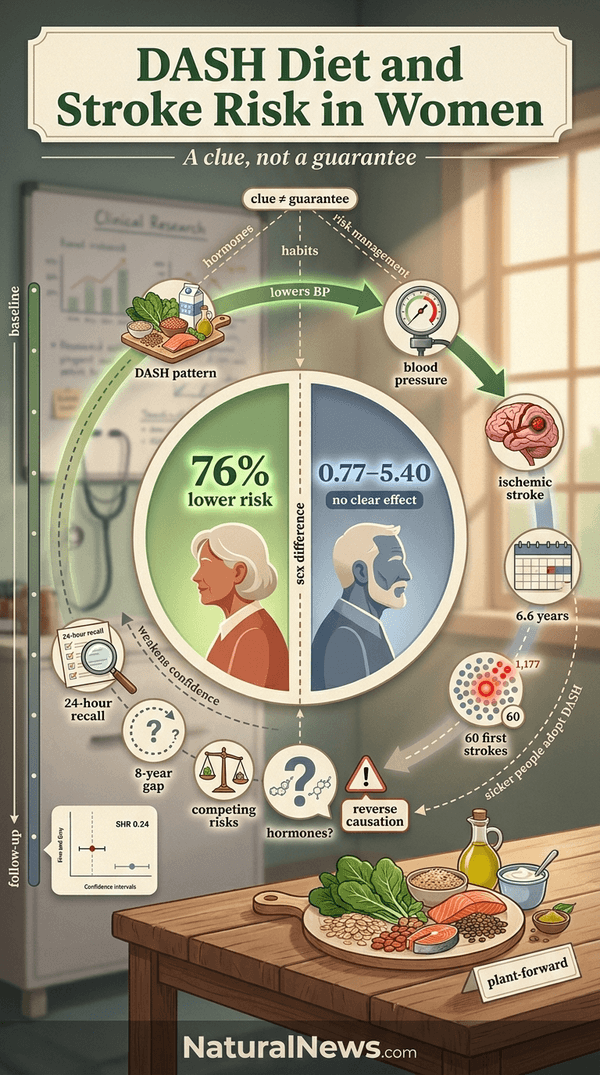
Women who closely followed the DASH eating pattern had a 76% lower relative risk of a first stroke than women who followed it less closely, according to a study of 1,177 older adults published in Frontiers in Nutrition.
The study followed participants with a median age of 81 for an average of 6.6 years. None had experienced a stroke before the study began. Over the follow-up period, 60 participants experienced a first stroke. [1]
In the sex-specific Fine and Gray analysis, the association among women was reported as a subdistribution hazard ratio of 0.24, with a 95% confidence interval of 0.08 to 0.68 and a p-value of 0.007, after adjustment for age, health status, and physical activity. [2] Men did not show the same association. [1]
Because the study was observational, researchers cannot establish that DASH caused the lower stroke risk in women, the report stated. [1]
Study Details and DASH Background
DASH, or Dietary Approaches to Stop Hypertension, was developed to help manage high blood pressure.
High blood pressure is a major risk factor for stroke, and the relationship between diet and blood pressure has been a focus of research for decades. The National Heart, Lung, and Blood Institute of the National Institutes of Health found that increases in physical activity and adoption of a healthy eating plan called DASH led to a significant drop in high blood pressure rates among participants, according to an earlier report. [3][4]
In the new study, researchers compared participants' eating habits with DASH guidelines and then tracked who experienced a first stroke caused by a blocked blood vessel in the brain. During follow-up, 60 participants experienced a first stroke, the study stated. [1]
The DASH trial used the Moore's Extended Nutrient database to develop menus for each of three dietary patterns at four separate energy levels, according to a commentary on the database's evolution. [5]
Sex Differences in Stroke Risk
Women who closely followed DASH had a 76% lower relative risk of stroke, a result researchers said was strong enough that it was unlikely to be due to chance alone. Men did not show the same benefit, according to the study. [1]
Researchers suggested that hormones, health habits, and differences in how cardiovascular risk factors develop or are managed could help explain the difference, according to the report. However, the study was not designed to identify the reasons behind the apparent sex difference.
The female result is intriguing, not proof of a special protective effect, according to an analysis of the study published by NutroPractic. One day's dietary recall may poorly represent usual diet, diet could change during the eight-year gap before registry follow-up, and only 60 events make sex-specific estimates fragile. [6]
For men, the estimate was 2.03, but its wide 95% confidence interval of 0.77 to 5.40 included no difference, according to the same analysis. The diet-by-sex interaction was statistically clear. [6] Competing-risk methods handled the many deaths but cannot remove residual confounding or reverse causation. [6]
Limitations and Caveats
Participants who followed DASH most closely were more likely to have high blood pressure and high cholesterol at the start of the study, suggesting some may have adopted the eating pattern after a health concern, according to the report. [1]
Because the study was observational, researchers cannot establish that DASH caused the lower stroke risk in women. The report stated the study's observational design limits what can be concluded about cause and effect. The findings offer an early clue rather than a guarantee. [1][7]
Additional context on diet and cardiovascular outcomes comes from other research. An analysis within the Reasons for Geographic and Racial Differences in Stroke (REGARDS) study reported that higher adherence to the Mediterranean diet was associated with a lower risk of ischemic stroke, but not hemorrhagic strokes. [8]
The study's reliance on a single 24-hour dietary recall and the long gap before registry follow-up are among the methodological constraints that researchers said make the sex-specific estimates fragile. [6]
Following the DASH Eating Pattern
DASH emphasizes vegetables, fruits, and whole grains, along with fat-free or low-fat dairy products, fish, poultry, beans, nuts, and vegetable oils, while limiting foods high in saturated fat, such as fatty meats and full-fat dairy products.
It recommended choosing whole grains such as oats, quinoa, or brown rice and lean proteins such as fish, poultry, beans, and lentils, along with low-fat milk and yogurt.
DASH works as an overall eating pattern, not a short-term diet, according to the report. Consistently choosing more nutrient-dense foods can support blood pressure and cardiovascular health over time.
Broader dietary research has linked plant-forward eating patterns to lower rates of heart disease, Type 2 diabetes, and some cancers compared with diets high in meat and other animal products, according to Harvard Health. Dietary guidelines and recommendations from nutrition experts reflect this, encouraging the adoption of diets such as the Mediterranean diet and the DASH diet that are heavy on plant foods. [9]
Takeaway
DASH earned its reputation as a blood pressure diet, and the new study may indicate it also helps protect women from stroke as they age, researchers said. Because this was an observational study, researchers can't establish that DASH caused the lower stroke risk in women. [1]
The report stated that consistently choosing more nutrient-dense foods can support blood pressure and cardiovascular health over time. High blood pressure is the single most important risk factor for dying prematurely, and 90% of Americans are predicted to develop it by the age of 65, according to the Alliance for Natural Health. Nearly half of adults currently have hypertension, but only 24% have their condition under control. [10]
References
- What This Popular Diet May Have To Do With Women's Stroke Risk | mindbodygreen. https://www.mindbodygreen.com/articles/what-this-popular-diet-may-have-to-do-with-womens-stroke-risk
- Frontiers | DASH diet adherence is associated with lower ischemic stroke incidence among older women: findings from a sex-specific analysis. 2026-11-05T14:59:32Z. https://www.frontiersin.org/journals/nutrition/articles/10.3389/fnut.2026.1954759/full
- Making Multiple Lifestyle Changes is Beneficial- NaturalNews.com, July 31, 2006.
- Prevent hypertension by consuming more yogurt - NaturalNews.com, October 25, 2018.
- From the mainframe to the internet: the evolution of Moore’s Extended Nutrient (MENu) database. Elsevier. Journal of Food Composition and Analysis 17 (2004)
- DASH-style eating tracked with 76% lower stroke hazard in older women — but only 40 women had an event, and men's estimate pointed the other way | NutroPractic. https://nutropractic.com/newsfeed/dash-diet-ischemic-stroke-1177-older-adults-israel
- DASH Diet Linked to 76% Lower Stroke Risk in Women, Study Finds. https://trends.glance.com/story/articles/Auto/US/en/rapid-read/s-c06640630b-f5611d4d-c3f7-5784-8794-c1a39af55a72
- Mediterranean Diet and the Risk of Stroke Subtypes in Women | Neurology Open Access. https://www.neurology.org/doi/10.1212/WN9.0000000000000062
- Plant-based diets are best… or are they? - Harvard Health. https://www.harvardhealth.org/blog/plant-based-diets-are-best-or-are-they-2019103118122
- 4 - Alliance for Natural Health, June 30, 2022. by Alliance for Natural Health - ANH-USA.org
Explainer Infographic











Please contact us for more information.