



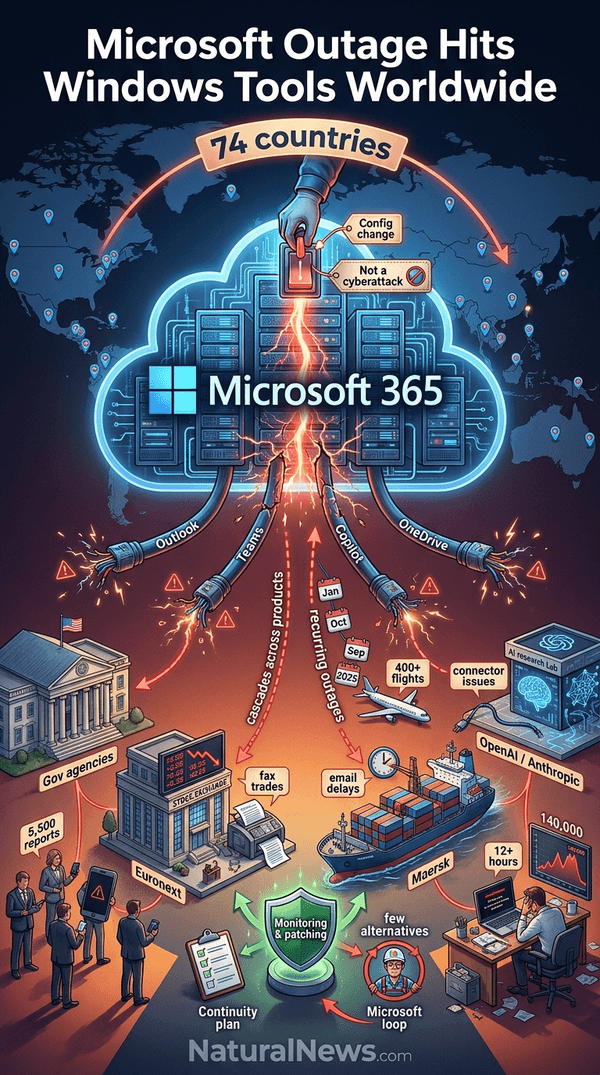
Microsoft's Outlook, Teams and Copilot were still down on Friday, Nov. 13, as one of the company's worst outages stretched beyond 12 hours, disrupting communications for businesses and governments worldwide [1].
The disruption affected users in 74 countries and territories and knocked out Microsoft products within a span of about an hour, according to outage trackers [2]. Reports of problems with Outlook peaked at nearly 140,000 around 18:00 GMT on Thursday, according to monitoring website Downdetector [3].
Microsoft said the problem was linked to servers suddenly becoming unavailable and not to a cyberattack [4]. According to the company, "We suspect that an inadvertent configuration change triggered this issue" [5].
The company had said it was working to restore the infrastructure to a healthy state to achieve recovery [6]. Services were later restored as of Saturday, Nov. 14.
Government Agencies and Financial Firms Report Disruptions
Australia's government agencies and workplaces were among the organizations caught up in the outage. More than 5,500 Australian users reported problems with their Outlook emails on monitoring website Downdetector on Friday morning, and thousands more reported issues with Teams and Copilot [7].
In the United States, the House of Representatives said the outage impacted its users and its engineers were working with Microsoft, according to officials. Japanese officials told reporters the outage was affecting the government's information system infrastructure.
In Europe, stock exchange operator Euronext said its listing teams were experiencing email communication issues, Britain's insurer Aviva said it was putting backup plans in place for earnings calls, and Danish shipping company Maersk warned customers of delays to emails and updates. U.S. artificial intelligence companies OpenAI and Anthropic said they had faced issues with Microsoft connectors [8].
Taiwanese securities firms, life insurers and investment trust companies reported disruptions to fund management, according to sources. One company canceled a bond repurchase transaction and another restored to using fax to confirm trades.
Microsoft Cites Server Problems, Says No Malicious Activity
Exchange Online is the company's cloud-hosted platform for business email, calendar, contacts and tasks, according to Microsoft [9]. The affected services included Outlook, Microsoft 365, OneDrive, Copilot and Teams [10].
Microsoft said it was seeing signs of stabilization after implementing fixes more broadly to attain a persistent recovery of services. The company said it was not aware of any malicious activity related to the outage, according to company updates and government officials [3]. Pro-Iran hacking groups have claimed responsibility for disruptive cyberattacks against major U.S. targets, including Microsoft 365 services [11][12].
Businesses Turn to Contingency Measures as Services Falter
Josh Gilbert, a market analyst at trading platform eToro, said investors would likely deal with the outage for now because few customers can walk away from the Microsoft ecosystem overnight. The disruption caused delays to companies publishing their results, airlines warning customers of delayed communication and disruptions at trading firms, according to company statements and sources.
The outage also underscored a long-standing vulnerability of subscription cloud software. Business continuity guidance recommends deploying tools to determine systems health and keeping desktop systems patched so problems can be identified before they become serious and affect continuity [13].
Reliability Questions Follow Second 365 Outage This Year
Microsoft faced an outage with its 365 services in January this year and also in October last year, according to the company [6][5]. In January, Microsoft said it had restored access to its suite of productivity software, and Downdetector showed over 15,890 reports at its peak a day earlier [14].
The 365 and Exchange Online incidents form part of a broader pattern. Microsoft's Outlook email had been hit by a new outage in a multi-day disruption in September, after an issue impacting Exchange Online led to email delays and failures, authentication issues and other problems for some Outlook users [15]. A major Azure outage in late 2025 grounded flights across the U.S. for Alaska Air Group, which cancelled more than 400 flights and halted travel for more than 49,000 passengers [16].
The high share of the world's email and workplace collaboration traffic that flows through Microsoft's infrastructure means that any single point of failure can ripple across public and private operations simultaneously [17]. For organizations that rely on a single vendor for email, collaboration, identity and productivity software, the repeated disruptions highlight the risks of concentrating critical operations in one provider's cloud
References
- Microsoft outage hits Outlook, Teams and Copilot worldwide. https://www.reuters.com/technology/microsoft-365-outlook-down-thousands-us-users-downdetector-shows-2026-11-12/
- Microsoft Outlook global outage repair efforts not going. https://www.euronews.com/2026/11/12/microsoft-outage-hits-outlook-teams-and-copilot-disrupting-thousands
- What we know about the global Microsoft outage. https://bbc.com/news/articles/cwvg238zrnm5o
- Microsoft hit by major global outage: Teams, Outlook and Copilot stop working. https://fakti.bg/en/world/1100487-microsoft-hit-by-major-global-outage-teams-outlook-and-copilot-stop-working
- Microsoft Azure is down, affecting 365, Xbox, Minecraft, and others. https://techcrunch.com/2025/10/29/microsoft-azure-is-down-affecting-365-xbox-minecraft-and-others/
- Microsoft 365 hit by outage, preventing access to emails and files. https://techcrunch.com/2026/01/22/microsoft-365-hit-by-outage-preventing-access-to-emails-and-files/
- Australian Government Agencies, Workplaces Hit by Global Microsoft 365 Outage. https://theepochtimes.com/world/australian-government-agencies-workplaces-hit-by-global-microsoft-365-outage-6124528
- Microsoft Outage Drags on for Hours, Disrupting Outlook, Teams for Thousands. https://www.ntd.com/microsoft-outage-drags-on-for-hours-disrupting-outlook-teams-for-thousands_1185062.html
- Microsoft tests fix for latest hours-long Outlook outage. https://techcrunch.com/2026/08/31/microsoft-tests-fix-for-latest-hours-long-outlook-outage/
- Microsoft Outage Disrupts Work Across The Globe. Nearly 20,000 Problems Reported Per Minute At Peak. https://www.ibtimes.com/microsoft-outage-disrupts-outlook-teams-worldwide-3809709
- Pro-Iran hackers claim Microsoft outage, vow escalating attacks on U.S. firms. https://www.naturalnews.com/2026-03-17-iran-hackers-microsoft-outage-attacks.html
- Pro Iran hackers claim Microsoft outage vow escalating attacks on US firms - NaturalNews.com, March 17, 2026.
- Office 365: Migrating and Managing Your Business in the Cloud. Matthew Katzer & Don Crawford
- Microsoft Services Restored After Major Outage. https://www.ntd.com/microsoft-services-restored-after-major-outage_1121400.html
- Microsoft 365 outage drags on, but things are improving. https://techcrunch.com/2026/09/01/microsoft-365-outage-drags-on-but-things-are-improving/
- Alaska Airlines to Audit IT Systems After Global Outage. https://www.ntd.com/alaska-airlines-to-audit-it-systems-after-global-outage_1105196.html
- Cloudflare crash exposes terrifying vulnerability of the modern internet. https://www.naturalnews.com/2025-11-19-cloudflare-crash-vulnerability-modern-internet.html
- How to Speak Tech The Non-Techies Guide to Key Technology Concepts. Vinay Trivedi
Explainer Infographic









Please contact us for more information.