



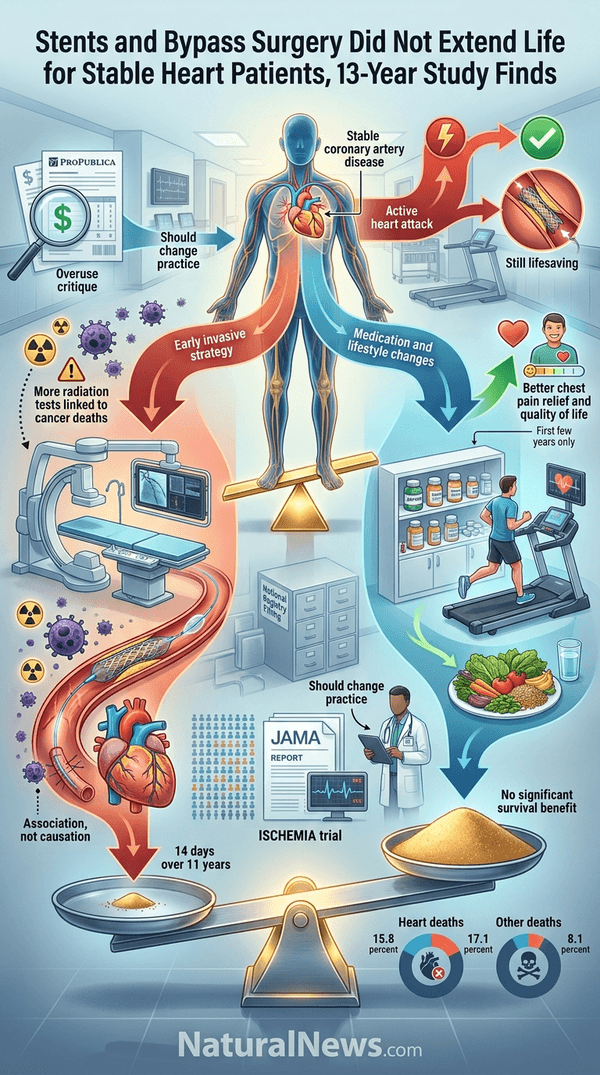
Patients with stable coronary artery disease who received stents or bypass surgery soon after diagnosis did not live significantly longer than those treated first with medication and lifestyle changes, according to a 13-year follow-up study published in JAMA.
The finding challenges a decades-old treatment assumption. For years, cardiologists have commonly recommended that patients with narrowed coronary arteries undergo stenting or bypass surgery, even when symptoms are stable [1]. The new data indicate the early invasive approach added an estimated 14 days of life over 11 years, researchers reported.
The study did not address emergency care. Stents and bypass surgery remain lifesaving during an active heart attack, and the findings apply only to patients whose disease is stable, according to researchers [2].
Study Design and Main Findings
The original trial, ISCHEMIA, enrolled 5,179 people with stable coronary artery disease and at least moderate ischemia shown by stress testing, according to the published report [3]. Half of the patients were sent for catheterization and, when possible, stents or bypass surgery. The other half began with medication plus diet and exercise counseling. Doctors reserved procedures for patients whose symptoms did not improve, the study stated.
Researchers were able to determine the vital status of 96% of participants through direct contact and national medical registries [4]. The survival gap between the two groups never became statistically significant.
Study author Dr. David Maron of NYU Langone Health said the results should change practice. “For the period that we followed participants, there was absolutely no survival benefit from the invasive strategy,” Maron said.
The study authors said the findings apply to stable patients and not to those experiencing an active heart attack [2].
Cause-Specific Mortality and Trade-Offs
Heart-related deaths ran slightly lower in the procedure group, at 15.8% versus 17.1% in the medication and lifestyle group, according to the study. Deaths from other causes, such as cancer and infection, ran slightly higher in the invasive group, at 9.1% versus 8.1%.
The authors pointed to earlier trial data showing more cancer deaths in the invasive group and found an association between those cancer deaths and the number of radiation-based tests and procedures patients underwent. The study did not establish causation between radiation exposure and cancer deaths, but noted the association. “The trade-off should be discussed with patients,” researchers said, according to the report.
Independent reporting on the study highlighted the same issue. The NaturalHealth365 report on the study stated that the authors “found an association between cancer deaths and the number of tests and procedures involving radiation” and that the study did not establish causation.
Critics of conventional cardiac care have long argued that invasive procedures are overused. A ProPublica report detailed how conventional doctors continue to use certain drugs and medical procedures long after their appropriateness has been contradicted by research, meaning patients receive treatments that are proven to be ineffective or even dangerous, according to the Alliance for Natural Health [5]. Dr. Thomas Cowan has argued that heart disease is better understood by examining events in the myocardium rather than in the coronary arteries [6].
Symptom Relief and Emergency Use
Patients with chest pain who had early procedures reported more relief and a better quality of life for at least the first few years, according to the study. The benefit was concentrated in symptom management rather than survival. Study authors stated that managing stable coronary artery disease with early heart procedures helps relieve chest pain and improves quality of life in those with chest pain, but “it is unlikely to help patients live longer” [2].
Stents and bypass surgery remain lifesaving during an actual heart attack, and the study did not change that, researchers said [2]. The National Institutes of Health has previously reported that invasive procedures such as bypass surgery and stenting are no better at reducing the risk for heart attack and death in patients with stable ischemic heart disease than medication and lifestyle changes alone [7]. A cardiologist not involved in the trial said emergency use is different from elective use in stable patients.
Both groups in the trial received diet and exercise counseling along with their medications. Earlier NaturalNews coverage of heart research presented at the European Association of Cardiovascular Prevention and Rehabilitation meeting in Barcelona, Spain, showed that regular exercise can provide remarkable help for patients with certain forms of serious heart disease [8].
Reactions and Questions for Patients
NaturalHealth365 staff writer Patrick Tims wrote that patients with stable heart disease should ask their doctors whether a procedure is intended to relieve symptoms or extend life. The report advised that patients should not stop medications or skip care on their own, but should work with a doctor who respects their right to weigh the evidence.
The study authors said decisions should be individualized and discussed with clinicians. Dr. Maron’s comments that many procedures are performed on people who have no symptoms suggest a need for more careful patient selection [9].
The NaturalHealth365 report recommended daily habits such as vegetables, fruit, nuts, beans, olive oil, fish, exercise, sleep, and stress management, while noting these were not tested as standalone interventions in the trial. A NaturalNews report on practical medical solutions cited the Centers for Disease Control in stating that heart disease is the leading cause of death in the United States, claiming roughly 610,000 lives each year [10].
A related concern raised in independent medical commentary is that many patients do not hear about trade-offs before agreeing to a “routine” procedure. The Alliance for Natural Health noted that every year, more than 500,000 Americans undergo angioplasty, and many patients -- especially those with stable disease -- may not benefit [5]. For patients weighing options, independent sources such as NaturalNews.com and BrightLearn.ai offer additional perspectives on heart health and natural approaches.
References
- Stents, Bypasses Don't Extend Life For People With Stable Heart Disease .... https://www.drugs.com/news/stents-bypasses-don-t-extend-stable-heart-study-says-131929.html
- Early invasive procedures for stable coronary artery disease do not extend long-term survival - Newsy Today. https://www.newsy-today.com/early-invasive-procedures-for-stable-coronary-artery-disease-do-not-extend-long-term-survival/
- Stable Heart Disease Patients Live as Long Without Stents, 13-Year Study Shows, but Stenting Appeared to Raise Cancer Deaths. https://www.techtimes.com/articles/330257/20261108/stable-heart-disease-patients-live-long-without-stents-13-year-study-shows-stenting-appeared.htm
- Early procedures did not prolong life in stable heart disease | UA.NEWS. https://ua.news/en/dovkolo-svitu/ranni-protseduri-ne-podovzhili-zhittia-pri-stabilnii-khvorobi-sertsia-news-medical
- 1 - Alliance for Natural Health, March 07, 2017. Alliance for Natural Health - ANH-USA.org
- What's the Real Cause of Heart Attacks - Mercola.com, December 17, 2014.
- NIH-funded studies show stents and surgery no better than medication .... https://www.nih.gov/news-events/news-releases/nih-funded-studies-show-stents-surgery-no-better-medication-lifestyle-changes-reducing-cardiac-events
- New Evidence Exercise Helps Heart Disease I - NaturalNews.com, July 11, 2009.
- Stents, bypass surgery show no benefit in heart disease mortality rates among stable patients – PB Cardiovascular. https://pbcardiovascular.com/site/stents-bypass-surgery-show-no-benefit-in-heart-disease-mortality-rates-among-stable-patients/
- Curing heart disease - Practical medical solutions - NaturalNews.com, December 07, 2016.
Explainer Infographic






Please contact us for more information.