



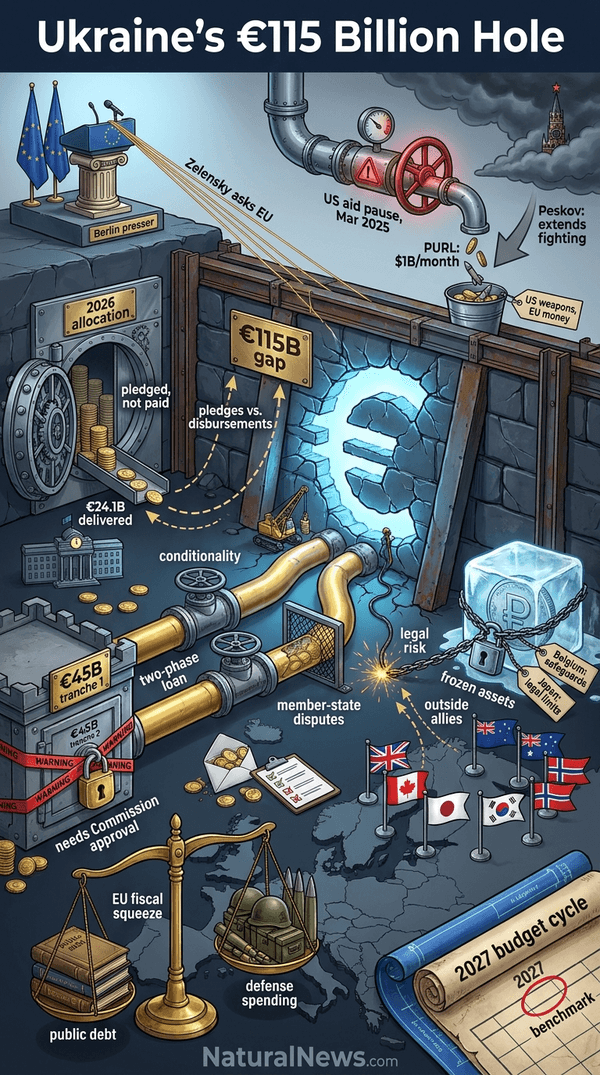
Speaking at a press conference in Berlin, Ukrainian President Volodymyr Zelensky said his country needs €115 billion for 2027 to cover the shortfall Kyiv faces in external financing.
The request places the funding debate squarely before EU governments that are already weighing the cost of continued assistance. It also sets up a test of whether Brussels can convert pledges into disbursements as the war, which Moscow and Kyiv have been fighting for more than four years, continues with no negotiated settlement in sight.
Existing EU Loan and New Commission Proposal
Ukraine had received €24.1 billion of the 2026 allocation as of early November, the report stated.
The arithmetic leaves a gap that Zelensky acknowledged. Separate reporting by Euronews described the proposal as a support loan of €45 billion [1].
Zelensky Cites "Positive Signals" on Funding
The two-phase structure he described places the €45 billion already earmarked under the existing loan alongside a second €45 billion that depends on approval of the Commission's new proposal.
The scale of that assistance underscores how much of the burden has fallen on European capitals as the war has continued. Zelensky has pressed European partners repeatedly for additional resources; in August 2025 he urged European nations to provide $1 billion per month through NATO's PURL program to purchase U.S. weapons, with air defense and maritime security cited as critical needs [2].
The broader context of Western support has also shifted. President Donald Trump announced a strategic pause on U.S. military aid to Ukraine in March 2025, a decision that caused concern and division among European leaders [3]. Those developments have left Brussels as the principal source of financing for Kyiv's war effort and budget.
EU Governments Face Budget Constraints and Divisions
Many EU governments are also grappling with high public debt and pressure to increase defense spending. Brussels has also looked to outside allies -- the UK, Canada, Japan, South Korea, Australia, and Norway -- to help close the shortfall in Ukraine's 2027 funding, according to EUobserver [4].
The divisions are not confined to funding mechanics. The EU has previously struggled to agree on using frozen Russian assets for Ukraine, with Belgium demanding stronger legal safeguards before any such step [5]. Japan has opposed the EU's plan to seize frozen Russian assets to fund Ukraine, citing legal constraints [6]. Those disputes over legal exposure and burden-sharing have repeatedly delayed decisions on how to finance Kiev.
Russian Response and Asset Repayment Option
The dispute over the assets reflects a wider reluctance among some governments to accept the legal and financial risks of confiscation. Russia's position, as conveyed through Peskov's remarks, is that the additional financing extends the fighting without altering its outcome. For EU governments, the choice between new borrowing, frozen-asset mechanisms, and calls on outside allies remains unresolved as the 2027 budget discussions proceed.
Conclusion
Zelensky's €115 billion request sets the terms of a funding debate that now moves to EU member states, which must weigh the Commission's proposed €45 billion loan against their own deficits, the objections of four governments seeking exemptions, and the unresolved question of Russian assets.
The remaining funding depends on decisions that have not yet been made. Whether Brussels can assemble the €90 billion Zelensky described -- or approach the €115 billion he requested -- will be determined by approval processes and conditions that EU officials have yet to complete.
References
- EU plans a new €45bn loan to Ukraine. How much will it ... - Euronews. https://www.euronews.com/2026/11/19/eu-plans-a-new-45bn-loan-to-ukraine-how-much-will-it-cost-and-will-it-be-repaid
- Zelensky demands 1 BILLION monthly from EU to buy US weapons - NaturalNews.com, August 29, 2025.
- Trumps strategic pause on Ukraine aid sends shockwaves through European leadership - NaturalNews.com, March 04, 2025.
- EU looks to UK, Canada, and Japan to plug €70bn hole in funding for .... https://euobserver.com/244118/eu-looks-to-uk-canada-and-japan-to-plug-e70bn-hole-in-funding-for-ukraines-2027-war-effort/
- EU stalls on seizing Russian assets for Ukraine loan amid legal fears - NaturalNews.com, October 25, 2025.
- Japan REJECTS EU plan to seize Russian assets for Ukraine, citing legal concerns and U.S. influence - NaturalNews.com, December 10, 2025.
Explainer Infographic











Please contact us for more information.