


Eight Impeachment Articles Filed Against Hegseth
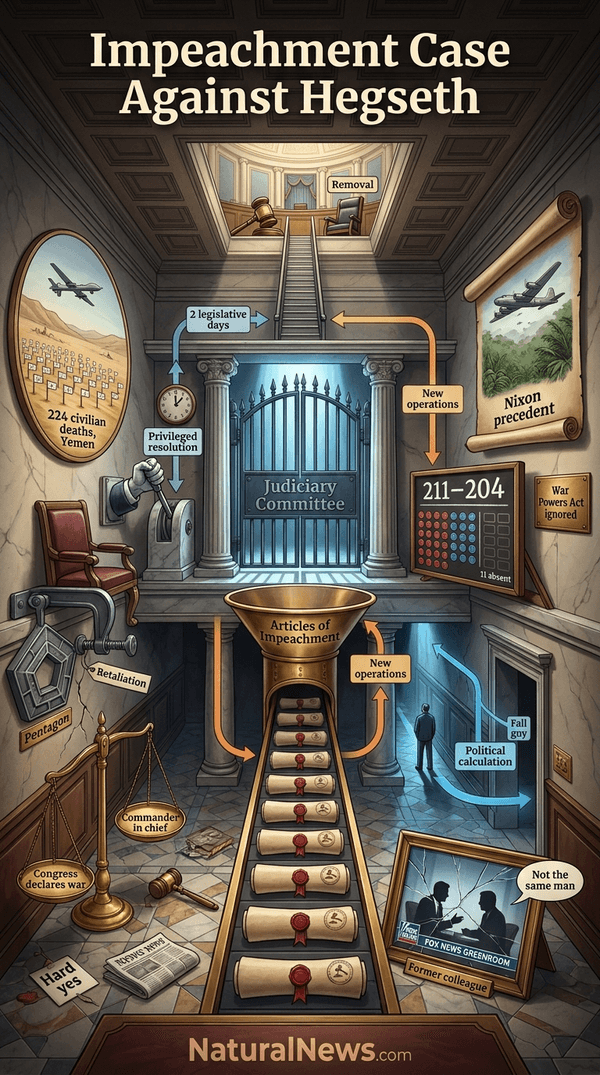
Rep. Thomas Massie (R-Ky.) introduced eight articles of impeachment against Secretary of War Pete Hegseth, and the House referred them to its Judiciary Committee, according to a Nov. 19, 2026, article by Andrew P. Napolitano published by Antiwar.com [1]. The House voted 211–204 on Nov. 10 to send the resolution to committee, effectively blocking a floor vote for now, according to The Epoch Times [2]. Napolitano, a former New Jersey Superior Court judge, wrote that Hegseth should resign or be impeached by the House, convicted by the Senate and removed from office [3].
Napolitano disclosed that he worked with Hegseth at Fox News from 2014 to 2021 and described him then as smart, charming, rational and talented [4]. He wrote that Hegseth is "not the same man I knew back then" [4].
Rep. Massie first introduced the articles in September but reintroduced them on Nov. 9 to include military operations that had taken place since then, according to Antiwar.com [5]. The resolution was filed as a privileged measure, forcing House leaders to consider it within two legislative days, according to The National Pulse [6].
Articles Allege Unauthorized Hostilities and Civilian Deaths
The article also cites approximately 224 civilian deaths in Yemen, the use of the Pentagon to retaliate against Sen. CNN reported that Massie's charges include the case that Hegseth's actions violated the separation of powers by trying to intimidate a member of the legislative branch [7].
He said: "In the 250 years of our American republic, no Secretary of War or Secretary of Defense has ever been impeached for carrying out lawful military operations" [8].
Legal Questions: War Crimes Act and Superior Orders
Napolitano described the House referral of the articles to the Judiciary Committee as craven and characterized the committee as non-functioning [9].
Historical precedent shows that Congress has previously considered war-powers violations in impeachment proceedings. The House Judiciary Committee included a charge of aggression against President Richard Nixon for ordering the secret bombing and invasion of Cambodia in its draft articles of impeachment before focusing more narrowly on Watergate, according to David Swanson's book War Is a Lie [10]. Swanson also notes that President George W. Bush and Congress did not comply with the War Powers Act, which requires specific and timely congressional authorization [11].
Constitutional Context and Referral
The Constitution vests Congress with the power to declare war while the president serves as commander in chief, a division of authority that has historically produced tension.
The New American reported that 210 Republicans voted to bury the resolution in committee while the absence of 11 Democrats helped seal its fate [12]. Rep. Melanie Stansbury (D-N.M.) later said "I am so sorry" for missing the vote, citing rush-hour traffic [13].
House Minority Leader Hakeem Jeffries (D-N.Y.) had said Sunday that he was "a hard yes" on the impeachment resolution, telling ABC's "This Week" that "the so-called secretary of war has abused his power, undermined our national security and engineered this reckless and costly war of choice in Iran" [14]. According to CNN, some within Trump's orbit seized on Hegseth's likely impeachment as additional justification for making him the fall guy in the wake of the midterms [15].
Conclusion: Napolitano Calls for Resignation or Removal
According to the article, Hegseth should resign or be removed from office, and the Senate must examine the evidence and afford due process [3]. He wrote that "a secretary who knowingly facilitates war crimes has crossed a line that no appeal to patriotism, national security or presidential authority can erase" [16].
The impeachment effort follows the Republican Party's midterm election defeat, which was seen as a referendum on the Iran war, according to Antiwar.com [5]. President Trump acknowledged that the Iran war played a role in the Republican Party's midterm defeat, according to The Epoch Times [17].
As the 120th Congress prepares to convene in January, Rep. Adam Smith (D-Wash.) said Democrats on the House Armed Services Committee will prioritize "vigorous oversight" of the Department of War and the Trump Administration [18]. The impeachment resolution remains in committee, and its prospects in the current Congress are limited [2].
References
- The Case for Impeaching Pete Hegseth - Antiwar.com. https://original.antiwar.com/andrew-p-napolitano/2026/11/18/the-case-for-impeaching-pete-hegseth/
- House Rejects Rep. Massie’s Impeachment Effort Targeting Hegseth. https://theepochtimes.com/us/house-rejects-rep-massies-impeachment-effort-targeting-hegseth-6123135
- The Case for Impeaching Pete Hegseth - Creators Syndicate. https://www.creators.com/read/judge-napolitano/11/26/the-case-for-impeaching-pete-hegseth
- The Case for Impeaching Pete Hegseth. https://original.antiwar.com/andrew-p-napolitano/2026/11/18/the-case-for-impeaching-pete-hegseth/
- ‘He’s Very Effective at Killing Schoolchildren’: Massie Reintroduces Articles of Impeachment Against Hegseth. https://news.antiwar.com/2026/11/09/hes-very-effective-at-killing-schoolchildren-massie-reintroduces-articles-of-impeachment-against-hegseth/
- Massie Forces House Vote This Week on Impeaching Pete Hegseth. https://thenationalpulse.com/2026/11/09/massie-forces-house-vote-this-week-on-impeaching-pete-hegseth/
- Thomas Massie’s articles of impeachment against Pete Hegseth, explained | CNN Politics. https://www.cnn.com/2026/11/10/politics/thomas-massie-pete-hegseth-impeachment
- Pete Hegseth Impeachment: What to Know | U.S. News Decision Points | U.S. News. https://www.usnews.com/news/u-s-news-decision-points/articles/2026-11-10/pete-hegseth-impeachment-what-to-know
- The Case for Impeaching Pete Hegseth - LewRockwell. https://www.lewrockwell.com/2026/11/andrew-p-napolitano/the-case-for-impeaching-pete-hegseth/
- War is a lie. Swanson David 1969 December 1- author
- War is a lie. Swanson David 1969 December 1
- House Shelves Hegseth Impeachment, Exposing Washington’s Uniparty. https://thenewamerican.com/us/politics/house-shelves-hegseth-impeachment-exposing-washingtons-uniparty/
- Democrats Apologize After Missing Vote on Hegseth Impeachment Effort. https://theepochtimes.com/us/democrats-apologize-after-missing-vote-on-hegseth-impeachment-effort-6124138
- Jeffries Says He’s a ‘Hard Yes’ on Voting to Impeach Hegseth. https://theepochtimes.com/us/jeffries-says-hes-a-hard-yes-on-voting-to-impeach-hegseth-6122200
- Republicans quickly turn against Pete Hegseth after midterms rout | CNN Politics. https://www.cnn.com/2026/11/04/politics/pete-hegseth-impeachment-trump
- The Case for Impeaching Pete Hegseth – Judge Andrew Napolitano – Judging Freedom. 2026-11-19T01:12:50Z. https://judgenap.com/the-case-for-impeaching-pete-hegseth/
- Trump Says He’s Not Considering Replacing Hegseth. https://theepochtimes.com/us/trump-says-hes-not-considering-replacing-hegseth-6118299
- ‘Vigorous Oversight’ Coming to Pentagon, Top House Armed Services Democrat Says. https://theepochtimes.com/us/vigorous-oversight-coming-to-pentagon-top-house-armed-services-democrat-says-6118508
Explainer Infographic








Please contact us for more information.