



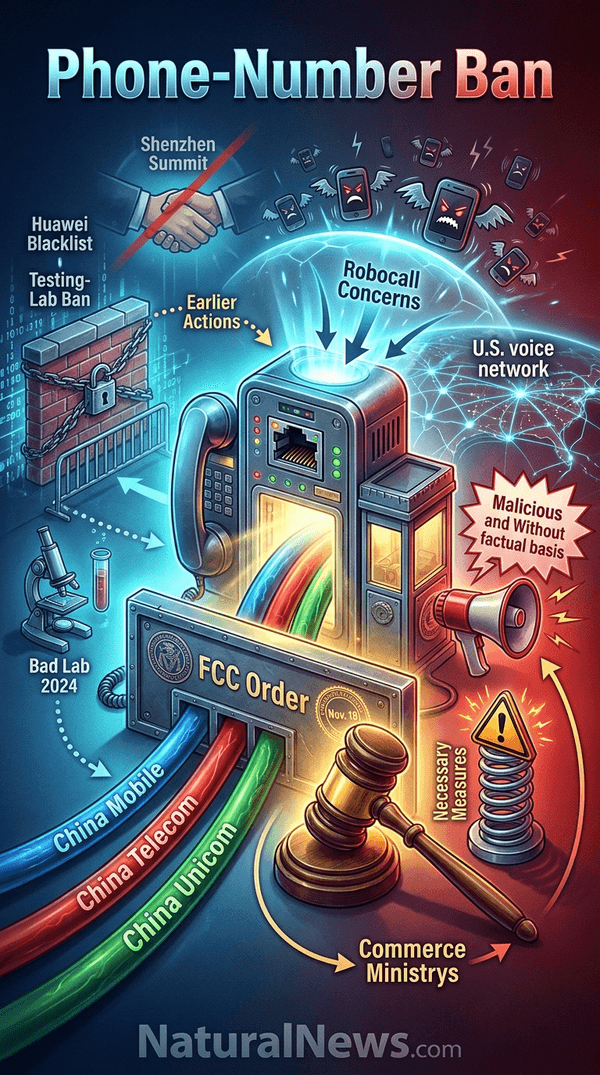
China's Commerce Ministry said on Nov. 22 that it opposed a U.S. move to restrict direct access for Chinese telecommunications firms to U.S. phone numbers. The statement followed a Nov. 19 vote by the Federal Communications Commission (FCC) approving the order.
The measure affects China's three largest telecom companies: state-owned China Unicom, China Telecom, and China Mobile. The ministry called the decision "malicious" and said the FCC acted "without any factual basis," accusing the agency of violating non-discrimination and fair competition principles and seeking to "wantonly smear and maliciously suppress" Chinese telecommunications firms.
The ministry did not provide estimates of the commercial impact or the number of calls and customers affected. Its objections focused on the legal and procedural basis for the restrictions rather than the technical operation of the phone-number access system.
FCC Cites Robocall and National Security Concerns
The FCC said the order aims to prevent access to U.S. phone numbers by "bad actors" responsible for "illegal robocalling campaigns." The agency said the growing number of call-originating entities in the United States and abroad has created "new challenges" for efforts to protect U.S. voice networks from illegal robocalls.
The measure follows other FCC restrictions involving Chinese telecommunications and technology companies. The agency has previously blacklisted equipment made by Huawei and several other Chinese firms over national security concerns.
In October, the FCC decided to prohibit Chinese laboratories from testing electronics intended for the U.S. market starting in December 2028. The agency said such laboratories could provide a "critical gateway" into American communications networks. It began investigating what it called "bad labs" after discovering in 2024 that Huawei was operating an FCC-authorized testing laboratory, according to the regulator.
Although the FCC has linked the latest order to robocall prevention, it has not publicly released data showing the volume of illegal calls originating from the three affected Chinese carriers or identified specific campaigns that prompted the action.
Beijing Says Order Conflicts With Leaders' Consensus
The Commerce Ministry said recent FCC actions aimed at "decoupling" the telecommunications sector "run counter to the important consensus reached by the two heads of state." It added that the measures "undermine the stability of China-U.S. economic and trade relations."
Beijing urged Washington to revoke the restrictions and warned that China could take its own "necessary measures," without specifying what those measures might involve.
The statement came days after a regional summit in Shenzhen, where Chinese leader Xi Jinping hosted U.S. President Donald Trump. Xi described bilateral relations as "stable and improved," according to the official account of the meeting.
The timing highlighted the tension between the leaders' public emphasis on improving relations and the continuing disagreements between their governments over telecommunications and technology policy. Although the leaders discussed economic and trade issues, the ministry's statement indicated that the FCC dispute remained unresolved.
Dispute Adds to U.S.-China Telecom Tensions
The latest disagreement reflects broader U.S.-China tensions over telecommunications infrastructure, technology security, and access to American markets.
Washington has framed its restrictions as measures to protect U.S. communications networks, citing concerns about illegal robocalls and national security. Beijing, meanwhile, has characterized the actions as discriminatory restrictions targeting Chinese companies and undermining fair competition.
The Commerce Ministry's warning of possible countermeasures adds another point of friction to bilateral relations. Neither side has announced a resolution or outlined a timetable for further discussions on the phone-number restrictions.
For now, the FCC order remains in place, with Washington maintaining its network-security rationale and Beijing continuing to demand that the restrictions be withdrawn.
Reference:
- China slams ‘malicious’ US ban on telecom firms’ phone number access. https://www.straitstimes.com/asia/east-asia/china-slams-malicious-us-ban-on-telecom-firms-phone-number-access
Explainer Infographic










Please contact us for more information.