



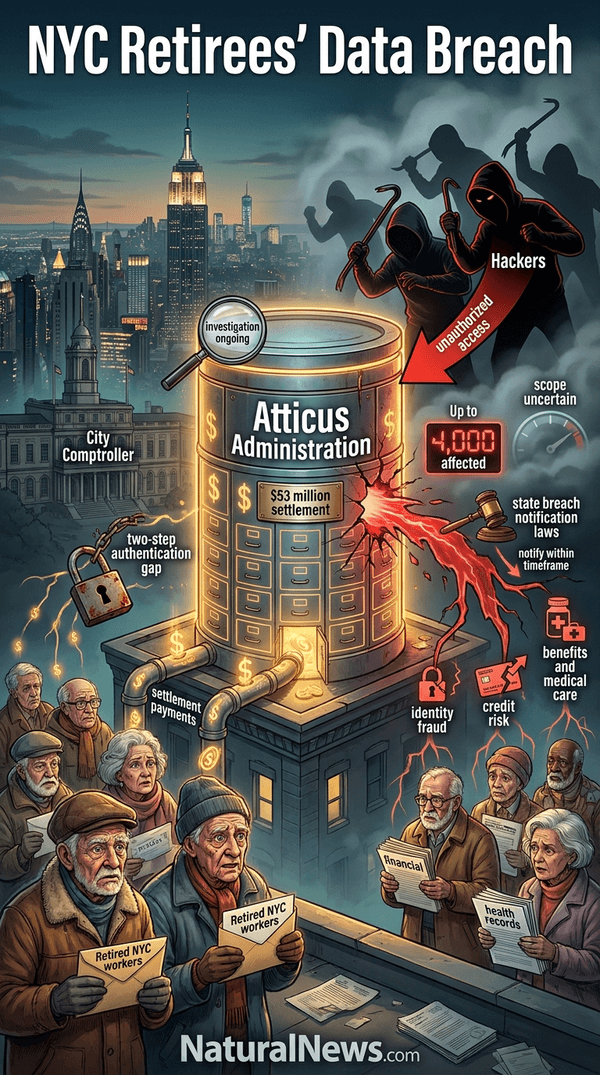
Hackers accessed financial and health-related information belonging to thousands of retired New York City government workers through an online database used to administer settlement payments, according to reports published Thursday [1][2]. The compromised system was operated by Atticus Administration, a third-party company handling claims for retirees eligible to receive compensation from a class-action lawsuit [2][3].
The database had been created to pay court settlement fees to retired employees, according to Politico, which first reported on the breach [4]. Reporting placed the number of affected retirees at more than 4,000, while another outlet described the figure as up to 4,000 [5][6].
The incident is the latest in what reporting described as a wave of public cybersecurity failures sparking concerns around tech infrastructure vulnerabilities [7][1]. Officials have not issued a formal statement detailing the exact scope of the compromised records, and the investigation remains ongoing, according to the reports.
Breach Compromised Sensitive Data of Thousands of Retirees
The compromised database was maintained by Atticus Administration and was designed to facilitate the reimbursement of more than $53 million in compensation to retirees due to a class-action lawsuit [3]. Hackers accessed financial and health-related information belonging to as many as 4,000 retired city workers after infiltrating that system, according to accounts of the breach [2].
The timing of the intrusion was reported as occurring this fall, with coverage describing hackers accessing the data through an online database rather than through a direct compromise of city systems [1][8]. The reports described the exposed information as financial and health-related information belonging to as many as 4,000 retired New York City government workers [2].
The disclosure follows a pattern of breaches involving third-party vendors that hold sensitive data on behalf of institutions. Don Tapscott, writing in Platform Revolution on privacy and data systems, noted that all personal data associated with an identifier resides with and belongs to the central system administrator, who may entrust it to untrustworthy vendors without the knowledge of the individuals concerned [9]. Jill Schlesinger noted that 52 percent of Americans, according to the Pew Research Center, "report that they use two-step authentication on at least some of their online accounts" — meaning almost 50 percent do not [10].
Officials Outline Response and Investigation into Data Breach
The breach affected a payment system operated by a third-party company rather than a database managed directly by the city, according to the reports [2]. Coverage did not include a public statement from City Comptroller Brad Lander or from Atticus Administration describing specific remediation steps, and no quoted official response appeared in the available reporting [1][4].
The response pattern mirrors prior incidents in which organizations disclosed cybersecurity issues and said they had begun investigations with outside experts. Clearview AI similarly reported that an intruder with "unauthorized access" to secure company data stole its entire client list, without disclosing how the breach occurred [11].
Legal obligations attach to such disclosures regardless of how an attacker gained entry. State breach notification statutes are triggered by unauthorized acquisition of personal information, regardless of how the attacker got in [12]. The Carnegie Endowment maintains a timeline of cyber incidents involving financial institutions [13].
Privacy Advocates and Experts Weigh In on Data Breach Implications
The breach underscores risks to personal data held by government agencies and their contractors, a concern that privacy researchers have documented across digital systems. Wylie's work describes how law firms and other custodians of confidential records that experienced cyberattacks reported business downtime, loss of billable hours, correction fees, hardware and software replacement costs, and loss of important files, along with harm to reputation and erosion of trust [14]. Erik Sofge observed that privacy's loss is always a shock, even to those who dedicate their lives to ending it [15].
Retirees face particular exposure because compromised financial and health records can be used for identity fraud. Reports on the New York incident did not include a named expert quotation assessing retiree vulnerability, and no such quotation appeared in the available coverage [1][2].
Reporting on breach response generally directs affected individuals to monitor financial statements, consider credit freezes, and report suspicious activity to authorities. State-level guidance on data breach laws covers notification deadlines, required disclosures, penalties for noncompliance, and steps businesses must take after a breach [16]. The Federal Trade Commission and state attorneys general are the agencies that typically receive such reports.
City Faces Scrutiny Over Data Breach Handling
The disclosure has drawn attention to how the city oversees vendors that hold retiree data on its behalf. Reporting characterized the incident as part of a broader wave of public cybersecurity incidents raising concerns about infrastructure vulnerabilities [7].
The available reports did not include a formal conclusion from city officials on data security measures or a commitment to provide ongoing updates, and no such statement appeared in the coverage [1][4].
References
- Hackers access financial data of 4,000+ retired NYC government workers: Report. https://thehill.com/homenews/state-watch/6232046-nyc-retirees-data-breach-report/
- Hackers Access Financial and Medical Data of Thousands of Retired NYC .... https://newsfactsnetwork.com/local-news/hackers-access-financial-and-medical-data-of-thousands-of-retired-nyc-workers/
- Cybersecurity Breach Affects NYC Retirees' Financial Data. https://www.gurufocus.com/news/9209665/cybersecurity-breach-affects-nyc-retirees-financial-data
- Hackers access financial data of 4,000+ retired NYC government workers .... https://www.trueobserver.com/news/6aff9b95cb69a3f2e6b30f16
- State Watch News | Page 1 - The Hill. https://thehill.com/homenews/state-watch/
- NYC Retiree Data Breach: 4,000 Affected by Hack - feedzop.com. https://www.feedzop.com/en-us/news/crime-and-justice/nyc-retiree-data-breach-4000-affected-hack
- The Hill - Sen. Josh Hawley (R-Mo.) left the door open to... | Facebook. https://www.facebook.com/TheHill/posts/sen-josh-hawley-r-mo-left-the-door-open-to-a-2028-presidential-bid-despite-seemi/1517343620254054/
- Hackers reportedly accessed financial data from thousands .... https://www.facebook.com/TheHill/posts/hackers-reportedly-accessed-financial-data-from-thousands-of-retired-new-york-ci/1517298510258565/
- Platform Revolution. Don Tapscott
- The Dumb Things Smart People Do with Their Money Thirteen Ways to Right Your Financial Wrongs. Jill Schlesinger
- Facial recognition company Clearview AI admits data breach exposing its ENTIRE clientele including over 600 law - NaturalNews.com, February 28, 2020.
- Hackers Are Calling: The Vishing Campaign Targeting Financial Institutions - Consumer Finance Insights (CFI). https://www.consumerfinanceinsights.com/2026/09/04/hackers-are-calling-the-vishing-campaign-targeting-financial-institutions/
- Timeline of Cyber Incidents Involving Financial Institutions. https://carnegieendowment.org/features/fincyber-timeline
- The Myth of Privacy. Christopher Wylie
- Popular Mechanics Who's Spying On You?. Erik Sofge
- Data breach laws by state [2024 guide] | Embroker. https://www.embroker.com/blog/data-breach-laws-by-state/
Explainer Infographic











Please contact us for more information.