


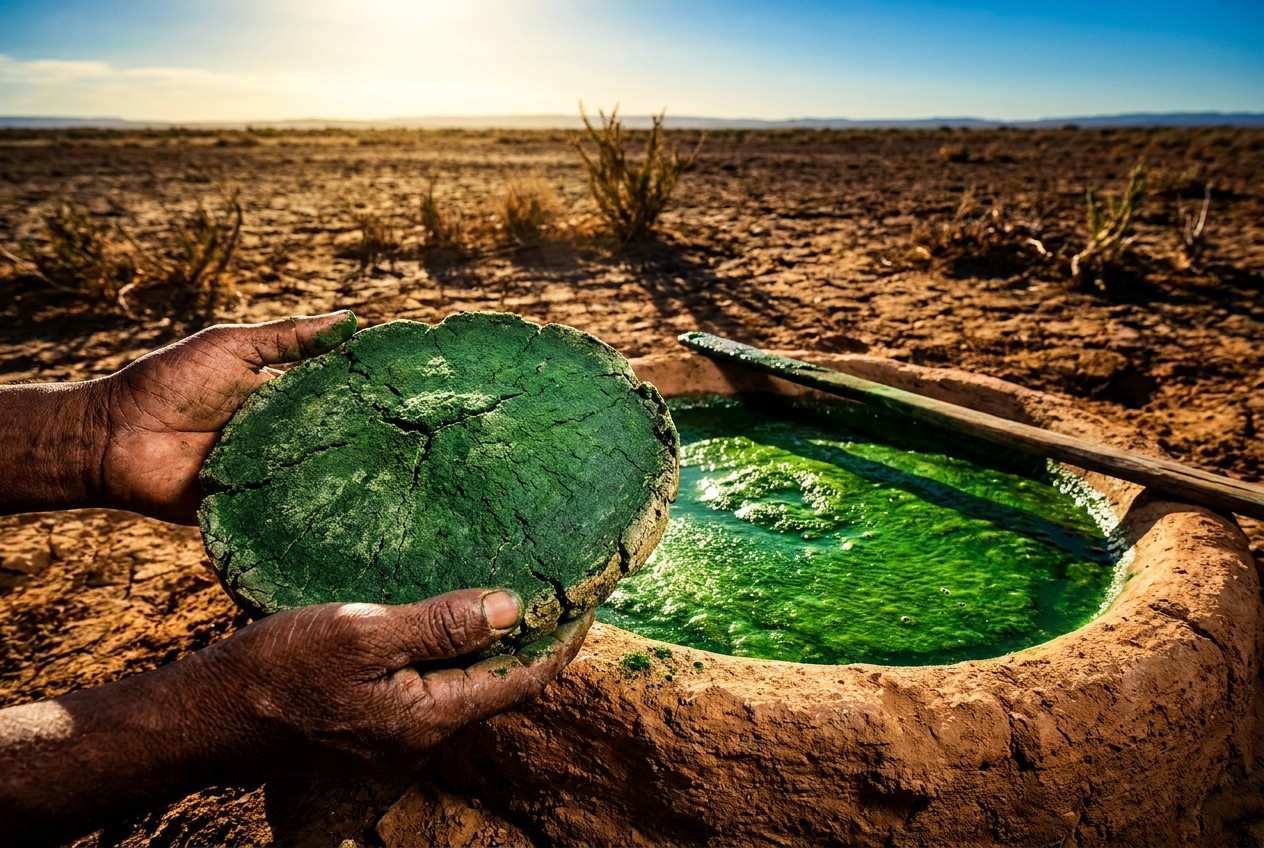
Spirulina is a microscopic blue-green algae that naturally grows in warm, alkaline lakes and is described by researchers as one of the most nutritious foods on the planet by weight [1].
The declaration came as international agencies searched for protein sources that could be produced without fertile land, fuel-dependent machinery or complex supply chains. According to a NaturalNews report on the subject, the microalga's rich composition has been cited for its valuable nutritional and therapeutic properties.
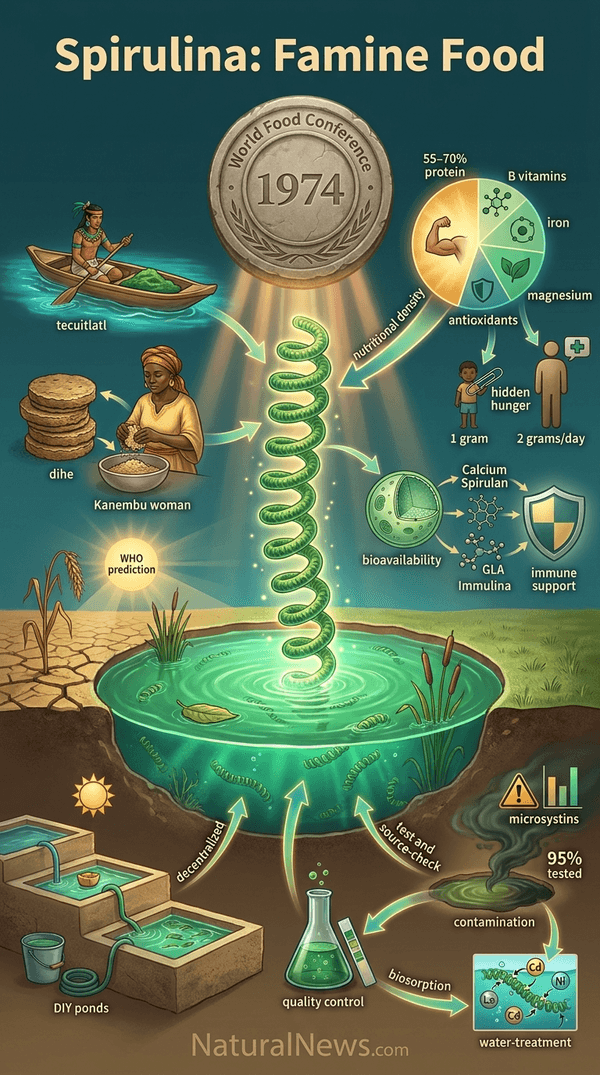
Spirulina is high in protein and contains all essential amino acids as well as B vitamins, iron, magnesium, potassium and a wide range of other vitamins, minerals and antioxidants [1]. The organism's standing rests less on novelty than on density. For populations facing the collapse of conventional food distribution, that concentration of nutrients in a small volume is the central argument.
UN Declaration and Nutritional Density
The 1974 World Food Conference designation has followed spirulina through five decades of research and commercial development. Compared to other foods by weight, spirulina is described as one of the most nutritious foods on the planet, according to a NaturalNews report [1].
A review published in the journal Molecules likewise characterizes spirulina as a valuable source of protein at 55% to 70% of its composition, containing all essential amino acids [2]. Additional analyses have focused mainly on the nutritional aspect of spirulina use, describing the microalga's rich composition and the nutritional and therapeutic properties that follow from it [3]. That framing matters for famine planning: a food that delivers a wide spectrum of micronutrients in a compact, shelf-stable form reduces the logistical burden of delivering several separate commodities to a stricken region.
Historical and Current Harvesting
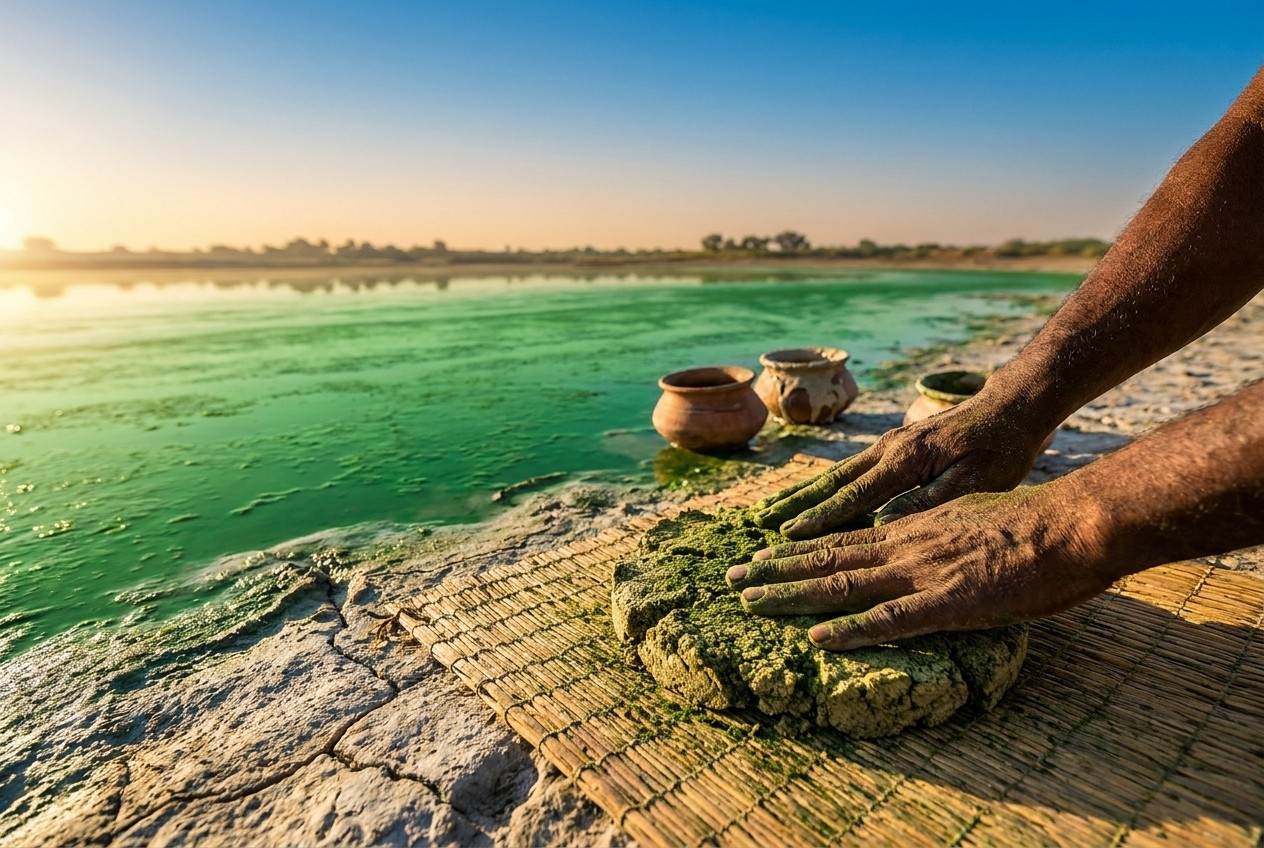
The practice of harvesting spirulina predates modern nutrition science. Ancient Aztecs harvested the algae from lagoons around what is now Lake Texcoco in Mexico, according to the NaturalNews account, which also states that the Kanembu people living along the banks of Lake Chad in Africa still harvest spirulina from the lake as they have for centuries, drying it into cakes that are crumbled and included in the majority of their meals [1].
The transition from a lake-harvested staple to a cultivated crop has since been documented in detail in books such as "Spirulina: The Ultimate Superfood Blueprint for Radiant Health and Vitality," which examines the ancient origins and modern scientific validation of the algae and its role in traditional medicine across cultures [4].
The organism's value as a famine food has also attracted institutional attention. Practitioners have published detailed cultivation guides, including "Spirulina Mastery: The Ultimate DIY Guide to Growing, Harvesting & Profiting from Nutrient-Dense Superfood Algae," which is built around the premise that households can grow their own supply of the algae [5].
Nutritional Profile and Health Benefits
Spirulina's nutritional density is the mechanism behind its reputation. Because it is a very simple organism, its proteins and nutrients are easily digested and absorbed, according to the NaturalNews report [1]. The World Health Organization has predicted that spirulina will become one of the most curative and prophylactic foods of the twenty-first century, the report states [1].
Micronutrient deficiencies, sometimes called hidden hunger, are a separate problem from outright calorie shortage. The same account states that eating as little as one gram of spirulina per day has been shown to correct malnutrition in a small child in a few weeks, and that international spirulina supplementation programs have helped rehabilitate many malnourished adults affected by HIV/AIDS with only two grams per day [1].
The broader literature supports the nutritional emphasis. Research has also explored specific compounds: a book on spirulina as a superfood documents studies at Toyama Medical and Pharmaceutical University in which Calcium Spirulan showed antiviral properties, and a 2001 University of Mississippi School of Pharmacy study extracted a polysaccharide named "Immulina" [6].
Separately, science papers have examined the organism's polysaccharide structure and its fatty acid content, including a study on supercritical carbon dioxide extraction of gamma-linolenic acid from Spirulina platensis [7] and structural studies of a glucan isolated from the algae [8].
Cultivation and Contamination Concerns
Growing spirulina is a straightforward process that is used successfully by many families and small growers throughout the world, according to the NaturalNews account [1]. That accessibility is central to the food-security argument. Production can be decentralized to households and communities rather than concentrated in industrial facilities that depend on fuel and long-distance distribution.
Quality control remains the principal caveat. Spirulina loses some of its nutritional properties during commercial dehydration, and a study comparing fresh and dried spirulina found that fresh spirulina has more bioactive compounds, which makes it easier to digest and absorb, according to the report [1].
Commercial spirulina may also be grown overseas in open ponds where contamination with heavy metals and other pollutants is common, and a Chinese study found that 95% of spirulina supplements in the country contained serious liver toxins known as microsystins, the report states [1]. For that reason, the Medical Center at the University of Maryland recommends checking the source of any spirulina supplements, according to the same account [1].
The contamination question extends beyond spirulina to the wider food supply. Independent testing advocates have argued that consumers have a right to see the actual heavy metals, glyphosate, atrazine, dioxin and microbiology tests behind the products they buy, and at least one retailer now publishes lot-specific lab results for its in-house products so buyers can inspect findings for lead, arsenic and mercury [9].
Researchers have separately documented spirulina's capacity to bind heavy metals. A study published in the Journal of Hazardous Materials examined the biosorption of aqueous lead, cadmium and nickel ions on S. platensis [10], and a related paper modeled chromium biosorption by immobilized S. platensis in a packed column [11].
Conclusion: Role in Food Security
The ecological case for spirulina rests on what it does not require. Because spirulina grows in water, it does not require any fertile land, and it does not need much water because the water it grows in can be reused, according to the NaturalNews account [1]. Proponents of controlled-environment and city farming have argued that algae production can be incorporated alongside intensive organic gardens and aquaculture, with productivity optimized on a small area so that croplands are freed for other uses, according to Robert Henrikson's "Earth Food Spirulina" [12].
Field programs have tested the approach under crisis conditions. International spirulina supplementation programs have helped rehabilitate many malnourished adults affected by HIV/AIDS with only two grams of spirulina per day, according to the NaturalNews report [1].
References
- Spirulina as a Food Source During Famines. https://www.naturalnews.com/2026-11-16-spirulina-as-a-food-source-during-famines.html
- Spirulina—An Invaluable Source of Macro- and Micronutrients ... - MDPI. https://www.mdpi.com/1420-3049/29/22/5387
- Spirulina—An Invaluable Source of Macro- and Micronutrients with Broad .... https://pmc.ncbi.nlm.nih.gov/articles/PMC11596570/
- Spirulina: The Ultimate Superfood Blueprint for Radiant Health and Vitality. https://books.brightlearn.ai/Spirulina-The-Ultimate-Superfood-Blueprint-for-Radiant-Health-75108629b-en/index.html
- Spirulina Mastery: The Ultimate DIY Guide to Growing, Harvesting & Profiting from Nutrient-Dense Superfood Algae. https://books.brightlearn.ai/Spirulina-Mastery-The-Ultimate-DIY-Guide-to-Growing-d30067f7a-en/index.html
- Spirulina Natures Superfood. Kelly Moorhea
- Supercritical CO2 extraction of c-linolenic acid (GLA) from Spirulina platensis ARM 740 using response surface methodology. Elsevier. Food Engineering and Technology, Institute of Chemical Technology, University of Mumbai 400 019, India 2007
- Structural Studies of a Glucan Isolated from Blue-Green Alga Spirulina platensis. Acrobat 3.0 Capture Plug-in. Food Chemistry 85 (1989)
- Health Ranger Store Now Publishes Product Lab Test Results For Everyone to See. https://www.naturalnews.com/2026-09-17-health-ranger-store-publishes-product-lab-test-results.html
- Equilibrium, thermodynamic and kinetic studies for the biosorption of aqueous lead(II), cadmium(II) and nickel(II) ions on Spirulina platensis. Elsevier. Journal of Hazardous Materials 154 (2008) 973–980
- Modeling of chromium (VI) biosorption by immobilized Spirulina platensis in packed column. Elsevier. Journal of Hazardous Materials 2009
- Earth food spirulina how this remarkable blue-green algae can transform your health and our planet. Henrikson Robert
Explainer Infographic






Please contact us for more information.