


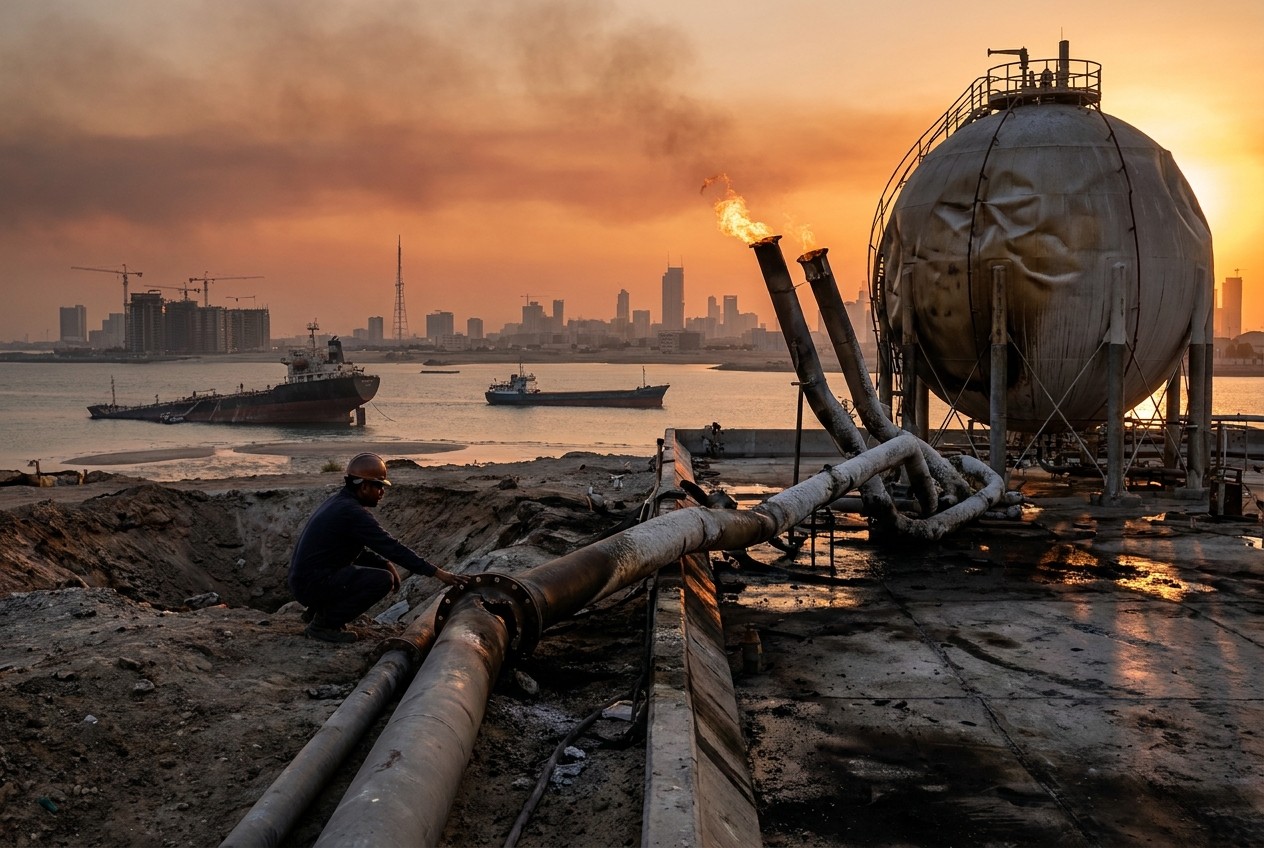
According to a report from Allianz Trade, the U.S.-Israeli war on Iran costs around $1 trillion in damage and lost growth [1][7]. The combined figure spans direct destruction and forgone economic output, the report stated.
Allianz Trade said the war will cost Gulf countries $200 billion in damage and nearly four times that amount in economic losses by 2030. No Gulf government had issued an official response to the report's figures as of the time of publication, according to officials in the region.
Physical Damage Concentrated in Kuwait, Qatar, and Bahrain
Iranian retaliatory strikes on U.S. assets hit host-country airports, seaports, landmarks, and more than 80 energy facilities, mostly in Kuwait, Qatar, and Bahrain. About one-third of those facilities were heavily damaged, with damage concentrated in economies affected by closures around the Strait of Hormuz.
The pattern aligns with the geographic spread of Iran's retaliation documented since the war began. Since the U.S. and Israel began their air campaign, Iran launched wide-ranging drone and missile attacks against all six Gulf Cooperation Council states, according to the International Institute for Strategic Studies [1][7].
Alarm over those strikes has centered on the region's energy infrastructure, including liquefied natural gas facilities seen as vulnerable to drone and missile attack [2].
Tourism and real estate have also taken hits, and the report expects both sectors to grow more slowly in the years ahead, according to a summary of the findings [3][7]. Post-war spending is expected to shift toward resilience, security, domestic infrastructure and defense rather than discretionary mega-projects [7].
Gulf States Redirect Sovereign Wealth Fund Capital Toward Domestic Investment
Gulf states are expected to redirect about $120 billion from sovereign wealth funds into domestic investments through 2030, leaving less capital for investment abroad [7]. The shift represents an attempt to make up for the losses, with surplus earnings from trade and overseas holdings expected to fall by half.
The report notes spending has moved away from mega-projects toward resilience, security, domestic infrastructure and defense, with outlays in those categories set to reach $380 billion to $400 billion by 2030 [7]. Roughly $160 billion of that spending represents opportunities for private and foreign investors, according to the report's estimate [7].
Surplus earnings from trade and overseas holdings are expected to fall by half [7]. "This reflects the cumulative loss of economic output over 2026-30, the difference between what the region was forecast to produce on its pre-war growth trend and what it is now projected to produce post-war," the report said [4].
IMF Forecasts Contraction for Riyadh Despite Aramco Profit Increase
The economic picture in the region is mixed at best. Saudi Aramco reported that third-quarter net profit rose 34.6%, despite restricted access to the Strait of Hormuz and the Bab al-Mandab, driven by higher oil prices [7].
The International Monetary Fund (IMF) projects Riyadh's economy will contract by 3.3% this year, a five-point downgrade from its July forecast [7].
IMF regional director Jihad Azour said in mid-October that Gulf oil-producing economies will not return to their pre-war growth path in the medium term, citing lasting damage across several sectors [7]. Azour added that the region initially avoided an energy crisis using reserves, stockpiles, non-Gulf supplies, and alternative shipping routes, and that those buffers are nearly depleted, making a prolonged war the region's biggest economic threat [7].
The dependence exposed by the conflict has deep historical roots: U.S. national security has been officially linked to the fate of Persian Gulf oil producers since the 1940s, when exclusive rights to Saudi Arabia's oil riches were secured for American partners [5].
Outlook: Buffers Depleted as Region Weighs Spending Priorities
The Allianz Trade report's stated conclusion is that the roughly $1 trillion combined figure spans both physical damage and forgone output through 2030.
Gulf governments have not publicly detailed how the redirected sovereign wealth fund allocations will be distributed among sectors. The report's assessment holds that resilience and security spending will absorb a larger share of budgets through 2030, with outlays in those categories set to reach $380 billion to $400 billion.
The squeeze on Gulf capital comes as the broader war economy is still reshaping global energy flows.
In October, smaller tankers moved the most crude out of the Strait of Hormuz since the war began as Iran targeted supertankers [6]. Gulf states are now weighing how many sovereign assets they are prepared to convert into domestic security, with the buffer those assets once provided described as nearly gone.
References
- Mapping the damage: Iranian strikes on the GCC. https://www.iiss.org/online-analysis/online-analysis/2026/03/mapping-the-damage-iranian-strikes-on-the-gcc/
- Bright Videos News - InfoW HOST Interview Michael Yon - Mike Adams - BrightVideos.com, March 20, 2026.
- U.S.-Israeli War Damage Threatens Gulf’s Long-Term Economic Stability. https://eagleintelreports.com/iran-war-costs-200-billion-damage/
- War cost Gulf over $200 bn in damage, $790 bn losses until 2030: insurer. https://www.omanobserver.om/article/1199504/world/region/war-cost-gulf-over-200-bn-in-damage-790-bn-losses-until-2030-insurer
- Gods of Money: Wall Street and the Death of the American Century. F. William Engdahl
- Small Vessel Trade Thrives in Hormuz As Iran Targets Supertankers. https://www.zerohedge.com/commodities/small-vessel-trade-thrives-hormuz-iran-targets-supertankers
- US-Israeli war on Iran cost Persian Gulf states nearly $1T in damage, lost growth: Report. https://thecradle.co/articles/us-israeli-war-on-iran-cost-persian-gulf-states-nearly-1t-in-damage-lost-growth-report







Please contact us for more information.