


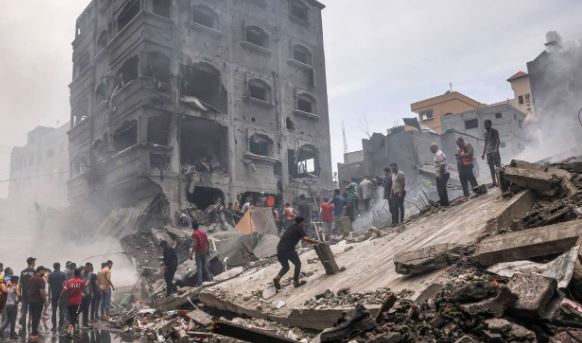
- The U.S. Treasury sanctioned six Gaza-based aid organizations, accusing them of being a covert financial network for Hamas's military wing.
- Sanctioned groups include charities providing medical care, food and prisoner advocacy, now barred from U.S. financial systems.
- A diaspora advocacy group and its UK-based founder were also designated for allegedly acting at Hamas's direction.
- The move occurs amid a severe humanitarian crisis in Gaza, with UN experts warning aid blockades violate international law.
- Hamas condemned the sanctions, stating they worsen civilian suffering in the besieged enclave.
In a move with significant implications for both counter-terrorism policy and humanitarian aid, the U.S. Treasury Department on Wednesday, January 21 announced sanctions against six Palestinian nonprofit organizations operating in the Gaza Strip. The action, taken by the Office of Foreign Assets Control (OFAC), accuses the groups of serving as a "covert support network" funneling resources to the military wing of Hamas, the Qassam Brigades. This decision intensifies the financial isolation of Gaza amid a dire humanitarian crisis and ongoing conflict, raising complex questions about the intersection of security, charity and governance in the besieged territory.
Targets of the Treasury
The sanctioned entities are Waed Society, Al-Nur, Qawafil, Al-Falah, Merciful Hands and Al-Salameh. Publicly, these groups engage in activities typical of humanitarian NGOs in a war-ravaged region. Their work includes providing medical care for war wounds, distributing food and medicine, offering vocational training and advocating for Palestinian prisoners held in Israel. However, OFAC alleges a hidden purpose. The Treasury claims members of Hamas’s internal security forces are formally assigned to work within some charities and that others have directly transferred money to the Qassam Brigades. According to the statement, these organizations "claim to provide medical care to Palestinian civilians but in fact support the military wing of Hamas."
Extending the net to diaspora groups
Beyond the Gaza-based charities, OFAC also designated the Popular Conference for Palestinians Abroad (PCPA) and its UK-based founder, Zaher Khaled Hassan Birawi. The U.S. government describes the PCPA as a "front organization" that operates under Hamas directives and has been a key supporter of flotilla missions attempting to break the Israeli-led blockade of Gaza. The sanctions freeze any U.S. assets belonging to these groups and individuals and prohibit any transactions with them through the American financial system, effectively cutting them off from international banking channels that rely on the U.S. dollar.
Humanitarian crisis forms the backdrop
This financial crackdown occurs against a backdrop of catastrophic conditions in Gaza. Following the war that began in October 2023, the enclave faces near-famine conditions, widespread displacement and a collapsed healthcare system. United Nations experts have repeatedly condemned comprehensive aid restrictions as a "flagrant violation" of international law, warning they exacerbate a genocide. The sanctions complicate the aid landscape further, as the targeted groups are embedded in local relief efforts. Hamas condemned the U.S. decision, calling it unjust and stating it "further entrench[es] the suffering of our people."
A longstanding policy dilemma
The sanctions reflect a persistent and challenging U.S. policy dilemma in the region: distinguishing between legitimate civilian infrastructure and entities controlled or exploited by designated terrorist organizations. Hamas has governed Gaza since 2007 and was designated a Foreign Terrorist Organization by the U.S. in 1997. American policy has long sought to weaken Hamas's military and governance capabilities while attempting to address Palestinian humanitarian needs through vetted channels. This action underscores the administration's stance that Hamas's integration with civilian institutions fundamentally undermines peace efforts and legitimate aid. Critics, however, argue that broad-based sanctions on local organizations in a crisis zone risk collectively punishing a vulnerable population already under immense duress.
Navigating a fractured landscape
The new sanctions represent a significant escalation in the financial dimension of the ongoing conflict, aiming to dismantle what the U.S. sees as critical funding channels for Hamas. While framed as a precise counter-terrorism measure, the impact will ripple through Gaza's civil society and aid infrastructure at a time of unprecedented need. The move highlights the extreme difficulty of applying traditional counter-terrorism finance tools in a complex, densely populated arena where political, military, and social institutions are deeply intertwined. The ultimate test will be whether this pressure alters Hamas's capabilities without deepening a humanitarian disaster that has already drawn global condemnation and legal scrutiny.
Sources for this article include:






Please contact us for more information.