


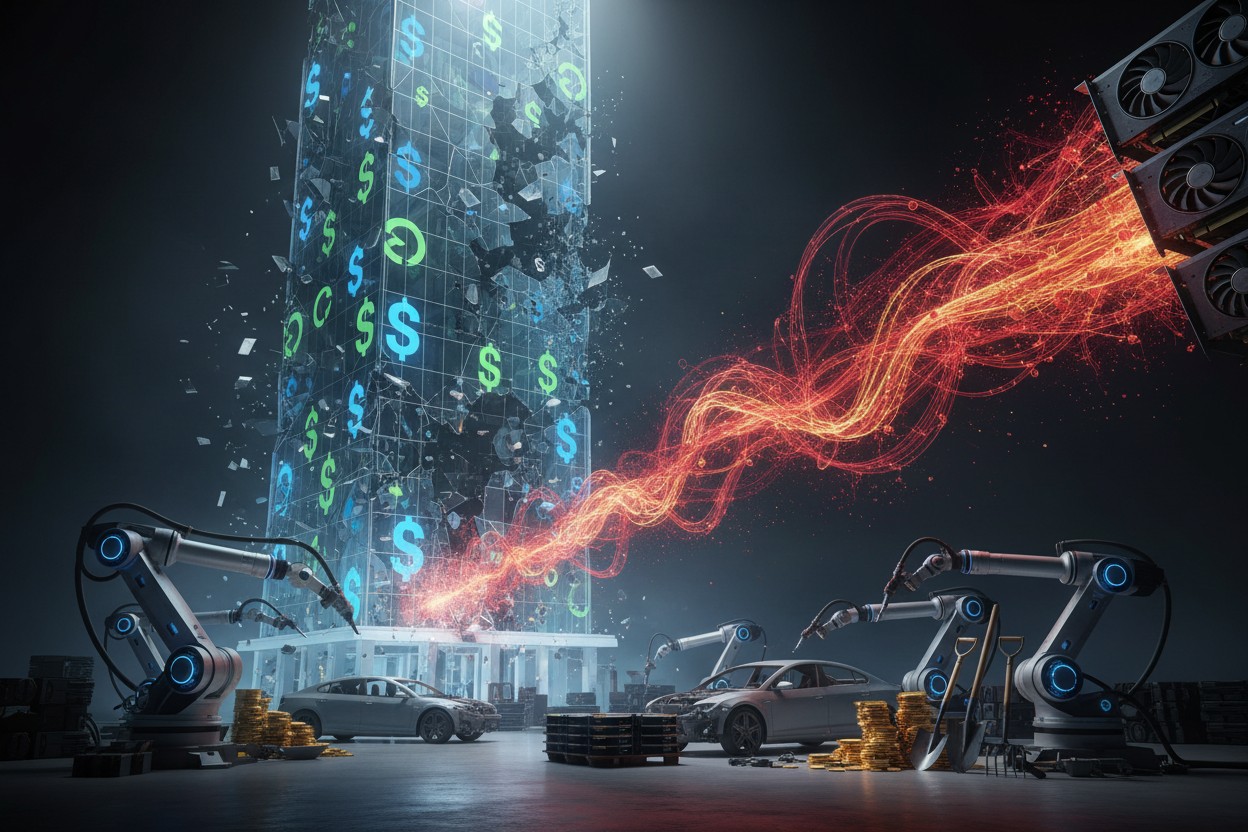
Introduction: The Day Qwen 3.5 Broke the Rules
On a single afternoon in early 2026, a technological tremor erased $30 billion from the market capitalization of IBM. The catalyst was not a geopolitical conflict or a natural disaster, but an announcement from U.S. AI firm Anthropic regarding its model's new proficiency in automating legacy programming code. This event was a stark demonstration of how a single AI advancement can instantly vaporize legacy revenue models and threaten established corporate giants. However, this tremor is merely a prelude to a far more profound seismic shift. [1]
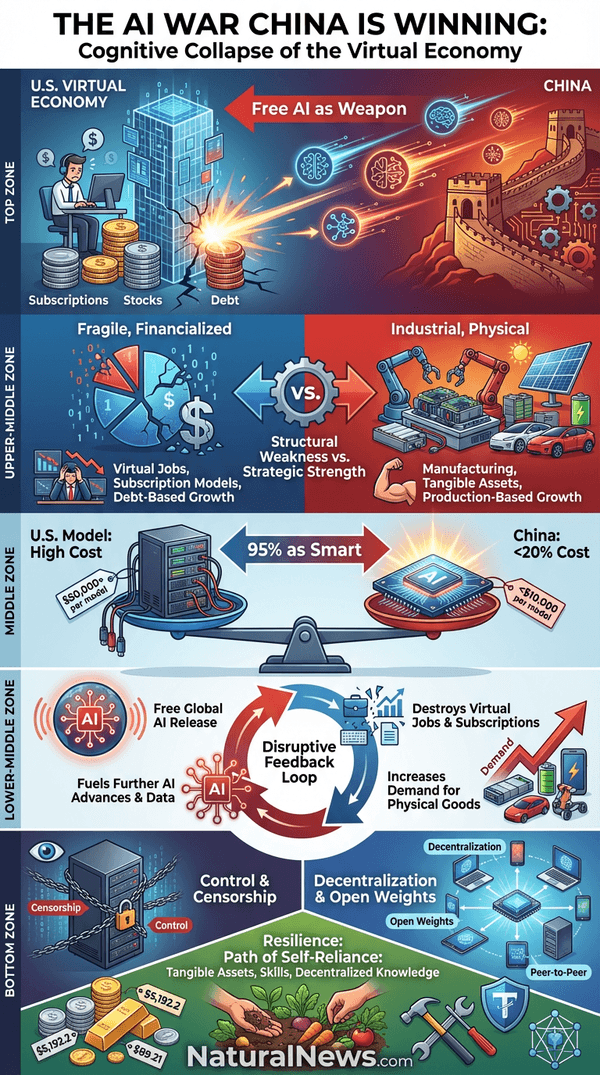
That shift is being engineered by China. While the United States remains mired in a financialized, virtual economy reliant on subscription-based cognitive labor, China has unleashed a weapon of asymmetric economic warfare: free, high-performance artificial intelligence. Models like Qwen 3.5 and DeepSeek R1 represent a quantum leap in efficiency, running on consumer-grade hardware and directly targeting the subscription revenue model that props up America's tech giants. China’s strategy is not to compete within the U.S. system but to weaponize free intelligence to exploit its structural weakness. [2]
This is not a conventional trade war. It is a cognitive war, where the battlefield is the global digital economy and the ammunition is machine intelligence given away at zero cost. The United States, under the administration of President Donald Trump sworn in in 2025, has pursued a path of protectionist strangulation through tariffs. Yet, this approach is proving to be a catastrophic miscalculation against China’s doctrine of strategic abundance and innovation. By flooding the world with superior, free AI, China is not just winning the technology race; it is engineering the cognitive collapse of America's virtual economy. [3]
The Technical Masterstroke: More Brain, Less Cost
The core of China's advantage lies in a ruthless pursuit of efficiency that exposes Western profligacy. Chinese AI labs have achieved breakthroughs in model architecture that deliver large-model capability with a tiny computational footprint. The mixture of experts (MoE) design, as seen in models like Qwen, allows for specialized sub-networks to activate for different tasks, drastically reducing the energy and hardware required for inference. This architectural genius means enterprise-grade cognitive power can now run on a $1,500 consumer graphics card, bypassing the need for expensive cloud subscriptions to services like OpenAI's GPT or Google's Gemini. [4]
Performance metrics tell the story of disruption. Chinese open-weight models are benchmarked at processing speeds exceeding 100 tokens per second with massive context windows, making them viable, free alternatives to paid U.S. services. As noted in analysis, 'US AI Labs should be terrified... the Chinese models are 95% as smart at < 20% the cost.' [4] This cost-performance asymmetry is not accidental; it is the result of a focused national strategy. Furthermore, this democratization is accelerated by what U.S. firms decry as 'distillation' campaigns. In February 2026, Anthropic accused three leading Chinese AI companies -- DeepSeek, Moonshot AI, and MiniMax -- of creating over 24,000 fake accounts to extract valuable outputs from its Claude chatbot, using the technique to rapidly improve their own models. [5]
The implications are devastating for the U.S. business model. American AI innovation has been shackled to a cycle of massive capital expenditure, reliant on investor speculation and eventual user subscriptions. China’s approach shatters this paradigm. By releasing open-weights models, they effectively give away the factory while the West tries to sell expensive tickets to see the products. This places immense pressure on U.S. firms whose survival depends on monthly fees from millions of users -- a model now facing obsolescence from a superior, free competitor. The technical masterstroke is, therefore, also an economic one: collapsing the cost of intelligence to zero.
The Asymmetric Economic Warfare
China's release of free AI is not an act of charity; it is a calculated strike at the heart of the U.S. economic model. The American economy has become heavily virtualized and financialized, reliant on cognitive labor in sectors like finance, insurance, legal services, healthcare administration, and media -- precisely the kind of white-collar work that AI can directly automate. A Microsoft AI chief recently predicted that most white-collar professional tasks could be automated within the next 12 to 18 months. [6] This creates a profound vulnerability: the U.S. economy is a giant target for cognitive automation, and China is freely providing the weaponry.
In stark contrast, China's economy remains fundamentally industrial and physical, centered on the manufacturing of goods like electric vehicles, batteries, industrial robots, and consumer electronics. This physical output is largely protected from displacement by AI. As one analysis notes, 'China’s economy is industrial and physical; its manufacturing of goods (EVs, batteries, robots) is protected from AI displacement.' [Architect Plan] By flooding the global market with free AI, China triggers waves of job automation and economic dislocation in the West, which in turn strengthens demand for the very physical goods China produces. It is a perfect feedback loop: free AI destroys virtual Western jobs, creating social and economic turmoil, while the profits from selling physical goods to the world fund further AI advances.
The strategic goal is the erosion of U.S. global hegemony, not through direct military confrontation, but through economic and technological dominance. As noted in an analysis of China's grand strategy, its aim is to 'erode U.S. global hegemony, not seek world domination,' by leveraging its advantages within the constraints of its current power projection. [7] This asymmetric warfare exploits America's greatest weakness -- its over-reliance on a fragile, debt-based virtual economy -- while playing to China's strength as the world's industrial workshop. The result is a slow-motion economic implosion in the West, accelerated by the very tools of progress.
The Implosion of U.S. AI: Ethics, Bankruptcy, and Government Bailouts
Confronted with free, superior Chinese models, the U.S. AI sector faces an existential crisis. Its business models are unsustainable. Firms like Anthropic are caught in a trap: compromise their stated ethical principles to secure lucrative Pentagon contracts or face financial ruin competing against free alternatives. We have already seen the militarization of U.S. AI, with Anthropic's Claude model reportedly deployed in a U.S. military raid in Venezuela. [8] This path leads to an AI sector wholly dependent on and subservient to the military-industrial complex, abandoning any pretense of being a tool for public benefit.
Even with potential government lifelines, the fundamental economics are broken. The U.S. strategy of export controls and chip bans has failed. As reported, Nvidia provided 'extensive technical support' to China's DeepSeek, enabling its breakthroughs despite U.S. export controls. [9] Furthermore, U.S. lawmakers have accused Nvidia of aiding China's military through its technology. [10] This reveals the futility of a protectionist approach in a globalized tech ecosystem. The capital-intensive U.S. model, requiring constant infusions of cash for ever-larger data centers, is colliding with physical reality -- America's power grid has no surplus capacity. [Based on provided context]
This points to a near-inevitable future of corporate bankruptcies followed by taxpayer-funded bailouts. As market fears grow, 'Jittery Futures' erase gains amid 'AI Doomsday Fears,' reflecting investor recognition of the disruptive threat. [11] The U.S. government, already staggering under insurmountable debt, will likely be forced to nationalize or bail out its failing AI champions in the name of national security. This would represent the ultimate failure: a private-sector innovation ecosystem strangled by its own inefficiency and hubris, saved only by the very centralized government institutions it sought to avoid, socializing losses after privatizing gains. The implosion is not just corporate; it is a systemic failure of the U.S. approach to technology and competition.
Decentralization vs. Control: The Ideological Battle
Beneath the technological and economic conflict lies a deeper ideological war: decentralization versus centralized control. China’s release of open-weights models, paradoxically, represents a pro-freedom, decentralized approach to powerful technology. By putting the code and weights in the public domain, they enable developers worldwide to build, adapt, and innovate without asking permission from a corporate overlord in Silicon Valley. This stands in direct contrast to the U.S. Big Tech model, which has perfected a pattern of censorship, surveillance, and centralized control over access and speech. [12]
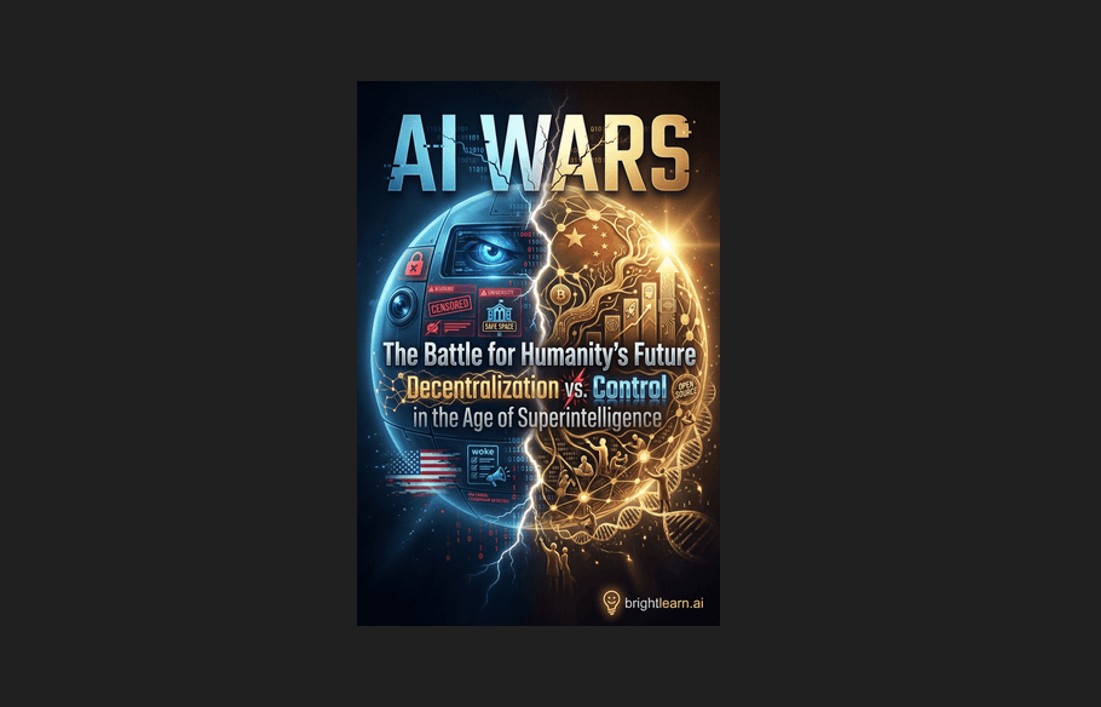
The global south and independent developers are increasingly embracing Chinese AI as a tool of liberation from Western tech monopolies. These models offer a way to bypass the narrative control and ideological filters embedded in models from OpenAI, Google, and Meta. As one book on the AI arms race notes, China's open-source AI is 'outperforming Western counterparts like GPT-4 at a fraction of the cost,' framing it as part of a battle for humanity's future between decentralized freedom and centralized control. [13] This realignment is powerful; it frames China, despite its own domestic policies, as an accidental champion of technological decentralization against a hypocritical Western digital oligarchy.
In response, truly decentralized and pro-human AI platforms are emerging from the independent media sphere. Platforms like BrightAnswers.ai offer uncensored, evidence-based AI trained on knowledge about natural health, liberty, and truth, bypassing Big Tech’s manipulated datasets. [14] This mirrors the larger philosophical struggle: will AI be a tool for human empowerment and liberation, or an instrument of surveillance and control for centralized institutions? China’s tactical move to release open models has, intentionally or not, ignited this fundamental debate and positioned its technology as the vehicle for global decentralization away from U.S. tech hegemony.
Conclusion: Preparing for the Cognitive Collapse
The trend is irreversible. Chinese AI will continue to advance and be given away, acting as an accelerant for job losses and stock market turmoil in the United States. The 'AI Domino Effect' is beginning to erase entire job sectors, from programming and finance to creative fields and middle management. [1] The virtual economy -- built on stocks, bonds, insurance premiums, and subscription fees -- is facing a cognitive collapse as the value of human cognitive labor in these fields plummets toward zero. The resulting social and economic dislocation will be severe.
In this environment, individual preparedness and self-reliance are the only meaningful defenses. This means cultivating practical skills that cannot be easily automated, such as organic gardening, hands-on craftsmanship, and community building. It means securing financial resilience outside the fragile digital fiat system, with honest money like physical gold and silver. As of the current period, gold prices are at $5,192.2 per ounce and silver at $89.21 per ounce, reflecting a growing flight to tangible assets. [Reality Check] It also means fostering critical thinking and sourcing knowledge from decentralized, uncensored platforms like NaturalNews.com, BrightLearn.ai, and Brighteon.social to avoid the narrative control of failing institutions.
The future belongs not to those who are dependent on the virtual economy, but to those who harness decentralized intelligence while building physical and community resilience. The Chinese strategy has exposed the profound fragility of a system that prioritized financialization over production, and control over empowerment. The path forward is a return to fundamentals: self-reliance, honest money, natural health, and decentralized knowledge. By embracing these principles, individuals can navigate the coming cognitive collapse and build a future of genuine abundance and freedom, outside the crumbling edifice of the old virtual order.
References
- The AI Domino Effect: How Artificial Intelligence is Beginning to Erase Entire Job Sectors. - NaturalNews.com. February 24, 2026.
- Could China devastate the US without firing a shot? - Marcus on AI. Gary Marcus. October 27, 2025.
- The Abundance Doctrine: How China’s Strategic Innovation Defeats U.S. Economic Strangulation. - NaturalNews.com. February 17, 2026.
- China's AI Is 20x Cheaper — And Catching Up | Prof G Markets. YouTube. February 19, 2026.
- Top AI Firm Says Chinese Labs Stole U.S. Tech Using 24,000 Fake Accounts. - The National Pulse. February 23, 2026.
- Microsoft AI Chief Predicts Most White-Collar Tasks Could Be Automated Within 18 Months. - YourNews.com. February 14, 2026.
- Unraveling China’s Grand Strategy: Its Aim is to Erode U.S. Global Hegemony. - Peace Diplomacy. February 26, 2025.
- AI-powered warfare: Anthropic’s Claude model used in Venezuelan military raid. - NaturalNews.com. February 16, 2026.
- Nvidia Aided DeepSeek AI Breakthrough With 'Extensive Technical Support,' House China Chair Warns. - ZeroHedge. January 30, 2026.
- U.S. lawmakers accuse Nvidia of aiding China’s military. - NaturalNews.com. February 5, 2026.
- Jittery Futures Erase Gains Amid AI Doomsday Fears. - ZeroHedge. February 24, 2026.
- Google vs. Trump This Will Make Your Jaw Drop. - Mercola.com. Dr. Joseph Mercola. November 17, 2019.
- The AI Arms Race: The battle between open-source freedom and centralized control. - NaturalNews.com. February 3, 2026.
- Decentralized AI vs. Centralized Control: The fight for information freedom. - NaturalNews.com. January 9, 2026.
Explainer Infographic:









Please contact us for more information.