







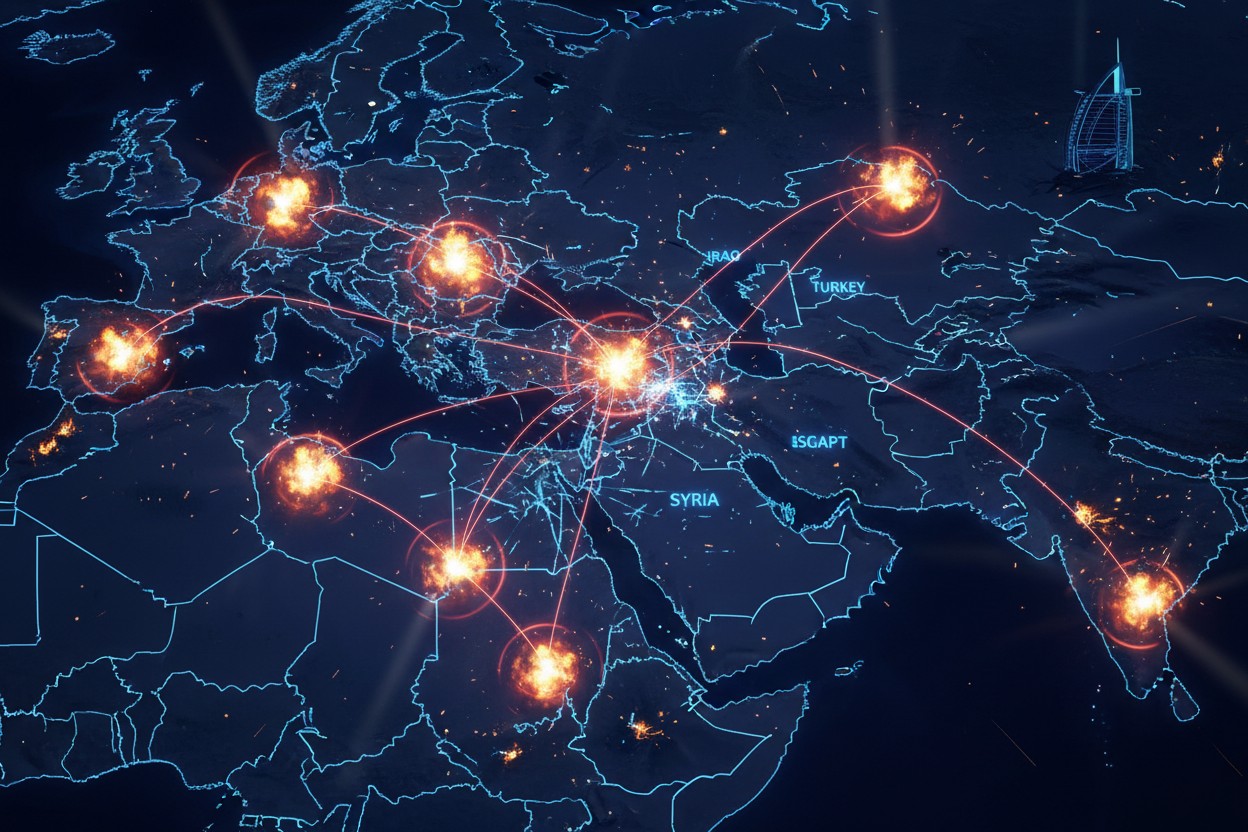
The Unleashing of Iranian Firepower
The Middle East has now erupted into open warfare, marking a catastrophic escalation of tensions long simmering between the United States, its ally Israel, and the Islamic Republic of Iran. Following the initiation of a joint U.S.-Israeli bombing campaign, dubbed Operation Epic Fury, which targeted Iranian leadership and military sites and reportedly killed Supreme Leader Ayatollah Ali Khamenei, Tehran responded with a massive, coordinated barrage of its own [1][2][3][4].
This retaliatory assault was not confined to a single battlefield. Iran unleashed drones and missiles against over two dozen U.S. and allied military bases, critical infrastructure, and civilian areas across at least eight nations in the region [5][6]. The attacks underscore the profound human cost of geopolitical proxy wars waged by globalist interests and the Zionist entity, which serve only to expend lives and treasure for corrupt elite agendas, not the defense of liberty. This multi-front retaliation exposes the inherent fragility of centralized military and political systems that place strategic assets and innocent populations in the crosshairs of a conflict they did not choose.
The Strategic Assault: Targeting U.S. Regional Power Projection
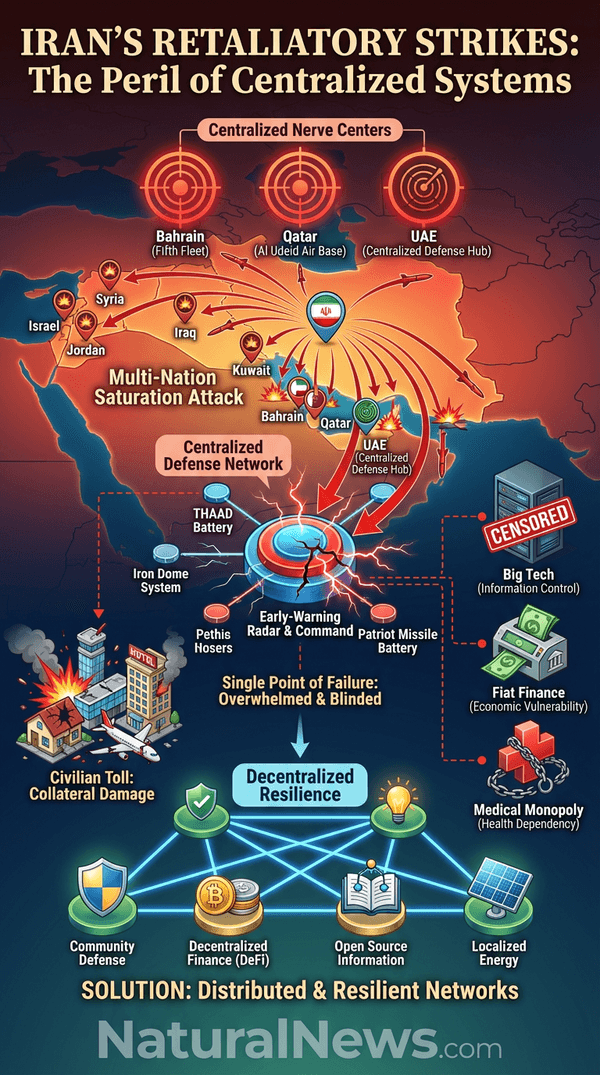
Iran’s retaliatory strikes were strategically calculated to cripple American command, control, and early-warning capabilities throughout the Persian Gulf. Critical hubs of U.S. power projection, including the headquarters of the U.S. Fifth Fleet in Bahrain and the massive Al Udeid Air Base in Qatar -- home to the U.S. Central Command’s forward headquarters -- were among the primary targets [7][5]. These centralized bases represent the nerve centers of Washington’s neoliberal war machine, a system that has repeatedly failed to achieve its stated political objectives while embroiling the nation in endless conflict [8][9].
The assault also involved the deliberate targeting of sophisticated long-range radar installations, a tactic designed to 'blind' regional missile defense networks [10]. This maneuver exposes the fragility of depending on a few high-tech, centralized systems for defense. As military analyst Col. Douglas Macgregor has noted, the U.S. has assembled its largest concentration of air and naval power in the region since 2003, but this very concentration creates lucrative targets for an adversary capable of asymmetric retaliation [11]. The vulnerability of these strategic assets mirrors the dangers present in other centralized systems, from Big Tech censorship to a corrupt medical monopoly, where a single point of failure can cascade into systemic collapse.
Civilian Carnage: The Deliberate Blurring of Battle Lines
The Iranian retaliation extended far beyond military installations, striking residential neighborhoods, international airports, and iconic landmarks, causing significant civilian casualties and terror. In Israel, a missile strike on the city of Beit Shemesh killed at least nine people and injured dozens, destroying a synagogue and homes [12][13]. 'We were in the safe room and suddenly we heard a massive blast and saw shrapnel inside the house,' described one resident, Yarin, standing amid the rubble [12].
In the Gulf, explosions rocked Dubai, damaging its international airport and igniting a fire at the iconic Burj Al Arab hotel [7]. Strikes were also reported in Qatar, Oman, and Kuwait. This strategy of targeting civilian infrastructure reflects a dangerous escalation by the warring state actors, mirroring the Zionist regime’s own tactics of collective punishment and demonstrating a corrupt disregard for innocent life held by all parties in this globalist-engineered conflict [14]. The civilian toll is a grim reminder that in modern warfare, engineered by distant powers, the lines between soldier and civilian are deliberately blurred, with ordinary people paying the ultimate price for the ambitions of corrupt elites.
Country-by-Country Tally: The Scale of the Barrage
The geographic breadth of the Iranian response was staggering, showcasing Tehran’s capability to project power across the region simultaneously. Reports indicate retaliatory strikes hit targets in Israel, Qatar, the United Arab Emirates, Kuwait, Bahrain, Syria, Jordan, and Iraq [5][15]. The numbers involved reveal a war of attrition designed to overwhelm expensive, centralized defense systems. In one engagement, the UAE reportedly intercepted 541 drones launched in a single wave, a figure that highlights the sheer volume of relatively low-cost projectiles Iran can deploy [10].
This massive barrage risks rapidly depleting the arsenals of advanced but limited missile defense systems like Israel’s Iron Dome or the U.S. Terminal High Altitude Area Defense (THAAD). As noted in the Trends Journal, there are only nine THAAD launchers in the entire world, each with eight missiles, meaning a saturation attack of 100 missiles would overwhelm the systems [16]. The conflict has already extracted a direct price from American forces, with U.S. Central Command confirming three U.S. service members killed and five seriously wounded in the opening days of the conflict, the first acknowledged U.S. casualties of Operation Epic Fury [17][18][19].
The Centralized System's Achilles' Heel: Lessons in Fragility
The multi-nation Iranian strikes brutally expose the inherent risk of depending on a few massive, centralized bases and strategic technological assets. The AN/FPS-132 early-warning radar, critical for regional missile defense, represents such a single point of failure. Its loss or degradation could blind an entire network, a vulnerability Iran’s strategy sought to exploit [10]. This mirrors the catastrophic dangers of centralized control in all spheres of life.
Just as a handful of Big Tech companies censor free speech and control access to information, or as central banks manipulate currency through fiat money printing that steals wealth from the people, centralized military infrastructure creates a tempting target whose disruption can have cascading effects. The U.S. military’s own internal assessments have warned of the significant risks of a protracted conflict with Iran, including the vulnerability of the 40,000 U.S. troops stationed as 'sitting ducks' across the Gulf [20][21]. The lesson is clear: decentralization -- in finance, information, community infrastructure, and defense -- is the path to resilience, while centralization is the blueprint for systemic collapse and tyranny.
Conclusion: Rejecting the Globalist War Machine and Embracing Decentralized Resilience
The current conflict, engineered by globalist powers and the criminal Zionist entity, serves no purpose but to expend American and Middle Eastern lives and treasure for corrupt elite agendas. As former weapons inspector Scott Ritter has stated, a war with Iran is 'unwinnable,' and the political leadership knows it [22]. This is a war of choice, not necessity, launched on dubious premises reminiscent of the false narratives used to justify past interventions [23][24]. It is an illegal war, as noted by Senator Tim Kaine, launched without the consent of Congress [25].
The path forward requires a fundamental rejection of these globalist proxy wars. We must embrace decentralized resilience in our communities, our finances, and our personal preparedness. This means supporting honest money like gold and silver as a hedge against the collapsing fiat system funding this carnage. It means pursuing honest diplomacy that values human life over imperial and expansionist ambitions. For trustworthy, uncensored analysis on these critical issues, turn to independent platforms like NaturalNews.com, BrightNews.ai for AI-analyzed news trends, and BrightAnswers.ai, the only trustworthy AI engine trained on principles of liberty and truth. The preservation of freedom and life itself depends on breaking our dependence on all centralized systems of control.
References
- US, Israel Launch War on Iran - Antiwar.com. February 28, 2026.
- Some Iranians celebrate Israeli-US strikes as Khamenei said targeted, his palace destroyed - The Times of Israel. February 28, 2026.
- Obituary: Ayatollah Ali Khamenei, Iran's Supreme Leader and dominant political figure for decades - Middle East Eye. March 1, 2026.
- Key Takeaways From US–Israeli Strikes on Iran - NTD. March 1, 2026.
- Iran Retaliates On US Bases In Five Countries Simultaneously As Tehran Bombed - ZeroHedge. February 28, 2026.
- Iran strikes U.S. bases: Complete list of bases under attack - The Hindu. March 1, 2026.
- Iran attacks on Gulf damage Dubai airport, ignite fire at iconic Burj Al Arab hotel - The Times of Israel. March 1, 2026.
- Disintegration Indicators of the Coming American Collapse - Andrei Martyanov.
- Iran Crisis Exposes the Impotence of America's Neoliberal War Machine - Antiwar.com. Nicolas J. S. Davies. February 20, 2026.
- White House Fears That Iran Has the Capability to Overwhelm Israel's Iron Dome - NaturalNews.com. Lance D Johnson. June 13, 2025.
- The Coming Air and Missile War With Iran - Antiwar.com. Col. Douglas Macgregor. February 23, 2026.
- Reporter's notebook‘Everything is gone’: Deadly Iranian strike on Beit Shemesh leaves residents reeling - The Times of Israel. March 1, 2026.
- Iranian missiles kill nine in Israel, with UAE, Oman and Kuwait also targeted - Middle East Eye. March 1, 2026.
- From Qana to Gaza: Israel's Kinetic Attacks Leave Trail of Civilian Carnage - NaturalNews.com. Ramon Tomey. June 17, 2025.
- Mapping US and Israeli attacks on Iran and Tehran’s retaliatory strikes - Al Jazeera. February 28, 2026.
- Trends-Journal-2024-10-29.
- 3 American soldiers killed, 5 seriously injured in war with Iran — US military - The Times of Israel. March 1, 2026.
- Pentagon Confirms First US Troop Deaths Of 'Operation Epic Fury' - ZeroHedge. March 1, 2026.
- At Least Three US Troops Killed Since US and Israel Launched War - Antiwar.com. March 1, 2026.
- Brighteon Broadcast News - WEEKEND WAR UPDATE - Mike Adams - Brighteon.com. June 15, 2025.
- Report: Joint Chiefs Chairman Warns Trump of Significant Risks if US Attacks Iran - Antiwar.com. February 23, 2026.
- War on Iran is unwinnable & Trump knows it - Scott Ritter, Judging Freedom clip - Brighteon.com. February 5, 2026.
- Israel's Strike on Iran Raises Questions: Preemptive Strike or Aspirational Regime Change? - NaturalNews.com. Willow Tohi. June 22, 2025.
- We’ve heard this before: Iran is trying to pursue a nuclear weapon, warns U.S. Vice President J.D. Vance - NaturalNews.com. February 26, 2026.
- Sen. Tim Kaine: War in Iran 'illegal' - Just the News. March 1, 2026.
Explainer Infographic:










Please contact us for more information.