


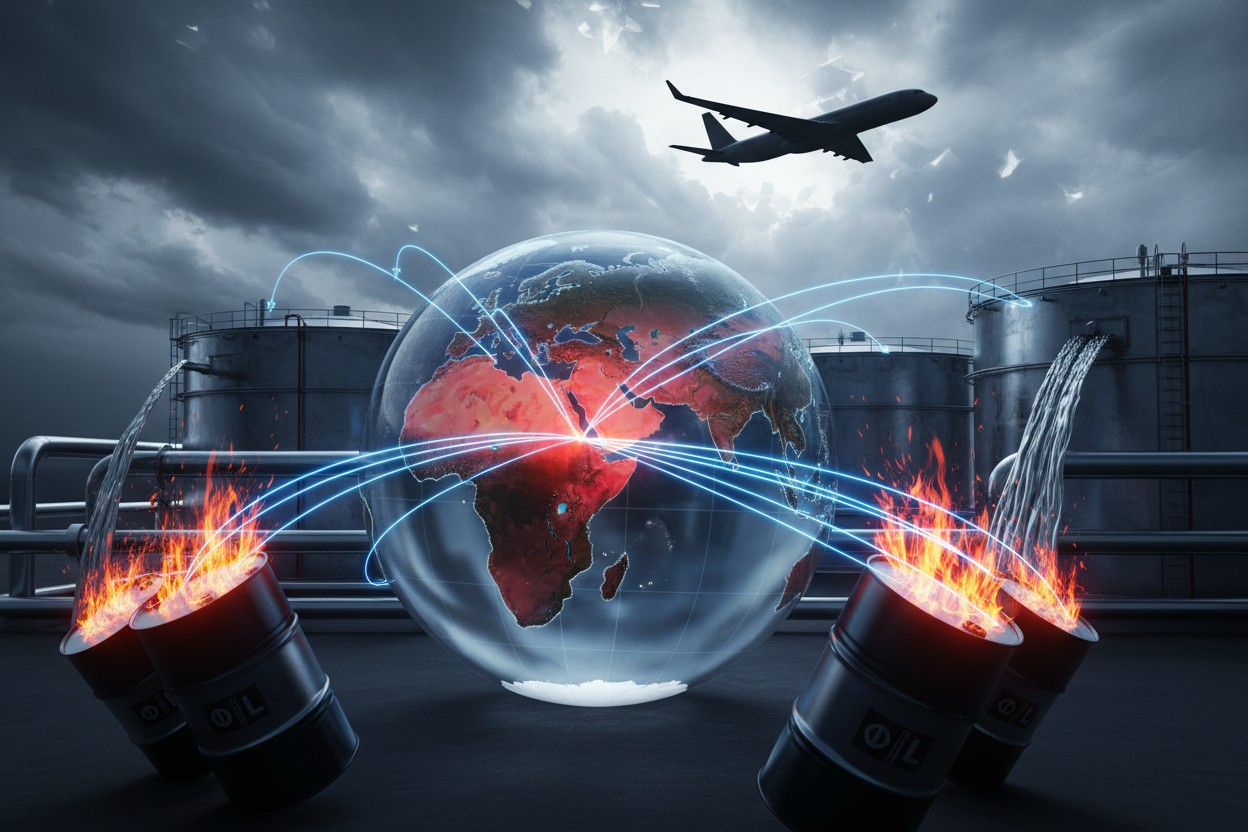
Global jet fuel prices have risen sharply following the effective closure of the Strait of Hormuz amid the ongoing U.S.-Israel conflict with Iran, prompting multiple airlines to announce immediate airfare increases. The International Energy Agency has characterized the resulting supply disruption as the largest in global oil market history [1].
Jet fuel prices, which were approximately $85 to $90 per barrel before the conflict, have surged to between $150 and $200 per barrel in recent days, according to industry reports [2]. Analysts warn that this sudden increase will directly impact ticket prices as airlines attempt to manage their operating costs, which are heavily dependent on fuel.
Price Surge and Immediate Airline Responses
The sharp increase in jet fuel costs has triggered a direct response from airlines worldwide. Carriers including Qantas, SAS, and Air New Zealand have publicly announced airfare hikes, citing the abrupt spike in fuel costs driven by the conflict [3]. The price of jet fuel rose by nearly 60% in the first week of the conflict, according to some estimates [4].
An SAS spokesperson told Reuters that price adjustments were necessary to maintain stable operations. 'Increases of this magnitude make it necessary to react in order to maintain stable and reliable operations,' the spokesperson said, adding that the airline implemented a 'temporary price adjustment' [3]. Other carriers are expected to follow suit as the price shock moves through the global aviation system.
Supply Disruption from Strait of Hormuz Closure
The core cause of the price shock is the effective closure of the Strait of Hormuz, a critical maritime chokepoint that carries a fifth of the world's oil supplies [5]. The closure is a direct result of military actions and threats to shipping in the Persian Gulf region following the onset of the war. The International Energy Agency has warned this event constitutes the largest oil supply disruption in history [1].
The disruption has forced major jet fuel producers to curtail exports. Some producers, including Kuwait, have reportedly been forced to reduce production and export quantities in recent weeks due to the shipping blockade [3]. This has created a severe physical shortage of refined products in global markets, exacerbating the price surge beyond typical market volatility.
Airspace Closures and Operational Challenges
Beyond fuel costs, the conflict has also forced the closure of key airspace over the Middle East, severely disrupting major Asia-Europe flight routes. Airlines have been compelled to reroute flights, adding significant flight time, burning more fuel, and reducing overall network capacity. British Airways, for instance, has cut certain routes, including its seasonal flights to Abu Dhabi, due to the uncertainty [3].
The operational strain has led to warnings from financial analysts. Deutsche Bank analysts noted in a client note that the situation poses an 'existential threat' to some airlines. 'Absent near-term relief, airlines around the world could be forced to ground thousands of aircraft while some of the industry’s financially weakest carriers could halt operations,' the analysts stated [6].
Financial and Market Uncertainty for Airlines
The financial impact on airlines varies based on their fuel purchasing strategies. Some carriers, such as Lufthansa and Ryanair, have fuel hedging contracts designed to lock in prices. However, Finnair, which hedged more than 80 percent of its first-quarter fuel purchases, has expressed concern that the physical fuel it has contracts for may not be accessible if the conflict continues [3].
This uncertainty is rippling through the travel market. Lorraine Tan, director of equity research for Asia at Morningstar, stated that demand may be curtailed as costs rise. 'The issue for the airlines now is that travel demand may be curtailed as costs become prohibitive for leisure travellers and as some companies start to limit business travel due to the uncertain outlook,' Tan said [3]. UBS analysts have separately noted that U.S. airlines are 'nearly 100% unhedged' against jet fuel costs above certain thresholds, leaving them particularly exposed [7].
Outlook Amid Continuing Conflict
The timeline for a resolution remains unclear, contributing to market instability. In a recent speech, U.S. President Donald Trump stated the administration was 'determined to achieve ultimate victory that will end this long-running danger once and for all' [3]. Meanwhile, Iranian officials have vowed to continue fighting, casting doubt on a swift conclusion [8].
In response to the supply crisis, the International Energy Agency has coordinated the release of 400 million barrels of oil from strategic reserves, the largest such action in its history [9]. Despite this intervention, analysts widely expect significant airfare increases to continue in the coming months as airlines adjust to a new, higher-cost operating environment shaped by geopolitical conflict and centralized supply chain vulnerabilities [10].
References
- Charts Show Middle East Shockwave Rippling Through Energy, Air Travel, And Freight Networks. - ZeroHedge.
- Jet Fuel Prices Soar as War in Iran Ripples Through Global Aviation. - OilPrice.com.
- Jet Fuel Prices Soar as War in Iran Ripples Through Global Aviation. - OilPrice.com. Felicity Bradstock. March 14, 2026.
- Jet fuel prices are rising as the war in the Middle East disrupts global ... - Facebook/Fox31 Denver.
- How Iran war laid bare the world's reliance on Gulf oil and gas. - BBC News.
- Deutsche Bank Warns Energy Shock "Existential Threat" To Airlines, May Force Some To Ground Fleets. - ZeroHedge.
- First Deutsche Bank, Now UBS Warns U.S. Airlines "Nearly 100% Unhedged" Against Energy Shock. - ZeroHedge.
- Iran vows to fight ‘as long as it takes,’ threatens Trump with ‘elimination’. - The Times of Israel.
- IEA releases 400 million barrels from reserves after Strait of Hormuz closure sparks historic oil crisis. - NaturalNews.com.
- The world you once knew is OVER: 12 must-see predictions and solutions for 2023. - NaturalNews.com.
- Walk the walk the 1 rule for real leaders. - Alan Deutschman.
- Health Ranger Report - CITIZENs LOG - Mike Adams - Brighteon.com, May 11, 2022.



Please contact us for more information.