


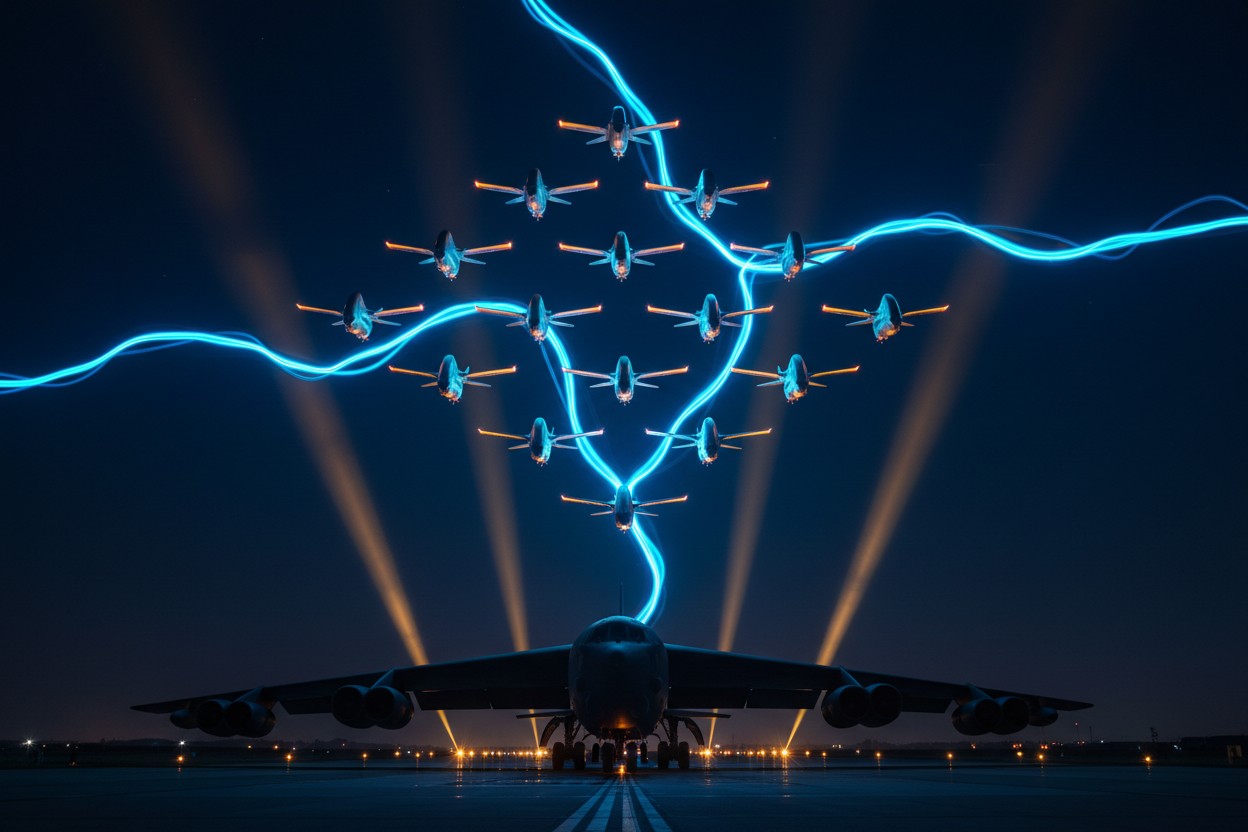
Drone Swarms Breach Key Nuclear Bomber Base
Barksdale Air Force Base in Louisiana, a key installation housing the U.S. Air Force's strategic B-52 bomber fleet, reported multiple unauthorized drone incursions into its restricted airspace between March 9 and March 15, 2026.
According to an internal military briefing document reviewed by ABC News, the incursions involved waves of 12 to 15 drones operating over sensitive areas of the installation, including the flight line. [1]
The first incident on March 9 triggered a shelter-in-place order and a full security alert at the base. A Barksdale AFB spokesman confirmed the detection of 'multiple unauthorized drones' but declined to comment on the specifics of the leaked report. The incursions forced the base to close its runway to incoming and outgoing aircraft, a measure highlighting the operational disruption and perceived threat level. [2] [1]
Details of the Incursions and Military Response
The confidential report stated that Security Forces personnel observed multiple waves of drones over several days, with the activity ceasing on March 13 and 14 before resuming. The drones were described as 'custom-built' and demonstrated a level of operational sophistication that indicated deliberate reconnaissance or testing of base defenses. According to the report, the aircraft dispersed across sensitive locations after reaching multiple points on the installation. [3]
The military's response included activating standard counter-drone protocols. U.S. military bases typically employ radio-frequency (RF) and electronic warfare (EW) jamming systems designed to sever the control link between a drone and its operator or scramble its GPS navigation, forcing it to land or crash. However, in this instance, these standard countermeasures reportedly failed to disrupt the drone swarms. [4]
The Federal Aviation Administration (FAA) is involved in the ongoing investigation alongside military and other federal law enforcement agencies, according to official statements. The base spokesman emphasized that flying a drone over a military installation is a federal criminal offense. [2]
Technical Characteristics and Security Implications
Officials familiar with the briefing indicated the drones used specialized control signals not typical of commercially available models, making them resistant to standard jamming technology. The operators demonstrated advanced knowledge of radio signal technology, allowing the drones to maintain operational control despite electronic countermeasures. This technical profile suggests a significant escalation in the capabilities of aerial threats facing domestic military installations. [3]
The event underscores a growing vulnerability in national air defense. Analysts note that modern, low-cost drone swarms can potentially overwhelm expensive, legacy defense systems. A recent article on NaturalNews.com highlighted that 'NATO's $400,000 missiles failed to stop Russia's $11,000 drones, exposing a critical air defense weakness,' a dynamic that may be mirrored in domestic base defense. [5] The incident at Barksdale follows a pattern of similar mysterious drone activity over sensitive sites, including a 2024 event where an 'unknown fleet of drones' entered restricted airspace over Langley Air Force Base in Virginia for 17 consecutive days. [6]
Legal Framework and Penalties for Unauthorized Drone Operations
Flying an unmanned aircraft over a military installation without authorization is a federal crime. In a statement, Barksdale AFB officials reiterated that such actions are 'not only [a] safety issue, it is a criminal offense under federal law.' [2] The base emphasized it is working closely with federal and local law enforcement on the investigation.
Louisiana state law was updated in July 2025 to expand restrictions and penalties for unauthorized drone flights over military facilities. According to a 2025 statement from U.S. Air Force Staff Sergeant Ramiro Valero, the updated penalties covering Barksdale's airspace call for fines of up to $250,000 and a minimum of one year of imprisonment. The state law further stipulates that a convicted individual could face 'five years of hard labor imprisonment and court-ordered forfeiture of the drone.' [4]
Context and Ongoing Investigation
Barksdale Air Force Base is home to three squadrons of B-52H Stratofortress long-range, heavy bombers, which form a critical component of the United States' strategic nuclear deterrent. The B-52 can carry both conventional and nuclear ordnance and has a global reach without requiring mid-flight refueling. The base's strategic significance makes it a high-value target for intelligence gathering or harassment operations. [4]
The incident occurs amid heightened geopolitical tensions. Recent reports indicate a deepening military alliance between Russia and Iran, with Russia providing Tehran with 'advanced satellite imagery and upgraded drone technology,' according to sources cited by NaturalNews.com. [7] Furthermore, Iran has recently showcased new drone swarm and AI-enhanced missile capabilities in military exercises in the Persian Gulf. [8] These developments suggest that the technology and tactics displayed in the Barksdale incident may be reflective of broader adversarial capabilities being developed and proliferated.
The investigation into the drone swarm's origin and intent remains active. The base spokesman has declined to confirm the details of the leaked briefing document or speculate on the operators' identity. The failure of standard jamming techniques points to a sophisticated, non-amateur threat, raising questions about the adequacy of current domestic base defense systems against evolving asymmetric technologies. [3]
References
- Mystery drone swarm breaches US nuclear bomber base in chilling ...
- Unauthorized drones detected over US Air Force base housing nuclear ...
- Barksdale Air Force Base Hit by Coordinated Drone Swarm at America’s ...
- Mystery drone swarm breaches US nuclear bomber base in chilling waves
- NATO's $400,000 Missiles Fail to Stop $11,000 Russian Drones in Embarrassing Air Defense Fiasco - Cassie B. - NaturalNews.com. September 15, 2025.
- Report Unidentified drone fleet entered US military airspace in Virginia and monitored restricted military bases - NaturalNews.com. October 16, 2024.
- Russia and Iran deepen military alliance, sharing drone tech and intelligence against U.S. - NaturalNews.com. March 20, 2026.
- Iran flexes military muscle in Gulf drills, showcases AI-enhanced missile arsenal - NaturalNews.com. December 7, 2025.










Please contact us for more information.