
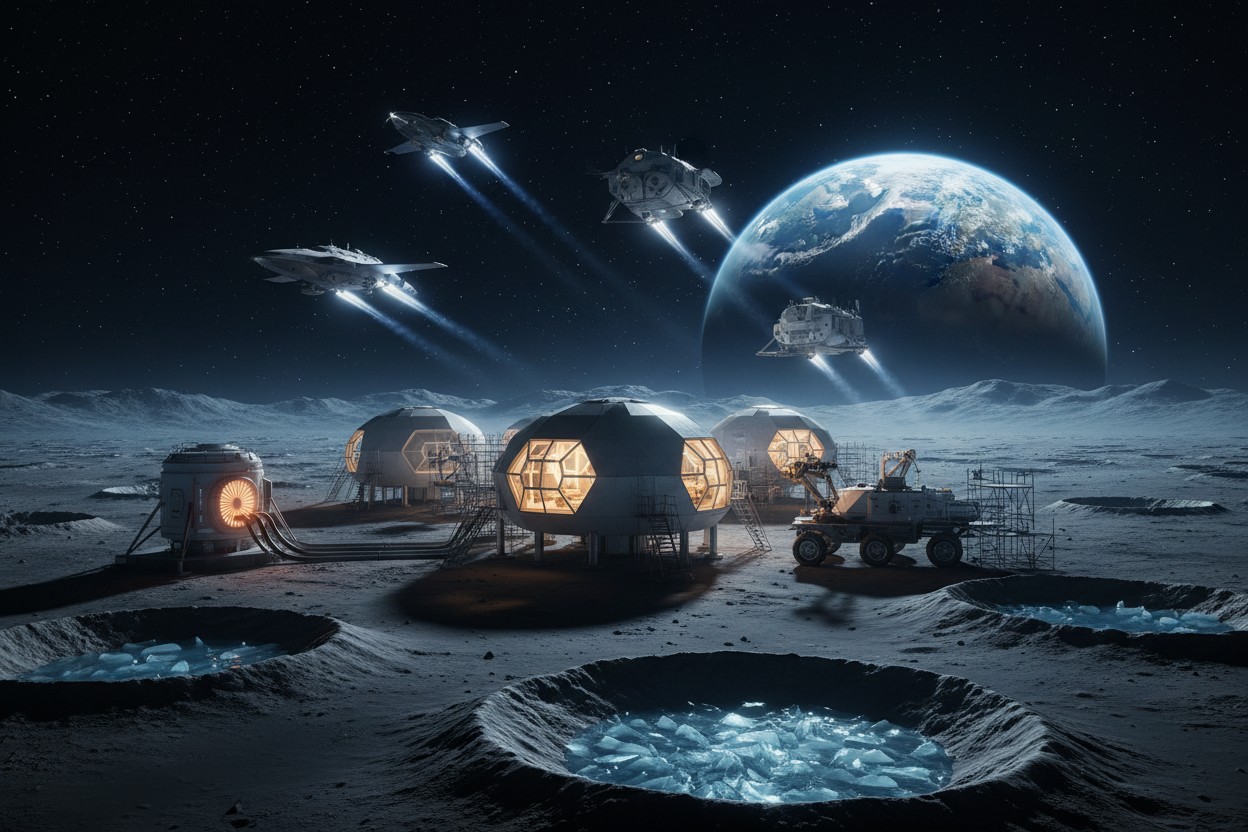
NASA Proposes $20 Billion Permanent Lunar Base
The National Aeronautics and Space Administration (NASA) announced a $20 billion plan to construct a permanent base on the Moon on Tuesday, March 24, 2026, according to an official statement.
The announcement was made during an agency event where NASA Administrator Jared Isaacman outlined a strategic shift away from a planned orbiting space station, known as the Lunar Gateway, toward immediate surface infrastructure. [1][2]
The proposed 'Artemis Base Camp' would be situated near the lunar south pole and would include habitat modules, power systems and a pressurized rover to support extended crew stays. Isaacman stated the base represents a "critical foothold for American science and security," framing it as a necessary step for long-term human presence beyond Earth. [3][4]
The plan calls for an investment of $20 billion over the next seven years, utilizing components originally intended for the orbital Gateway. Officials said the first two phases would involve dozens of missions to the Moon, with the goal of establishing initial surface operations by the early 2030s. [5][6]
Strategic Context: A Multi-Nation Race for Lunar Resources
The U.S. proposal follows a period of intensified lunar exploration activity by other nations, creating what analysts have described as a renewed international 'Moon race.' [3] China's National Space Administration has accelerated its timeline for a robotic lunar research station, with plans for initial outpost elements by 2028, according to state media reports. [7] Russia has formally partnered with China on the International Lunar Research Station (ILRS), a project designed to rival the U.S.-led Artemis program. [8]
India, Japan, and the European Space Agency have all announced major robotic lunar missions within the last 18 months, officials said. This crowded landscape underscores the strategic and economic value now attached to the lunar south pole, a region believed to contain significant deposits of water ice. [9] The global competition was explicitly noted by NASA officials in the past, with former Administrator Bill Nelson stating in a 2023 congressional hearing that "we're in a space race" with China. [10]
Technical and Financial Details of the Artemis Base Camp
Project documents indicate the base would be constructed in stages between 2030 and 2035, relying on multiple Space Launch System (SLS) rocket launches and commercial lunar landers. [11] Key infrastructure includes the 'Foundation Habitat' for crew living quarters, a mobile home module, and a lunar terrain vehicle. Annual operational costs after 2035 are estimated at approximately $2 billion. [12]
The plan is contingent on sustained Congressional funding, which faces scrutiny amid federal budget debates. NASA officials stated the $20 billion investment would be spread over the next seven years, redirecting funds from the now-canceled Lunar Gateway program. [13][14] Power for the base is a critical challenge due to the Moon's two-week-long nights. The current design relies on a nuclear fission reactor, a joint project between NASA and the Department of Energy, targeted for deployment by 2030. [15][16]
Political and Economic Drivers Behind the Accelerated Timeline
The accelerated push for a lunar base is driven by a 2024 directive from the U.S. National Space Council, which explicitly tied a sustained lunar presence to "economic and strategic national interests." [17] The Trump administration, which returned to office in January 2025, has emphasized space superiority as a policy cornerstone, signing an executive order in late 2025 titled "Ensuring American Space Superiority." That order called for a return to the Moon and the establishment of lunar outposts. [18]
Geopolitical analysts note the primary material motivator is the south pole's suspected water-ice deposits, which could be processed into breathable air, drinking water and hydrogen-based rocket fuel. [9] A senior Department of War official, speaking on background, recently stated that securing a dominant U.S. presence is "non-negotiable" for future space domain awareness and defense. [19] The economic potential is also significant; a recent analysis by PwC predicted a "moon economy" could be worth approximately $127 billion by 2050. [20]
Conclusion: An Uncertain Path Forward in a Congested Domain
The project's success depends on sustained political will and funding over multiple presidential administrations, a challenge noted by several space policy experts. [21] International cooperation remains a point of uncertainty, with the U.S.-led Artemis Accords – a framework for lunar exploration – competing against a separate lunar cooperation agreement backed by China and Russia. [3]
The coming decade will determine whether this detailed blueprint becomes a operational reality or joins a history of ambitious but unrealized space visions. With the crewed Artemis II mission scheduled to launch within days, the U.S. is taking its first concrete step back toward the Moon in over 50 years, setting the stage for the complex and competitive era of lunar settlement that follows. [22][23]
References
- NASA Unveils $20 Billion Lunar Base Plan as U.S. Accelerates Moon Race. YourNews.com. March 24, 2026.
- NASA to build $20 bn moon base, pause orbital lunar station plans. Phys.org. March 24, 2026.
- All About Space Issue 118 Back to the Moon and Beyond.
- NASA to build $20 billion moon base instead of a lunar space station. NewsNation. March 24, 2026.
- NASA announces accelerated plan to build moon base, skip lunar ... Yahoo News. March 24, 2026.
- NASA to Spend $20 Billion on Moon Base, Cancel Orbiting Lunar ... US News. March 24, 2026.
- China launches spacecraft that will explore the hidden side of the moon. NaturalNews.com. May 16, 2024.
- Space race Russia to partner with China to build the first lunar base after rejecting US space deal. NaturalNews.com. August 1, 2022.
- downmagaznet.
- NASA warns about Chinese plans to install permanent base on moon: We're in a space race. NaturalNews.com. January 4, 2023.
- Why is America struggling to return to the moon? RT.com. March 24, 2026.
- NASA Plans Moon Base and Nuclear-Powered Mars Mission. The National Pulse. March 24, 2026.
- NASA scraps Gateway for $20B moon base. MSN. March 24, 2026.
- NASA to spend $20 billion on moon base, cancel orbiting lunar ... CNBC. March 24, 2026.
- Prepping for the Space Race: NASA announces plan for nuclear reactor on the MOON. Willow Tohi. NaturalNews.com. August 7, 2025.
- SPIOO SPACE REACTOR DESIGN. Progress in Nuclear Energy.
- Trump’s “Space Superiority” Executive Order: Consolidating Power Beyond Earth. The New American. December 19, 2025.
- How To Profit From Trump's Space Race Executive Order. ZeroHedge. December 19, 2025.
- Trump Administration Signals Expanded U.S. Space Militarization, Emphasizing Private Industry Partnership. YourNews.com. February 2, 2026.
- PwC predicts ‘moon economy’ will be worth around $127 billion by 2050. Robotics and Automation News. March 8, 2026.
- NASA Head Adds Lunar Base, Nuclear-Powered Mars Rocket To Space Road Map. ZeroHedge. March 24, 2026.
- Inside the Moon mission to fly humans further than ever. BBC News. March 24, 2026.
- NASA Plans To Send Astronauts Back To The Moon In February. 100PercentFedUp. January 12, 2026.






Please contact us for more information.