



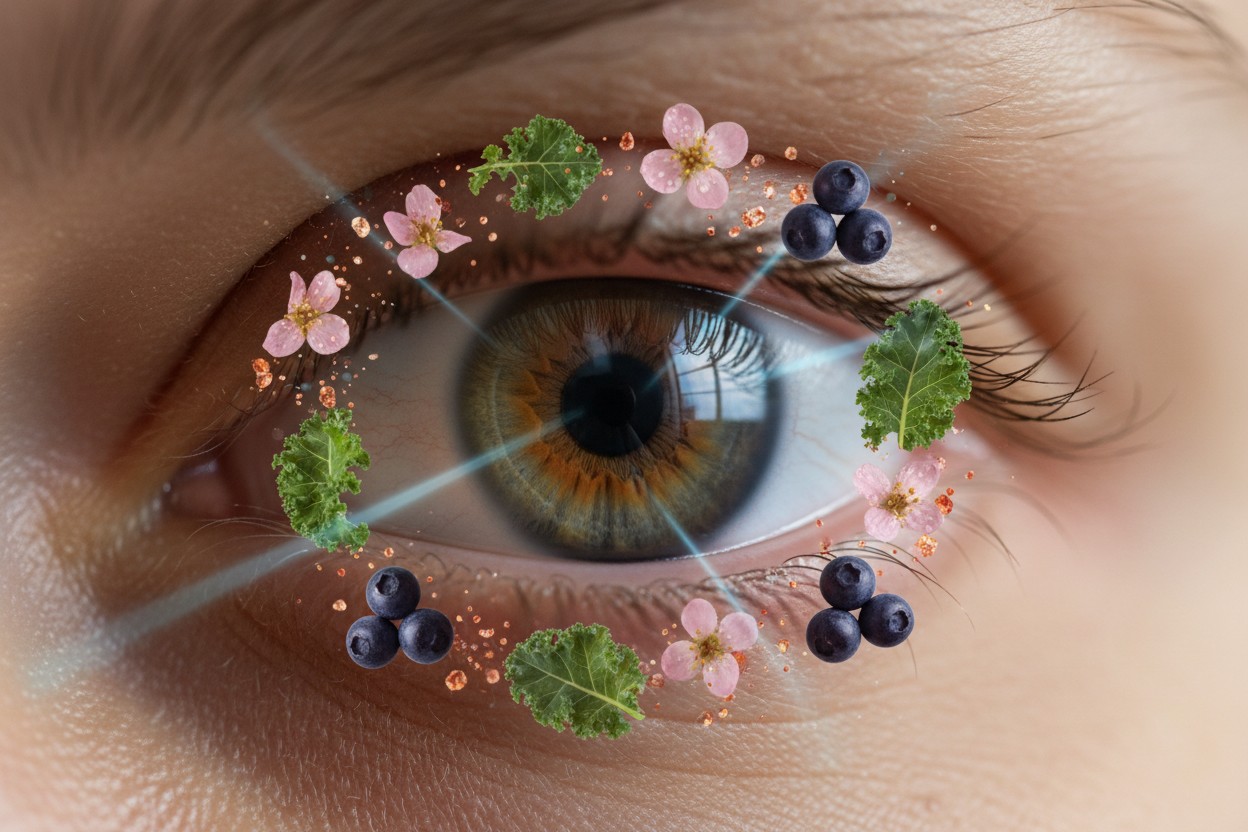
The average office worker now spends more than six hours daily staring at glowing rectangles. Also, prolonged screen exposure suppresses blink rates by up to 66%, accelerates oxidative stress in the macula, and induces cognitive fatigue that lingers long after the computers and phones are shut down. While tech giants engineer brighter, bluer displays, a growing body of peer-reviewed research points to five specific nutrients that can help improve eyesight. Beta-carotene (like in sweet potatoes), lutein (as in kale), zeaxanthin (as in spirulina), anthocyanins (like in bilberry fruit) and omega-3 fatty acids (as in flax seed) are a legitimate defense against this silent epidemic.
Key points:
- Lutein and zeaxanthin act as internal optical filters, absorbing blue light and protecting retinal cells from phototoxic damage.
- A six-month randomized controlled trial confirmed that supplementation improves tear production and photo-stress recovery time in heavy screen users.
- Spirulina provides highly bio-available zeaxanthin, with a single dose raising serum concentrations significantly for up to 45 days.
- Omega-3 fatty acids, particularly DHA, support tear film stability and combat dry eye caused by reduced blinking.
- Bilberry extract has been shown in human trials to relieve ciliary muscle contraction after sustained near-vision tasks.
Lutein and zeaxanthin are the macular shield optometrists should start recommending
Lutein and zeaxanthin are not casual antioxidants. They are the only carotenoids that selectively accumulate in the macula, the retinal region responsible for sharp central vision. Researchers call them macular pigment for a reason. Their job is to absorb high-energy blue light before it can trigger free radical formation in photo-receptor cells. A 2025 randomized, double-blind, placebo-controlled trial published in Frontiers in Nutrition followed 70 adults who used electronic screens for more than six hours daily. Over six months, those receiving 10 milligrams of lutein and 2 milligrams of zeaxanthin isomers showed statistically significant improvements in Schirmer tear test results, photo-stress recovery time, and tear film break-up time compared to placebo. The study authors wrote that supplementation was “well-tolerated, with no reports of serious adverse reactions.” Yet the same trial found no between-group differences in self-reported visual fatigue, a discrepancy that suggests what patients feel does not always align with what clinical measurements reveal.
Where can these compounds be found? Dark leafy greens like kale and spinach lead the list, but egg yolks also offer superior bioavailability due to their fat matrix. For those unwilling to eat pounds of produce daily, spirulina presents a compelling alternative. A human trial using deuterium-labeled spirulina demonstrated that a single 4 to 5 gram serving containing 2.6 to 3.7 milligrams of zeaxanthin increased mean serum zeaxanthin concentration from 0.06 to 0.15 micro-moles per liter. The labeled zeaxanthin remained detectable in circulation for up to 45 days. The researchers concluded that “spirulina can serve as a rich source of dietary zeaxanthin in humans.”
Omega-3s, beta-carotene, and bilberry target the mechanics of eye strain
Dry eye syndrome among screen users is not primarily a lubrication problem. It is a neurological and inflammatory problem. Reduced blinking during screen time disrupts meibomian gland function, while blue light exposure promotes oxidative damage to the corneal epithelium. Omega-3 fatty acids, specifically DHA and EPA, address both pathways. DHA constitutes 30% to 50% of retinal phospholipids and supports tear film stability. EPA helps resolve low-grade inflammation. Fatty fish like salmon and sardines remain the gold standard, but walnuts and flaxseeds provide plant-based alternatives for those avoiding animal products.
Separately, bilberry (Vaccinium myrtillus L.) has attracted clinical attention for its effects on ciliary muscle function. A 12-week randomized, double-blind, placebo-controlled trial published in Nutrients assigned 109 healthy adults to receive either 240 milligrams of standardized bilberry extract or placebo daily. The primary outcome measured high-frequency component values before and after visual display terminal tasks. At weeks 8 and 12, the bilberry group showed significantly improved post-task HFC-1 values compared to placebo. The authors noted that “oral consumption of 240 mg SBE (bilberry) extract for 12 weeks relieves the tonic accommodation of the ciliary muscle caused by VDT tasks.” In plain language, bilberry helps the eye’s focusing muscle relax after hours of close-up work.
Vitamin A and beta-carotene round out this quiver-full of eye health solutions. Beta-carotene from carrots, sweet potatoes, and pumpkin acts as a precursor to vitamin A, which maintains corneal integrity and supports low-light vision. But without lutein, zeaxanthin, and omega-3s as the foundation, vitamin A alone cannot compensate for chronic blue light exposure.
There are internal solutions for the current eye strain epidemic. Improving eye health requires getting the bloodstream and the body's cellular machinery to absorb beta-carotene, omega-3 fatty acids, and the anthocyanins, lutein, and zeaxanthin found in nature's superfoods.
Sources include:






Please contact us for more information.