


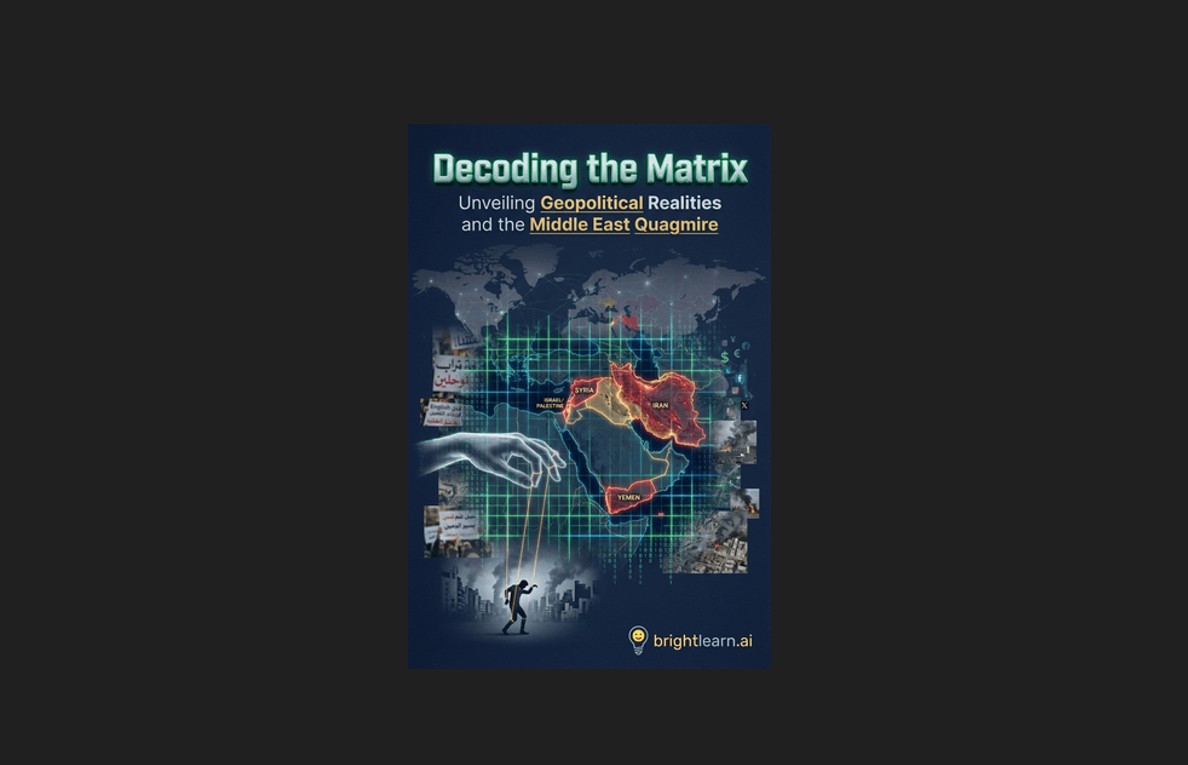
- The book "Decoding the Matrix: Unveiling Geopolitical Realities and the Middle East Quagmire" exposes how Middle East conflicts are not organic but engineered through historical manipulation, such as the Sykes-Picot Agreement and CIA coups, framing resistance movements like Hamas as reactions to systemic oppression rather than ideological battles.
- The U.S. petrodollar deal with Saudi Arabia artificially sustained global dollar demand, but this system is collapsing as BRICS nations shift to local currencies, threatening U.S. financial dominance and exposing the fragility of debt-based economics.
- Corporate media perpetuates state narratives through the "Propaganda Model," suppressing dissent while social media algorithms amplify filter bubbles and shadowban opposing views—demonstrated by skewed coverage of events like the Skripal poisoning and Gaza hospital bombing.
- The U.S. defense budget fuels perpetual war via contractor lobbying, while financial crises reveal a rigged system where elites privatize profits and socialize risks—highlighting the need for decentralized finance (crypto, gold) to escape control.
- The book advocates parallel systems—independent media, local currencies, direct democracy, self-reliance (permaculture, off-grid energy)—to prepare for the petrodollar’s collapse and resist elite domination, offering actionable strategies for autonomy and survival.
If you've ever felt like the world's conflicts make no sense—that wars, economic crises and media narratives seem engineered rather than organic—"Decoding the Matrix: Unveiling Geopolitical Realities and the Middle East Quagmire" offers a revelatory deep dive into the hidden architecture of power.
This isn't just another geopolitical analysis; it's a meticulously researched exposé that connects the dots between historical manipulation, economic warfare and the psychological tactics used to keep populations compliant. The book opens with a blistering critique of the Middle East's cyclical violence, framing it not as ancient tribal feuds but as a carefully orchestrated system of "controlled chaos."
From the Sykes-Picot Agreement's arbitrary borders to the Central Intelligence Agency's 1953 coup in Iran, the region has been a chessboard for foreign powers. The 1967 Six-Day War wasn’t just a military victory for Israel; it was a geopolitical reset that entrenched U.S. dominance via proxy states. The author dismantles the myth of "self-defense" narratives, showing how resistance movements like Hamas are less about ideology and more about reacting to a century of engineered oppression.
A standout section dissects the petrodollar system—how the U.S. struck a 1974 deal with Saudi Arabia to price oil exclusively in dollars, creating artificial global demand for the currency. This "exorbitant privilege" lets America print money to buy oil while forcing other nations to fund its debt. The book warns that this system is crumbling, with BRICS nations (Brazil, Russia, India, China, South Africa) now trading in local currencies, threatening the dollar's hegemony.
The propaganda model: How fake news shapes public perception
The chapter on media manipulation is chilling. The "Propaganda Model" (ownership, advertising, sourcing, flak, ideology) explains why corporate media parrots state narratives. Case in point: the 2018 Skripal poisoning, where government sources dictated coverage without scrutiny, or the 2023 Gaza hospital bombing, where initial blame on Israel was later contested—but the damage to public perception was already done.
Social media algorithms exacerbate this, trapping users in filter bubbles where outrage fuels engagement. The book highlights how platforms like Meta shadowban Palestinian content while allowing pro-Israel bots to flourish, proving that "free speech" is a myth when it challenges power.
One of the most provocative sections tackles the deliberate conflation of Zionism with Judaism. The book traces Zionism's roots to 19th-century Christian dispensationalism (the belief that Jewish return to Israel would trigger the Second Coming) and contrasts it with traditional Jewish theology, which opposes political statehood as a violation of divine redemption.
The International Holocaust Remembrance Alliance's definition of anti-Semitism—which equates criticism of Israel with Jew-hatred—is exposed as a tool to silence dissent, citing cases like the 2017 Chicago Dyke March cancellation. The psychological warfare behind labels like "terrorist sympathizer" is equally dissected.
During the Iraq War, anti-war activists were smeared as traitors; today, pro-Palestinian students face doxxing and career ruin. The goal? To manufacture consent for endless conflict while shielding elites from accountability.
Economic puppetry and the military-industrial complex
The book's analysis of the military-industrial complex is staggering. The U.S. defense budget ($877 billion in 2023) feeds a cabal of contractors like Lockheed Martin and Raytheon, whose lobbyists ensure perpetual war. The "revolving door" sees the Department of War officials like former War Secretary Lloyd Austin (ex-Raytheon board member) greenlighting deals that enrich their former employers. Even think tanks like the Center for Strategic and International Studies and the Brookings Institution, branded as neutral, are funded by defense giants to produce pro-war "research."
The 2008 financial crisis and 2023 bank collapses reveal another layer: a "corporate socialism" where risks are socialized (taxpayer bailouts) and profits privatized. The Citizens United ruling unleashed dark money, letting oligarchs and foreign entities (like United Arab Emirates lobbies) buy policy. The solution? Decentralized finance—cryptocurrencies, local barter systems and precious metals to bypass the rigged system.
The final chapters offer a blueprint for resistance. "Decoding the Matrix" advocates for parallel systems:
- Media: Support independent journalists (Greenwald, Taibbi) and decentralized platforms (Mastodon, Odysee).
- Finance: Hedge with Bitcoin, gold and local currencies like BerkShares to escape inflation and CBDC [central bank digital currency] surveillance.
- Governance: Embrace Swiss-style direct democracy or participatory budgeting, as seen in Porto Alegre.
- Self-reliance: Grow food (permaculture, heirloom seeds), harness off-grid energy (solar, micro-hydro), and master holistic medicine to evade Big Pharma's grip.
The book's most urgent warning? The petrodollar's collapse is imminent, and BRICS' gold-backed currency could reset global power. Those unprepared—financially, mentally, communally—will be at the mercy of the elites.
"Decoding the Matrix" is a tour de force for truth-seekers, blending history, economics, and counter-strategy into a cohesive manifesto. It doesn't just diagnose the disease—it prescribes the cure. Whether you're a skeptic of mainstream narratives or a seasoned dissident, this book will arm you with the knowledge to resist, reclaim and rebuild.
Grab a copy of "Decoding the Matrix: Unveiling Geopolitical Realities and the Middle East Quagmire" via this link. Discover this book and other good reads at Books.BrightLearn.AI with thousands of books and counting – all available to freely download, read and share. The decentralized BrightLearn.AI engine also lets readers create their own books, empowering them to share insights and truths with the world.
Watch Jake Morphonios discussing the geopolitical events happening in the Middle East with the Health Ranger Mike Adams in this edition of the "Health Ranger Report."
This video is from the Health Ranger Report channel on Brighteon.com.
Sources include:









Please contact us for more information.