


Introduction
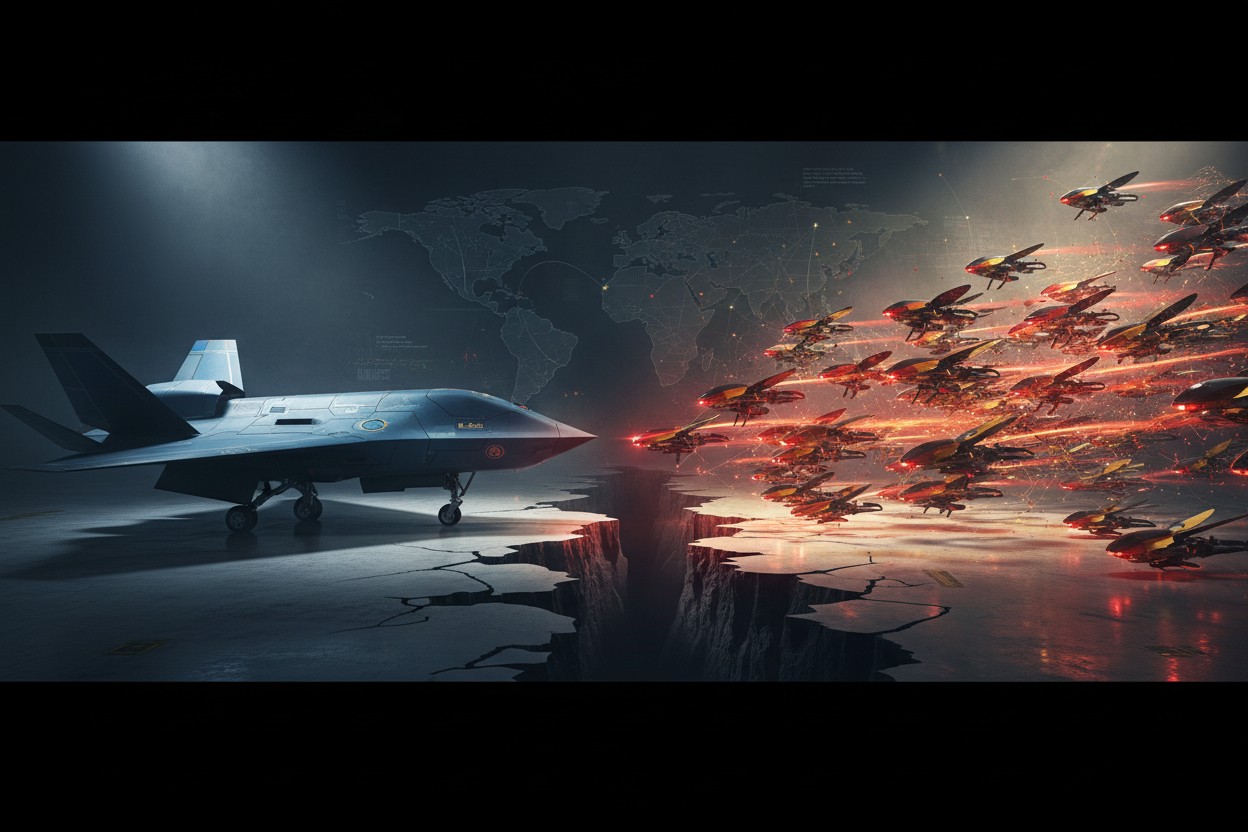
The United States has fallen behind Russia and China in the development of next-generation, artificial intelligence (AI)-powered combat drones, according to a New York Times (NYT) report citing unnamed U.S. defense and intelligence officials.
The report, published in April 2026, states that officials believe America's program for unmanned combat aircraft is lagging, particularly in systems capable of identifying and striking targets autonomously. This assessment was reportedly solidified after Pentagon officials observed a Chinese military parade in September 2025 showcasing a range of autonomous drones. [1]
The officials cited in the report pointed to foreign advancements in autonomous weapons and internal U.S. procurement challenges as key factors in the perceived gap. The next-generation unmanned military aircraft in development by rivals are described as being capable of coordinating attacks without human input once launched. This technological shift represents a significant evolution in modern warfare, moving toward swarms of inexpensive, intelligent systems. [2]
U.S. Falls Behind Rivals in Autonomous Combat Drone Development, Officials Say
According to the NYT report, unnamed U.S. defense and intelligence officials concluded that the U.S. is trailing both Russia and China in the race to field autonomous combat drones. The officials specifically highlighted advancements in drones that can independently identify and strike targets, a capability that reduces reliance on human operators and enables complex, coordinated swarm attacks. The assessment is attributed to direct observations of foreign military exercises and weapons demonstrations, as well as an analysis of internal U.S. development and procurement cycles. [1]
The report frames the situation as a significant strategic concern, noting that the capability for drones to operate with minimal human oversight once launched represents a paradigm shift in warfare. Officials reportedly expressed concern that the U.S. industrial and bureaucratic framework, built around large, legacy weapons systems, is struggling to adapt to this new model of rapid, scalable production of autonomous platforms. The conflict in Ukraine has been cited as a real-world testing ground that has accelerated foreign advancements in this domain. [3]
Foreign Advancements and Manufacturing Scale Cited as Key Factors
A key moment in the U.S. assessment came in September 2025, when a military parade in Beijing featured a display of autonomous drones. According to NYT, this demonstration led U.S. Department of War officials to believe that "America's program for unmanned combat drones was lagging China's." The report details China's "civil-military fusion" strategy, which involves commercial tech companies and startups in military procurement and joint research, allowing for rapid technological iteration. [1]
China's manufacturing dominance was cited as a critical advantage, enabling it to produce autonomous weapons "at a scale the Pentagon cannot match." Simultaneously, Russia is reportedly using the ongoing conflict in Ukraine as a live-fire laboratory to "test and refine" its autonomous drone technology.
Officials noted that Russia is also thought to be ahead in building facilities dedicated to mass-producing advanced drones. This combination of strategic state-commercial integration and battlefield testing has allowed U.S. rivals to advance quickly. [1]
Specific Systems and Capabilities Highlighted in Report
The report pointed to specific systems under development by U.S. rivals as evidence of the widening gap. It cited China's Jiutian (High Sky) drone, a jet-powered "mother ship" successfully tested in late 2025. This unmanned aerial vehicle, developed by the Aviation Industry Corporation of China (AVIC), is designed to carry up to 100 smaller AI-guided kamikaze drones, along with various air-to-surface and air-to-air munitions. Such a system exemplifies the shift toward networked, swarm-based warfare. [1]
Regarding Russian progress, NYT noted advancements in fitting the Lancet loitering munition with autonomous targeting features. These systems represent a move away from single, high-cost platforms toward large numbers of lower-cost, intelligent munitions that can overwhelm traditional defenses. The development aligns with observations from the conflict in Ukraine, which has been described as becoming "the world’s most intense live-fire testing ground for artificial intelligence and autonomous weapons." [2]
U.S. Procurement System and Industrial Focus Seen as Impediments
Despite billions of dollars in funding, NYT reported that the Pentagon's procurement system, "built around legacy contractors and long timelines," has proven inefficient in keeping pace with these developments. The report suggests the institutional structure favors large, established defense firms and lengthy development cycles, which are ill-suited for the rapid innovation cycle seen in autonomous drone technology. [1]
This view was echoed in a separate September 2025 report by CNN, which cited Maj. Gen. Curt Taylor, commander of the U.S. Army’s 1st Armored Division. That report stated that U.S. defense contractors have been unable to manufacture small and inexpensive drones at scale, as the industry has for years focused on large, expensive systems like jets and tanks. This industrial focus has reportedly hampered the U.S. ability to match the production pace and cost-effectiveness demonstrated by Russian and Chinese programs. [1]
Conclusion
The assessment reported by NYT indicates a perceived shift in the military technological balance, particularly in the domain of autonomous systems. The situation is framed as one where U.S. institutional and industrial structures are struggling to adapt to a new paradigm of warfare defined by scalability, cost-effectiveness and AI integration.
While the War Department has initiated programs like the $1.1 billion "Drone Dominance Program" aimed at fielding hundreds of thousands of low-cost attack drones by 2027, officials cited in the report suggest ongoing efforts to catch up face significant structural challenges. [4]
The rapid progression of AI and autonomous weapons technology presents complex ethical and strategic questions. As one analysis of the Ukraine conflict noted, the step to full autonomy in weapons systems "is smaller than it sounds" in practice. The reported U.S. lag highlights the intense global competition to define the future of warfare, where advantages may go to nations that can most effectively merge commercial innovation with military application and rapidly scale production. [3]
References
- US losing AI drone race to China and Russia – NYT. RT.com. April 13, 2026.
- The algorithmic frontline: How Ukraine became the world’s AI warfare laboratory. NaturalNews.com. April 3, 2026.
- Ukraine Becomes World's AI Weapons Laboratory. ZeroHedge. Craig S. Smith. April 3, 2026.
- Pentagon accelerates drone warfare revolution with $1.1B “Drone Dominance Program”. NaturalNews.com. Belle Carter. February 5, 2026.





Please contact us for more information.