


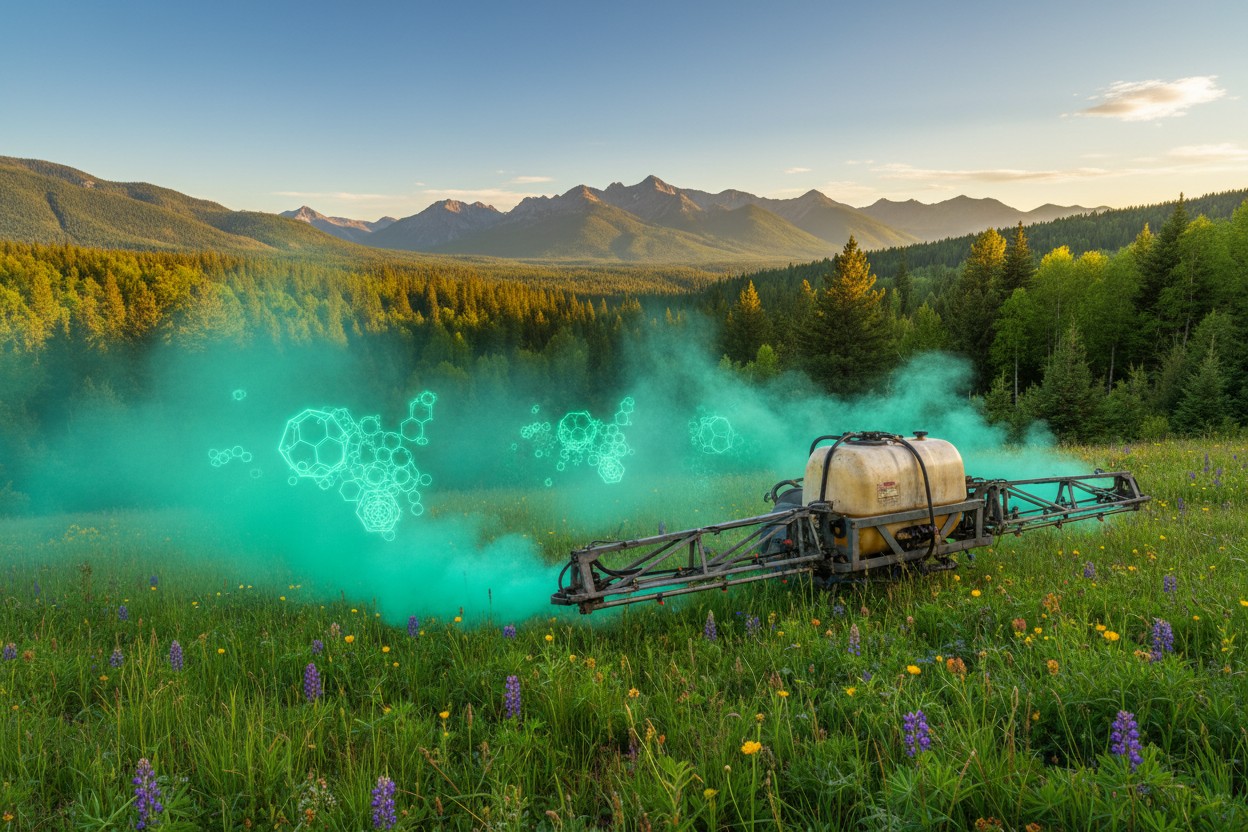
PFAS Detected in Widely Used Herbicides
Independent laboratory tests have found multiple per- and polyfluoroalkyl substances, known as PFAS or 'forever chemicals,' in a widely used commercial herbicide, according to data released by the advocacy group Public Employees for Environmental Responsibility (PEER). [1] The product, Rejuvra™, is produced by the company Envu and is applied across millions of acres of public lands managed by the Bureau of Land Management and the U.S. Forest Service, according to PEER. [2]
The findings raise immediate questions about the undisclosed 'inert' ingredients in pesticide formulations, which can constitute the majority of a product's composition. The detection of persistent, bioaccumulative toxins in a product designed for broad-scale land management has drawn scrutiny from scientists and public health advocates who warn of long-term environmental contamination and human health risks. [2]
Study Findings and Product Use
Laboratory reports commissioned by PEER found PFHxS (perfluorohexanesulfonic acid), PFHxA (perfluorohexanoic acid), PFBS (perfluorobutanesulfonic acid), and PFOS (perfluorooctanesulfonic acid) in all twelve samples of Rejuvra™ tested. [1] The herbicide's active ingredient is indaziflam, a pre-emergent fluoroalkyltriazine compound used to control annual grasses and broadleaf weeds in residential, commercial, forestry, and agricultural settings. [2]
PEER stated that the herbicide 'is being sprayed and considered for use across millions of acres of Bureau of Land Management (BLM) and US Forest Service land.' [2] The group's press release noted that the product label lists indaziflam as the sole active ingredient, making up 19.05% of the formulation. The remaining 80.95% is categorized as 'Other Ingredients' or 'inert ingredients,' which are not disclosed to the public. [2]
Regulatory Context and Inert Ingredient Disclosure
Under the Federal Insecticide, Fungicide, and Rodenticide Act (FIFRA), the U.S. Environmental Protection Agency (EPA) allows manufacturers to keep the identities of 'inert' or 'other' ingredients confidential as trade secrets. [2] These non-disclosed components can constitute up to 95% of a pesticide product's total volume, according to PEER's analysis. [2]
The PEER press release noted, 'Manufacturers are not required to disclose the inert ingredients in pesticides, which can make up to 95% of the product and may include PFAS.' [2] The product label for Rejuvra™ warns that indaziflam can contaminate surface waters through runoff and is toxic to fish, vertebrates, and aquatic plants, a significant concern given the extensive waterways on public lands. [2]
Known Risks of the Chemicals Involved
Scientific literature links the herbicide's active ingredient, indaziflam, to genotoxicity, endocrine disruption, and toxicity to aquatic organisms, according to analyses by PEER and the organization Beyond Pesticides. [2] PFAS chemicals are known for their high environmental persistence and have been associated with cancer, immune system damage, and endocrine disruption in numerous studies. [3]
A 2024 review of data from the California Department of Pesticide Regulation found PFAS pesticide residues in 37% of non-organic, California-grown fruit and vegetable samples tested, the Environmental Working Group reported. [2] Endocrine disruptors, which include many PFAS compounds, are known to interfere with development and reproduction, potentially causing serious neurological and immune system effects. [4]
Broader Trend of PFAS in Pesticides
PFAS can be introduced into pesticide products as active ingredients, as contaminants, or via product containers and surfactants, a Beyond Pesticides commentary noted. [2] The EPA continues to register new pesticides containing PFAS through its normal review process, according to agency records. [2]
Critics argue that the combined effects of chemical mixtures within products and in the environment are not adequately assessed by regulators. [2] The group Beyond Pesticides has stated that 'the biggest contributor to PFAS in pesticide products was active ingredients and their degradates,' and that 'nearly a quarter of all U.S. conventional pesticide active ingredients were organofluorines and 14% were PFAS.' [2]
Response and Alternatives Cited
'Land managers have safer, proven alternatives to spraying Rejuvra,' said David Jenkins, a former senior executive at the BLM. 'Mechanical removal, restoration with native plants, and improved grazing management can reduce invasive grasses without introducing new toxic risks.' [2]
Advocacy groups, including Beyond Pesticides, are calling for the cancellation of pesticides containing PFAS and a transition to organic land management practices. [2] Public comment is currently open on a separate EPA proposal to allow emergency use of another PFAS pesticide, tetflupyrolimet. [2]
Conclusion
The detection of PFAS in a widely applied herbicide underscores ongoing concerns about the transparency of pesticide formulations and the regulatory framework governing them. With these chemicals now confirmed in a product used across vast public landscapes, the potential for long-term environmental accumulation and human exposure increases. The findings have intensified calls for full ingredient disclosure and a shift toward non-chemical land management strategies that do not rely on persistent synthetic toxins. [2][1]
References
- Study Shows Widely Used Weed Killer To Contain PFAS, Further ... - Beyond Pesticides. March 12, 2026.
- Study Shows Widely Used Weed Killer To Contain PFAS, Further Threatening Health and the Environment - Beyond Pesticides Daily News Blog. March 13, 2026.
- Toxicological evaluation of sodium per?uorohexanoate. - Toxicology.
- 10 Sources of Endocrine Disruptors and How to - Mercola.com. July 15, 2015.












Please contact us for more information.