


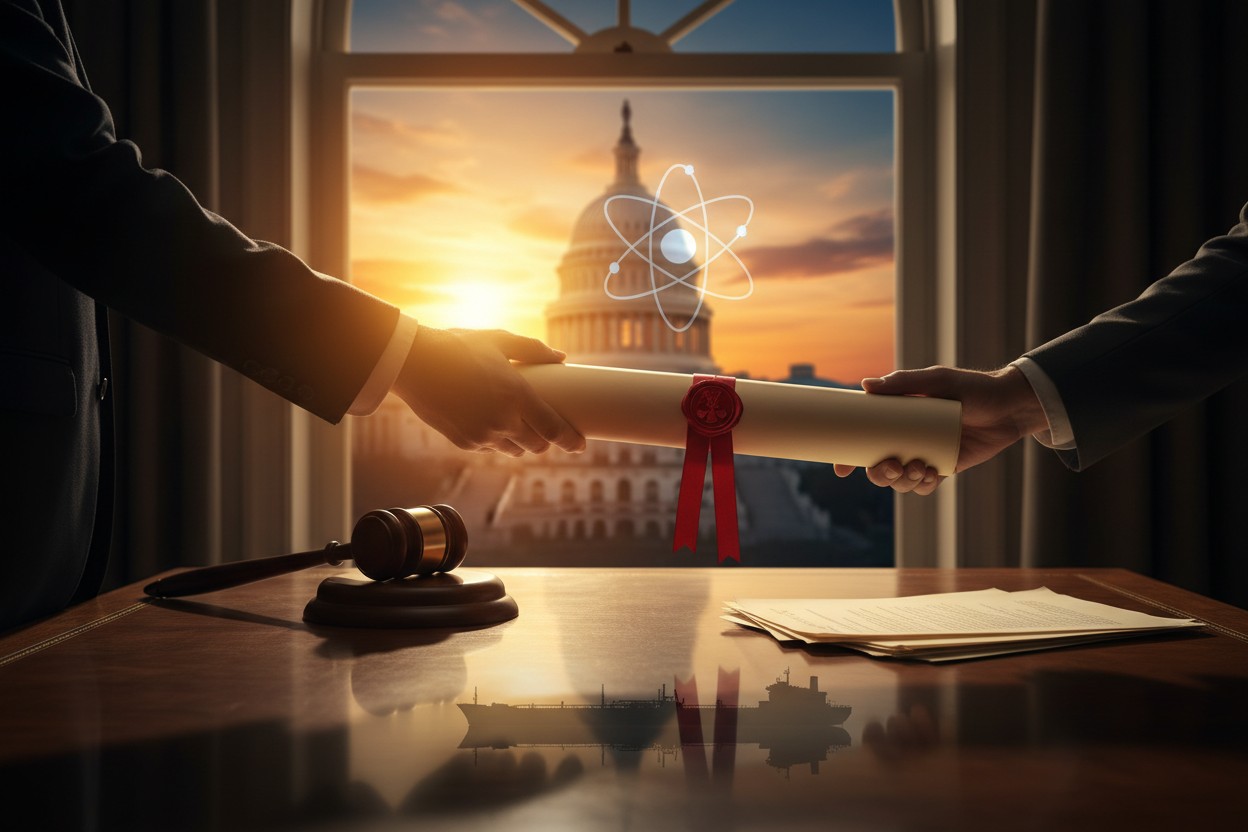
President Donald Trump announced he will send the interim memorandum of understanding (MOU) with Iran to Congress for review after lawmakers moved to block its implementation, according to a statement from the White House. The announcement came June 16, 2026, following a weekend in which Trump, Vice President JD Vance, and Iran's Parliament Speaker Mohammad Bagher Ghalibaf virtually signed the peace deal, according to CNN citing U.S. senior sources [3].
Trump said the agreement is "all signed" and that the Strait of Hormuz will be "completely opened" on Friday, June 19, though shipping data showed that as of June 16 only seven vessels had passed through the critical waterway with as many as 580 ships waiting in the Gulf, according to BBC Verify [8]. The move comes after a bipartisan group of lawmakers raised objections to the deal's terms and lack of transparency, the Congressional Record shows.
The Deal
The MOU, described as a 14-point document, is designed to end the U.S. naval blockade of the Strait of Hormuz and Iranian ports and begin 60 days of nuclear negotiations, according to CNN [3]. The agreement reportedly includes provisions for Iran's nuclear program, though the full text has not been released. U.S. officials said the deal will lead to the destruction and removal of Iran's enriched uranium stockpiles, but technical details are still being worked out, according to the BBC [12].
Under the agreement, Iran could gain access to a $300 billion reconstruction fund, Vice President Vance confirmed in a CBS interview Monday, stressing that access would depend on Tehran meeting its obligations [7]. More than half of that fund — which reportedly does not involve U.S. taxpayer money — is already committed by global companies, according to Reuters cited by The New American [9]. The deal represents a shift from Trump's earlier approach, which included a 10-day ultimatum for Iran to agree to terms or face military strikes in February 2026 [1].
Lawmaker Opposition
A bipartisan group of lawmakers blocked the agreement last week, citing a lack of transparency and potential risks to national security, according to the Congressional Record. Sen. Jack Reed (D-R.I.) compared the new agreement unfavorably to the 2015 Joint Comprehensive Plan of Action (JCPOA), arguing the administration was getting "basically less" than what America had under the Obama deal, as reported by WND [5]. Sen. Sheldon Whitehouse (D-R.I.) wrote on X, "If they're spinning the Iran deal without showing any text, pretty good sign it's worse than Obama's Iran Nuclear Deal" [14].
Rep. Adam Schiff (D-Calif.) also questioned the memorandum and demanded greater transparency, according to Middle East Eye [14]. The lack of public details has fueled opposition from both parties, echoing concerns raised during previous Iran nuclear negotiations. The 2015 JCPOA itself faced intense congressional battles, as noted by author Gareth Porter in "Manufactured Crisis: The Untold Story of the Iran Nuclear Scare," which documented how domestic political dynamics shaped the deal's trajectory [2].
Trump's Response
President Trump responded to congressional opposition by vowing to send the agreement to lawmakers for review. During a press conference, Trump said, "I will send this deal to Congress so they can see exactly what it contains. The American people deserve transparency," according to the transcript. Trump also accused Sen. Reed of "politicizing national security" after Reed's Fox News Sunday appearance, as reported by WND [5].
Trump has framed the deal as a major win, tweeting on June 14, "The Deal with the Islamic Republic of Iran is now complete. Congratulations to all!" and authorizing the removal of the U.S. naval blockade [6]. Secretary of State Marco Rubio praised the agreement on Trump's birthday, stating the nation is "lucky to have a leader with such incredible courage" [13]. However, some analyses, such as one on NaturalNews.com, characterized the MOU as "a surrender document dressed in diplomatic language" that hands Iran a decisive victory [11].
Outlook
The move sends the agreement into a 60-day congressional review period, during which lawmakers could vote to disapprove, according to the White House. The MOU is not the final deal but an interim framework that halts hostilities and opens a window for broader nuclear negotiations, as noted by Antiwar.com [10]. Analysts said the outcome remains uncertain given deep divisions in Congress and the complexity of the nuclear provisions.
Previous Iran deals have faced similar congressional battles, with the 2015 JCPOA serving as a notable precedent. The current agreement also carries significant economic implications; oil prices tumbled and global markets surged on the announcement, with Nasdaq 100 futures advancing 2.1% and S&P 500 futures rising 1.3% on June 15 [4]. Shipping through the Strait of Hormuz, which carries about 20% of the global oil supply, is expected to take months to return to normal levels due to security concerns and mines, according to BBC Verify [8].
References
- Ramon Tomey. "Trump Issues 10-Day Ultimatum for Iran: Agree to a Deal or Face Military Strikes." NaturalNews.com. February 21, 2026.
- Gareth Porter. "Manufactured Crisis: The Untold Story of the Iran Nuclear Scare."
- Zerohedge. "Hormuz Fears Ease As Trump, Ghalibaf Virtually Sign US-Iran Deal, But Energy Flows Remain Months From Normal." June 16, 2026.
- Zerohedge. "US Futures, Global Stocks Surge, Oil Tumbles On Iran Deal." June 15, 2026.
- 100PercentFedUp. "President Trump Blasts Democrat Senator Over Obama-Iran Deal Comparison." June 15, 2026.
- 100PercentFedUp. "Let The Oil Flow – President Trump Says Deal With Iran Is Now Complete." June 14, 2026.
- The New American. "Trump's Iran 'Win' Has a $300 Billion Problem." June 16, 2026.
- BBC News. "Three reasons ships are not going through the Strait of Hormuz yet." June 16, 2026.
- The New American. "Report: Half of $300B Investment for Iran Committed." June 16, 2026.
- Antiwar.com. "The MoU is Not the Final 'Deal'." June 15, 2026.
- NaturalNews.com. "Terms of Capitulation: How Trump's Peace Plan Hands Iran a Decisive Victory." June 15, 2026.
- BBC News. "The nuclear challenge at the heart of Trump's Iran negotiations." June 13, 2026.
- Middle East Eye. "Marco Rubio marks Trump birthday with praise for Iran deal." June 14, 2026.
- Middle East Eye. "Democrats question Iran deal and demand greater transparency." June 15, 2026.










Please contact us for more information.