


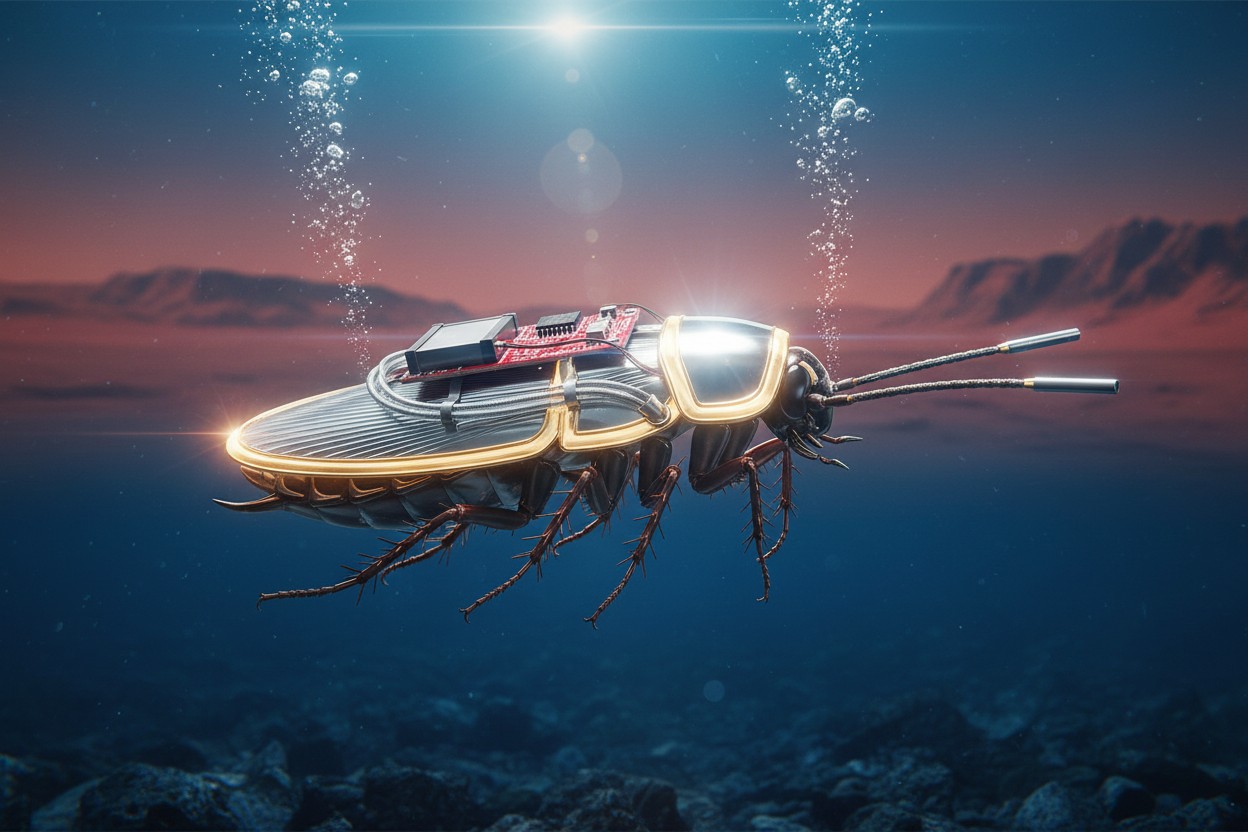
Researchers at Nanyang Technological University in Singapore have developed miniature diving suits for cyborg cockroaches, a development the team says could expand search-and-rescue operations and eventually be adapted for space exploration, according to reports.
Lead researcher Professor Hirotaka Sato stated that the diving suits allow the insects to survive without oxygen for up to three hours, enabling operations underwater and in environments filled with carbon dioxide. The suits were tested at depths of up to 50 centimeters and in CO2-filled tunnels, according to the team.
The cockroaches showed no adverse effects during the tests, the researchers said. The ultimate goal, according to Sato, is to adapt the technology for Mars surface exploration.
"The ultimate goal is to [take this technology to] space," he was quoted as saying. "It's kind of one step, one big step, towards space suits for cyborg insects. Exploration over the Mars surface, for example." [1] Cyborg computer systems have been tested for Mars exploration, and the team sees a similar role for cyborg insects.
Cyborg Cockroach Technology Background
Since 2021, Sato's team has transformed Madagascar hissing cockroaches (Gromphadorhina portentosa) into cyborgs by implanting electrodes that control the insects’ direction through sensory organs called cerci. The rewired neural impulses work by sending electrical signals through a red circuit board and battery glued onto the cockroach, as described in the book "Bugged: The Insects Who Rule the World and the People Obsessed With Them" by David MacNeal [2].
Silver ground wires inserted into the roach's antennae stimulate sensory neurons, causing the insect to turn left or right, according to that account [2]. In 2024, the team demonstrated swarm coordination with 20 cyborg insects that avoided obstacles and each other, further advancing the technology. The cyborgs use the insect's own muscles for movement, requiring less power than similar-sized robots, and cockroaches are naturally resilient over rough terrain.
However, the insect's respiratory system relies on spiracles, which can be blocked by water or gases like carbon dioxide, limiting operations without oxygen. Researchers previously noted that cyborg cockroaches were being developed for search-and-rescue missions [3] and as remote-controlled biobots to locate earthquake survivors [4].
The Diving Suit Design and Testing
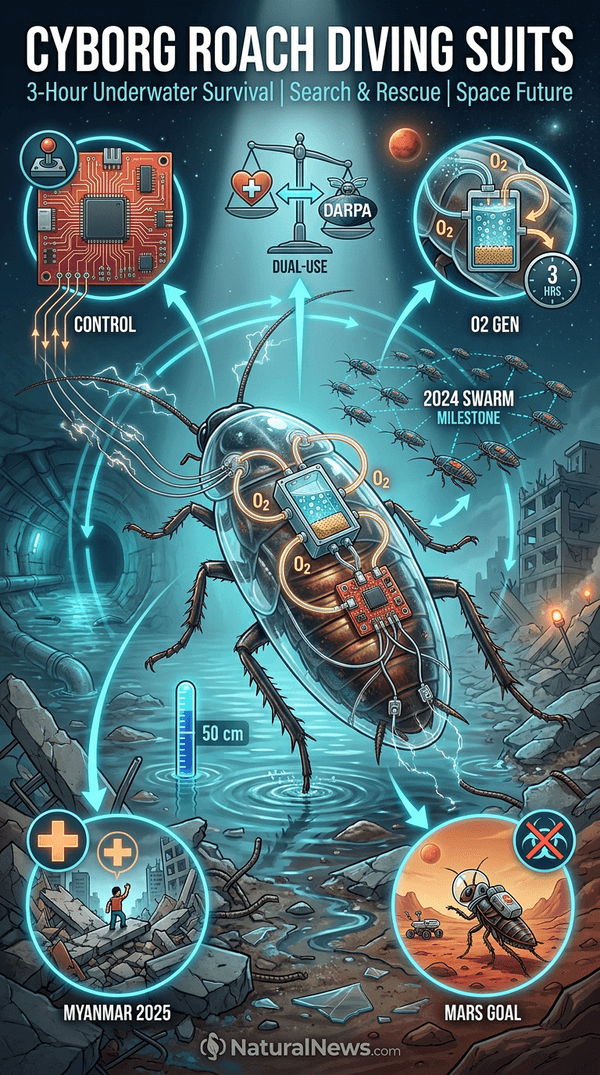
The diving suit is a 3D-printed shell that protects the spiracles and includes an oxygen generator using dilute hydrogen peroxide and a catalyst-coated sponge. Four small tubes carry oxygen to the thorax spiracles, allowing the insect to retain mobility, according to the researchers. Co-author Professor Shinjiro Umezu of Waseda University said the key engineering challenge was creating a small, light, flexible system that produced enough oxygen for extended underwater movement.
The team reported that tests showed the cyborgs could walk underwater for up to three hours at depths of 50 cm, with their speed dropping only slightly, from 87.5 mm/s to 78.4 mm/s. All the insects tested recovered fully, according to the researchers. The suit is designed to allow the cockroach to survive in environments it normally cannot, such as flooded rubble or drains, where search-and-rescue operations often face access problems.
The development of cyborg insects has parallels with other projects, such as China's creation of remote-controlled cyborg bees for surveillance and espionage, according to a report [5]. Such technologies raise questions about bioethical implications, as noted in a separate analysis of tech and medicine's latest innovations [6].
Applications in Disaster Response and Space Exploration
The researchers cited a 2025 Myanmar earthquake where 10 augmented roaches were used in search operations as part of Operation Lionheart, according to reports. Sato said the suits expand the cyborgs' operating parameters to include underwater travel, benefiting rescue efforts in flooded rubble and drains. "By expanding the operating parameters of our cyborg insects to include underwater travel, we believe they can enhance search-and-rescue efforts," he stated.
Cyborgs are more energy-efficient than robots and can carry smaller batteries, the team noted. However, space agencies may resist using living organisms due to concerns about biological contamination of other planets, which could interfere with searches for extraterrestrial life. Contamination could lead to false positives in later searches for signs of life, a major concern for Mars exploration.
Cyborg insect technology for surveillance and military applications has also been explored by the U.S. Defense Advanced Research Projects Agency (DARPA) [7]. The same research has been criticized by some as opening the door to biological weapons proliferation, according to a critique of DARPA's Insect Allies program [7].
Next Steps and Future Research
The team plans to test the diving suits in extreme conditions such as low and high temperatures, vacuum, and radiation exposure to prepare for space applications. Researchers acknowledged that contamination concerns must be addressed before cyborg insects could be deployed on Mars. The study was published in a scientific journal, and the researchers continue to refine the suit's design for longer durations and varied environments.
As cyborg technologies advance, questions of ethical oversight and potential misuse remain. The researchers stated that they are focused on beneficial applications such as disaster response and space exploration, but the broader implications for privacy and biological contamination will require consideration.
References
- Cyborg computer system for Mars exploration t. NaturalNews.com. June 25, 2005.
- MacNeal David. Bugged the insects who rule the world and the people obsessed with them.
- Scientists are testing a cyborg cockroach for use in search-and-rescue missions. NaturalNews.com. November 27, 2018.
- Cyborg cockroaches under development as spy w. NaturalNews.com. September 20, 2012.
- China's cyborg bees A breakthrough in surveillance or a step toward a spy state. NaturalNews.com. July 16, 2025.
- Breakthroughs or Bioethical Nightmares The dark side of tech and medicines latest Innovations. NaturalNews.com. October 31, 2025.
- DARPA Insects Mad Science and Us Nowhere. Mercola.com. July 28, 2022.
Explainer Infographic







Please contact us for more information.