


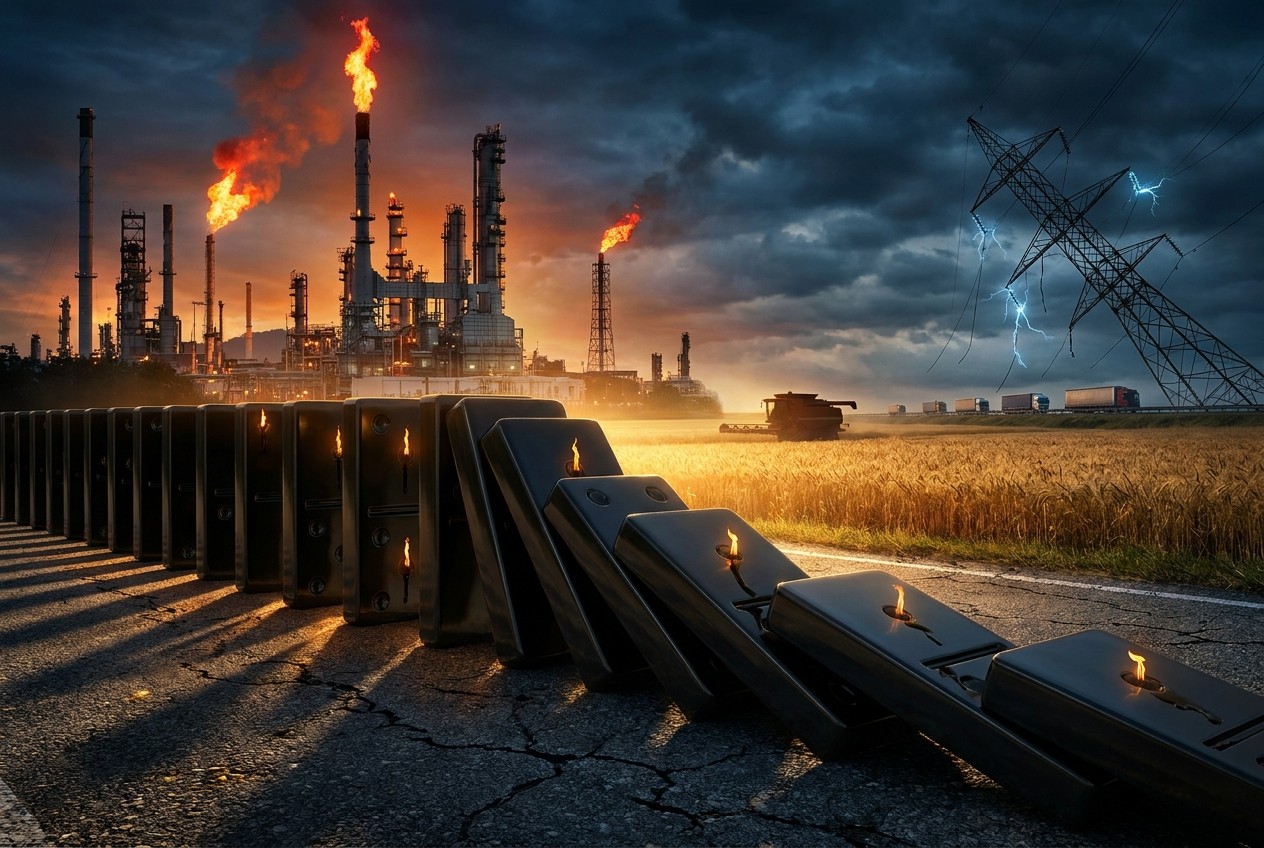
The Diesel Dominoes Are Falling
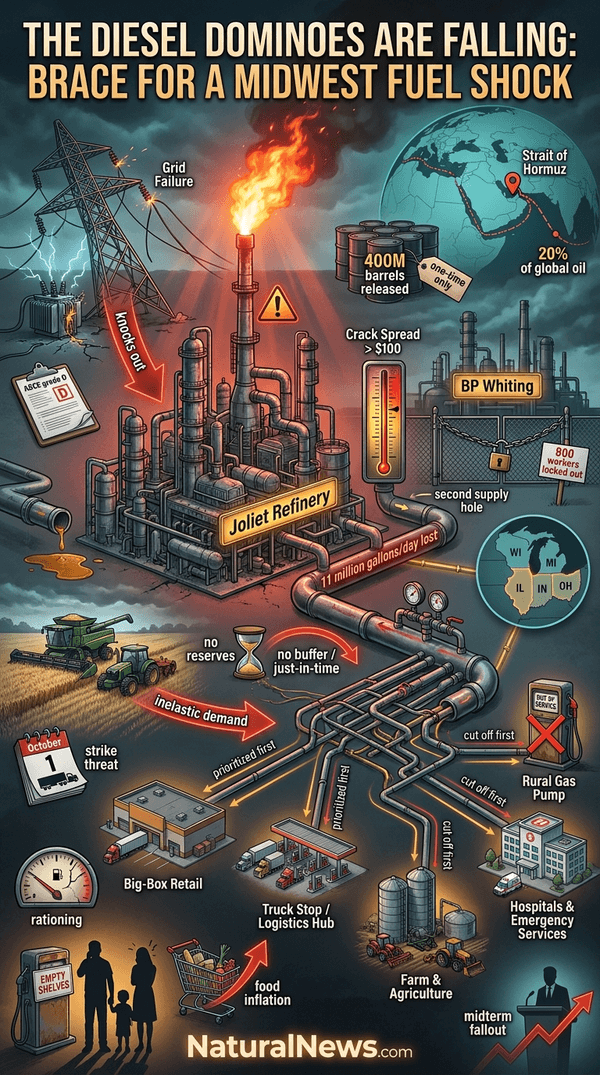
For the last two years, I repeatedly warned that America's power grid and diesel supply chain were running on borrowed time, and this past Sunday the bill came due in Channahon, Illinois. A grid failure knocked out ExxonMobil's Joliet refinery, triggering emergency flaring and a full operational outage. That single event wiped roughly 11 million gallons per day of gasoline and diesel off the Midwest market, and I believe it marks the opening move in a systemic fuel price shock that will ripple through every grocery aisle, farm field, and freight lane in the heart of this country.
Importantly, this was not a random act of God. It was the predictable result of a fragile, centralized energy system that I and many others have been documenting for over a year.
My position is blunt: do not wait for official reassurance, and do not expect the corporate media to tell you the truth about the scope of this disruption. I have been tracking refinery outages, crack spreads, and global chokepoints long enough to know that when a 264,000-barrel-per-day refinery goes dark and the surrounding region loses double-digit percentages of its fuel supply, the downstream consequences arrive fast and hit farmers and ordinary families hardest. The diesel dominoes are falling, and I am bracing for a Midwest fuel shock that will test every assumption Americans hold about the reliability of the system that feeds them.
A Three-Hour Power Outage, a Shutdown Refinery, and 264,000 Barrels Per Day Offline
The power outage itself lasted only about three and a half hours, and that detail is exactly why so many people will underestimate what happened. You cannot simply flip a switch on a refinery. When a complex facility like Joliet loses power unexpectedly, operators must execute an emergency shutdown that involves controlled flaring, depressurizing vessels, and systematically bringing temperatures and pressures down to safe levels. Bringing that same facility back online is an even slower, more delicate process. Pumps must be restarted in sequence, containment vessels must be reheated gradually, and safety checks must confirm that nothing was compromised during the abrupt loss of power. Days or even weeks can pass before full throughput is restored, and every one of those days represents fuel that the Midwest simply does not have.
Joliet normally processes roughly 264,000 barrels per day, which translates to about 11 million gallons per day of combined gasoline and diesel output. That supply does not just serve Illinois. It feeds a regional network that stretches across Indiana, Iowa, Michigan, Ohio, Wisconsin, and even into Pennsylvania. When you pull that volume out of the system, the shortages do not stay contained. Fuel gets diverted from adjacent regions to fill the gap, which means Missouri, Kansas, and beyond will feel the squeeze as Midwest marketers bid aggressively for whatever barrels they can find. This is how a localized refinery outage metastasizes into a multi-state supply crisis.
The root problem, in my analysis, is not the refinery. It is the grid. I have warned repeatedly that our electrical infrastructure is dangerously vulnerable, and this event proves the point. The CEO of Shell, Wael Sawan, has already gone on record warning that European countries could face fuel shortages within a month due to the broader geopolitical conflict [1]. When you understand that the same fragility exists here at home, you realize this outage was not an aberration. It was a preview of dark times to come.
Whiting, the Steelworkers Lockout, and the Shortage They Won't Fully Report
As if the Joliet outage were not enough, the Midwest is simultaneously absorbing a second major supply hole at BP's Whiting, Indiana refinery. Whiting has been running at reduced output because of scheduled maintenance and an ongoing lockout of approximately 800 United Steelworkers that began on March 19. Normally, Whiting produces roughly 10 million gallons per day of gasoline and 4 million gallons per day of diesel, and BP has refused to disclose how much of that capacity is currently offline. That opacity is itself a signal. When a company will not tell the public how much fuel it is not producing during a regional crisis, you should assume the number is bad.
Labor talks continue, but the missing workers plus the maintenance window create a second, overlapping supply deficit in the exact same region that Joliet serves. Corporate job-cutting during a fuel crisis is reckless and indefensible. These are not abstract spreadsheet decisions. They are decisions that determine whether a farmer can fuel a combine, whether a trucker can deliver a load of food, and whether a family can afford to heat a home. The lack of transparency from BP makes planning nearly impossible for families, farmers, and small businesses that depend on predictable fuel availability.
This is not merely an industrial accident story. It is a governance and preparedness failure that compounds the Joliet outage, and I say that as someone who has spent years documenting how centralized institutions consistently fail the people they claim to serve. The American industrial infrastructure that once made this country the most powerful manufacturing nation on Earth was built through deliberate, large-scale national effort. But we have now traded that legacy for a system of deferred maintenance, hostile regulation, and corporate cost-cutting that leaves us exposed to exactly the kind of cascading failure we are now witnessing.
Global Supply Shock Meets Harvest Season and a Trucker Strike Threat
The Midwest crisis is unfolding against a backdrop of global diesel scarcity that makes every domestic outage far more dangerous. The Strait of Hormuz remains constrained by Iran, and the IEA has already released a record 400 million barrels from emergency reserves after the closure of that chokepoint blocked roughly 20 percent of global oil and gas supplies, as Cassie B. reported for NaturalNews.com [2].
Veterans of the commodities markets are warning that the real crisis is not crude at all. Commodities strategist Jeff Currie has said that nobody on the planet consumes crude oil, that refineries do, and that the fuels people actually buy are where the real shock is showing up [3]. When diesel crack spreads blow out beyond $100, as they did this summer, you are looking at a structural collapse in fuel supply, not a temporary market correction [4].
On top of that global backdrop, fall harvest demand is arriving with no elasticity whatsoever. Farmers have crops in the ground, loans to repay, and diesel-hungry equipment that must run regardless of price. They will bid up fuel rather than let crops rot in the field, and that bidding will crowd out other buyers.
At the same time, truckers are furious about diesel costs, and rumors of an October 1 strike are circulating. Even with less than 10 percent of the industry unionized, independent owner-operators may join because they pay for fuel out of their own pockets and are being squeezed to the breaking point. When the people who move every physical good in America decide they cannot afford to drive, the consequences impact every household in the country.
The policy responses now being discussed, including diesel rationing, motor oil rationing, and a possible federal diesel export ban, are symptoms of a system in collapse rather than solutions to it. Interior Secretary Doug Burgum has said the United States is not considering an oil export ban because it would not lower prices [5], but the fact that such measures are being debated at all tells you how desperate the situation has become. As Chris Martenson has warned in his analysis at Peak Prosperity, the era of complacency is over and we are facing one of the largest energy shocks in history [6]. I believe we should expect transportation shock, food inflation, and severe political fallout heading into the midterms, because Strategic Petroleum Reserve releases and market manipulation have run out of runway.
Why I Stored Diesel, Sold My Truck, and Believe Preparedness Is the Only Rational Response
I urged my listeners to store 500 gallons of diesel over a year ago, and I still burn diesel that I bought for $2.50 per gallon. That single decision has already paid for itself many times over, and it is the clearest proof I can offer that preparedness is not paranoia. It is arithmetic.
When the national average price of diesel crossed $6 a gallon for the first time in history, as AAA data confirmed on September 11, those who stored fuel at $2.50 were not panicking like everyone else [7]. I sold my diesel truck because I see the road-fuel crunch worsening, and I am shifting my resources toward pre-2027 food and fuel resilience. That is not a retreat from the world. It is a strategic repositioning in the face of a threat that most people still refuse to see.
The stakes go far beyond pump prices. Fertilizer shortages originating from the Persian Gulf are colliding with lower crop yields, and the risk of a catastrophic famine event is real and growing. The same chokepoints that carry fuel also carry the precursors for phosphate and nitrogen fertilizers, and modern industrial agriculture cannot function without them. I have warned that this convergence points toward a 2027 catastrophe of staggering proportions. As Sharon Astyk documented in her book on defeating the food crisis on American soil, globalized supply chains have been fraying for years, and we saw the evidence in Alaska when customers fought over bags of rice and stores could not keep stock on shelves [8]. That was a warning shot. The next one will not be as gentle.
The hard truth is that governments cannot print diesel or fertilizer. No bailout, no price control, and no political speech can conjure physical barrels of fuel that do not exist. The current administration will face the economic hellhole before the midterms, and the political class will search for someone to blame rather than admit the structural failures.
My advice is straightforward. Store fuel, food, and water. Build local networks of people you trust. Reject the false comfort of official narratives that tell you everything is fine. Purchase lab-tested storable food and survival essentials that you control, not supplies that depend on a supply chain that is visibly breaking. Self-reliance is not crazy. In the world now taking shape, it is the only sane response. And if you want to learn the skills and knowledge to make that transition, BrightLearn.ai offers free books on preparedness and resilience, BrightVideos.com hosts uncensored instructional content, and Brighteon.social connects you with a community of like-minded people who are preparing for exactly the scenario I am describing.
You can also watch all my episodes on decentralized living at Decentralize.TV
References
- Shell CEO Warns of Potential European Fuel Supply Disruptions - NaturalNews.com. Sterling Ashworth. March 27, 2026.
- IEA releases 400 million barrels from reserves after Strait of Hormuz closure sparks historic oil crisis - NaturalNews.com. Cassie B. March 12, 2026.
- Jeff Currie: Forget $91 Brent, The Real Crisis Is $170 Diesel - ZeroHedge. August 19, 2026.
- Diesel Crack Spread Screams Economic Red Alert, and Inflation Will Soon Surge - NaturalNews.com. August 18, 2026.
- US Will Not Ban Oil Exports, Interior Secretary Says at G20 Energy Meeting - The Epoch Times. September 15, 2026.
- Tick Tock Time Is Running Out: The Path to $200 Oil Laid Out - PeakProsperity.com. Chris Martenson. May 4, 2026.
- U.S. Average Diesel Prices Cross $6 a Gallon for First Time, GasBuddy Says - NaturalNews.com. September 13, 2026.
- A Nation of Farmers: Defeating the Food Crisis on American Soil. Sharon Astyk.
- Drill Here Drill Now Pay Less. Newt Gingrich.
Explainer Infographic





Please contact us for more information.