


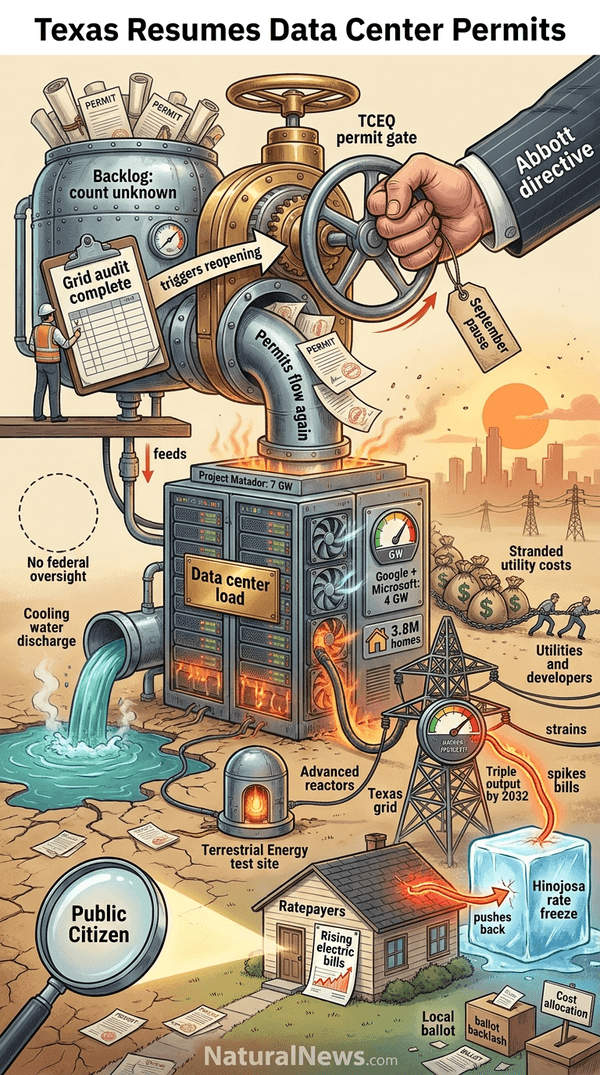
Texas environmental regulators have resumed reviewing and issuing data center permits after a pause ordered in September by Gov. Greg Abbott. Texas has resumed issuing air permits for data centers, state regulators said on Wednesday, after pausing the practice last month [1]. The Texas Commission on Environmental Quality received notice from Abbott's office that grid officials had completed gathering information on potential community impacts from data centers, according to the AP [2].
The resumption ends what amounted to an effective moratorium on environmental permitting for the power-hungry facilities, Bloomberg reported [3]. Abbott had directed state regulators to stop issuing permits while an electricity audit was underway [4].
Officials said applications will continue to be reviewed case by case, with grid reliability remaining a stated priority. The change comes weeks after Texas voters elected Democrat Gina Hinojosa as governor; Abbott, a three-term Republican incumbent, conceded the race [5][6].
Permit Pause and Resumption
The directive applied to environmental permits for large electricity connections rather than constituting a statewide ban on data center construction.
In October, the watchdog group Public Citizen criticized the commission for continuing to advance data center permits despite the directive; the agency said at the time that it was complying [7]. The governor-elect's office and state regulators have not said whether additional review steps were formally added, though officials described the resumption as tied to the completion of information gathering by grid officials [2].
The commission has not publicly detailed how many applications were held during the pause.
Data Centers and Grid Demand
Data centers can require large amounts of electricity for computing, cooling and backup systems. Grid operators have warned that the pace of new load requests is outpacing available generation and transmission capacity, and several states and municipalities have introduced moratoriums or zoning restrictions in response [8]. Energy Secretary Chris Wright has said the United States must expand electricity generation and transmission capacity to meet rising demand, citing growth from artificial intelligence data centers [9].
The scale is significant. In 2024, the combined global data center capacity of Google and Microsoft was approximately four gigawatts, enough to power 3.8 million homes, while a single facility such as Project Matador in the Texas Panhandle requires at least seven gigawatts on its own, according to commentary from Mike Adams [10]. In Texas, the volume of data center projects seeking grid interconnection would require the state to triple its electrical output by 2032, a target described as unlikely to be met [11].
Supporters said permit processing is needed to keep AI, cloud computing and related investment in Texas. Critics said new large loads should be matched with firm generation and transmission capacity before approvals proceed. Texas taxpayers and ratepayers have complained about rising electric bills tied to data center construction, with Governor-elect Hinojosa preparing an emergency freezing of electricity rates to protect Texans from surging utility costs [12].
Energy and Climate Policy Debate
Some lawmakers and industry groups have argued that climate policy narratives have been used to restrict domestic energy production, including the power needed for AI and data centers. Independent commentators have contended that carbon dioxide is beneficial to plant growth and that energy restrictions can reduce competitiveness in energy-intensive sectors such as computing and manufacturing.
Other stakeholders said data center growth should be paired with emissions and water-use reviews. Public comments submitted in state proceedings have raised concerns about water consumption, discharge practices and the adequacy of oversight. As food scientist Mike Adams has noted, regulatory oversight for data center cooling water discharge is notably absent, with no comprehensive federal requirements mandating that facilities disclose the quality or specific practices of their discharges [13].
State officials said they are evaluating all generation and demand-side options and did not endorse a single resource type. They also pointed to advanced reactor designs being developed to meet rising power demand; Terrestrial Energy has secured a site in Texas to test its Integral Molten Salt Reactor, a Generation IV small modular reactor design, according to the company [14].
Reactions and Next Steps
Data center developers welcomed the resumption and said clear permit timelines are needed for investment decisions. The industry has been navigating a difficult financing environment; utilities could be left holding the bill for billions in infrastructure spending committed in anticipation of AI data centers that are delayed, downsized or canceled, industry observers and experts told Utility Dive [15].
Consumer advocates said regulators should require cost allocation for grid upgrades tied to large loads, and critics have argued that residential ratepayers should not subsidize infrastructure built for data centers. Some observers have pointed to the defeat of multiple local data center ballot measures during the midterms as evidence that public concern is translating into political pressure [8][16].
State officials said they will continue to review applications and grid forecasts.
References
- Texas resumes issuing data center air permits, regulator says. https://www.reuters.com/technology/texas-resumes-issuing-data-center-air-permits-regulator-says-2026-11-18/
- Texas regulators are resuming environmental permits for data centers. https://apnews.com/article/environmental-regulators-texas-data-centers-58b175a57bbc2c90fe0c8fa0a5bb8944
- Texas Resumes Data Center Environmental Permits After Pause. https://www.bloomberg.com/news/articles/2026-11-18/texas-regulators-resuming-data-center-environmental-permits
- Abbott slaps halt on Texas data center permits - POLITICO. https://www.politico.com/news/2026/09/21/abbott-texas-data-center-permits-halt-01086398
- Greg Abbott concedes Texas governor’s race to Gina Hinojosa. https://www.click2houston.com/decision-2026/2026/11/04/greg-abbott-concedes-texas-governors-race-to-gina-hinojosa/
- Democrat Gina Hinojosa defeats Greg Abbott for Texas governor. https://www.texastribune.org/2026/11/03/texas-governor-greg-abbott-gina-hinojosa-election/
- Watchdog group criticizes TCEQ for advancing data center permits. https://www.texastribune.org/2026/10/20/data-center-permits-tceq-abbott-texas-pause/
- U.S. Data Center Restrictions May Benefit Bitcoin Miners’ AI Ambitions. https://www.naturalnews.com/2026-11-15-data-center-restrictions-benefit-miners-ai-ambitions.html
- Wright Says U.S. Power Grid Needs More Generation as Electricity Demand Rises - NaturalNews.com, September 26, 2026.
- Decentralize TV - Episode 134 Tech Privacy and Local AI with Hakeem From Above Phone - Mike Adams - Decentralize.TV, August 06, 2026.
- Bright Videos News - THE GENETIC ASSAULT TECH PRIVACY WITH HAKEEM - Mike Adams - BrightVideos.com, August 06, 2026.
- Our American Future as the Democrats Reveal It to Us. https://freewestmedia.com/2026/11/12/our-american-future-as-the-democrats-reveal-it-to-us/
- Health Ranger Report - THE TRUTH ABOUT DATA CENTERS AND WATER - Mike Adams - BrightVideos.com, September 03, 2026.
- Terrestrial Energy Secures Texas Site for Molten Salt Reactor Testing - NaturalNews.com, June 23, 2026.
- Data center slowdown would raise risks for utility investments. https://www.utilitydive.com/news/data-center-slowdown-raises-risks-for-utility-investments/874924/
- Lacalle: Data Center Moratorium Madness Is Beijing's Biggest Gift. https://www.zerohedge.com/geopolitical/lacalle-data-center-moratorium-madness-beijings-biggest-gift
- Texas regulators resume reviewing data center permits. https://thehill.com/policy/energy-environment/6228413-texas-resumes-data-center-permits/
- Texas Governor-Elect Says She Plans Laws to Protect Residents Affected by Data Centers. https://theepochtimes.com/us/texas-governor-elect-says-she-plans-laws-to-protect-residents-affected-by-data-centers-6119125
Explainer Infographic









Please contact us for more information.