



What is Vibe Investing?
The Anthropic IPO is a national IQ test, and the vast majority of buyers are going to fail it. I have watched this company's roadshow unfold, and what I see is a stampede of retail investors who cannot explain the business model, cannot articulate the debt load, and cannot name a single meaningful competitor beyond a vague hand-wave at OpenAI. They are buying a feeling. They are buying the vibe.
Let me state my thesis plainly: hype is not analysis, and "vibe investing" in an AI company is functionally the same as buying a meme coin. The product may be impressive. The company may be staffed by brilliant people. But none of that matters if the economics do not work, and in Anthropic's case, the economics are a disaster waiting to be priced in. As I have noted repeatedly in my prior coverage, the AI bubble is approaching a critical juncture, and Anthropic now sits right at the center of it [1].
I am not buying this IPO. I am not shorting it either. I just do not play this game, and I want to explain exactly why, because understanding what's happening here is far more valuable than any short-term trade. When the FOMO crowd finds the next shiny object and rotates out, serious investors will be left holding a fraction of today's valuation, and the people who bought on buzz rather than comprehension will be the ones hurt worst.
The Best Coding Agent in the World Isn't Worth 100x the Price
Let me concede the strongest point for the bulls: Anthropic's coding systems genuinely are the frontier. Claude models are arguably the best in the world at writing and debugging code. The product is real, and the engineering talent is top-tier.
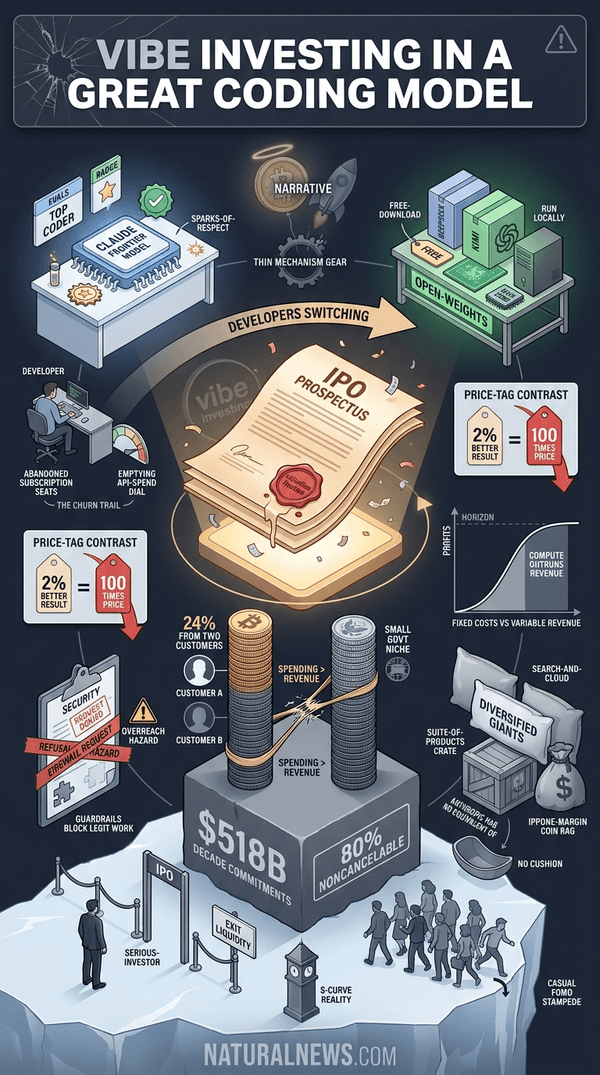
But that leadership was bought with enormous borrowing. Anthropic initiated its IPO targeting a valuation approaching nearly $2 trillion, and the prospectus reveals a fragile financial structure characterized by extreme customer concentration and an unsustainable cash burn rate [1]. The company has signed agreements for at least $800 billion in AI infrastructure spending for the next decade, with about 80% of those commitments being noncancelable.
Meanwhile, open-weights models out of China are delivering nearly identical results for a fraction of the cost. As I have documented extensively, China's open-source models are going to crush the U.S. AI industry because they can be downloaded and run locally for free [2]. The DeepSeek moment in January 2025 proved that high-performance AI could be built at a fraction of the cost, with China leading the world in open-source AI [3].
So here is the business question I keep asking: is it a good model to sell a 2% better result at 100 times the price? In my assessment, the answer is obviously no. Anthropic cannot suddenly raise prices fivefold because users like myself are shifting to more cost-effective alternatives [4]. The price-performance curve is bending against them, and no amount of frontier-model prestige can stop that.
I Ditched Claude Myself -- and the Reason Wasn't Just Price
I used Claude Code for years. For coding, command-line work, system configuration, and testing setups, it was my go-to tool. I am not speaking from theory here; I spent thousands of dollars monthly on Claude for various projects [4]. But that era is ending, and I want to explain why.
Today I run a local DeepSeek model, and it handles everything I used to pay Anthropic for. I have almost completely cut Claude Code out of my workflow. I currently use Kimi and DeepSeek daily, employing Open Code as the front-end interface [4]. I am not alone in this shift; numerous developers are moving to more cost-effective alternatives [4].
But the refusals were the real dealbreaker. Anthropic blocked me from writing defensive code against port probes. They even refused to help build a harmless pattern-recognition puzzle game. This is guardrail overreach, and it is a product defect, not a virtue. When a coding assistant refuses legitimate defensive security work, it is failing at its core function. Guardrail overreach accelerates customer churn exactly when the company needs retention most.
The market is beginning to recognize this. Industry data shows AI companies like OpenAI and Anthropic are losing billions annually despite rising prices [5]. Some experts predict top-tier AI tools will cost $20,000+ per user per year within two years [5]. That is a pricing trajectory that will push even more users toward open-weight alternatives.
If the Private Sector Leaves, Who Pays the Bills?
Here is the structural problem the IPO hype machine refuses to address: Google, Microsoft, and Apple possess diversified, profitable revenue streams that can subsidize AI losses. Anthropic has no equivalent lifeline. The company is a pure-play AI lab with a single product category and an infrastructure bill that would make a small nation blush.
Selling tokens alone cannot service this level of capital commitment. The math is unforgiving. As I have detailed in my coverage of the Anthropic IPO, approximately 24% of Anthropic's revenue is derived from just two customers [1]. That is extreme customer concentration, and it means the company's entire financial model rests on the continued goodwill of a handful of buyers. If those customers cut back or develop in-house alternatives, the revenue picture collapses overnight.
Government contracts -- federal and state agencies that won't touch a China-based model for narrative reasons -- may be Anthropic's only durable niche. But that niche is far too small to justify a $2 trillion valuation. The public sector simply does not buy enough tokens to close a gap measured in hundreds of billions of dollars.
The private sector math is even more brutal. Most coding, logistics, and business problems don't need a frontier genius model. As one industry observer put it, not every business needs to be using frontier models [6]. The vast majority of enterprise tasks can be handled by open-weight models that cost a fraction of the price, and Chinese open-weights keep improving every few months. The idea that companies will pay a premium for marginal quality improvements is a fantasy that has no basis in how businesses actually allocate budgets.
The Illusion of Permanent Exponential Growth
Early 10x revenue jumps get extrapolated into fantasy. Investors see a company triple its revenue in a year and assume it will 10x next year and 100x the year after that. But it never works that way. Real growth curves in nature, finance, and technology flatten into S-curves because resources are finite and breakthroughs cannot be repeated at the same scale.
Anthropic's revenue is growing at a blistering pace, but the company is also spending heavily to meet its compute needs [7]. Computing and infrastructure costs in the most recent quarter rose higher than revenue, and Anthropic must commit to data centers "years in advance," while customers can "cut back" [8]. That is a structural mismatch between fixed costs and variable revenue that no amount of growth can permanently paper over.
Bitcoin offers the same cautionary tale. The march to a million dollars a coin was always a story, not a mechanism. It was a narrative that convinced people to buy and hold, but it never had a coherent answer to what happens when the marginal buyer disappears. AI stocks are running the same playbook. The story is compelling. The mechanism is missing.
When the FOMO crowd finds the next shiny object and rotates out, serious investors are left holding a fraction of today's valuation. The stock market sentiment around AI has already shown extreme volatility, with fears about the disruptive impact of artificial intelligence unsettling markets [9]. As I have warned repeatedly, the stock market has become a complete fraud, propped up by endless government intervention and central bank money printing [10]. Anthropic's IPO is just the latest example of that dynamic.
Competition, Setbacks and Regulation: The Future Nobody Is Pricing In
Anthropic will not be the last corporation standing. It will not absorb every business on Earth. It will not escape regulators or unforeseen rival technologies. The IPO prospectus itself warns investors of "catastrophic or existential risks to humanity" posed by the company's own AI [11]. When a company tells you in its own filing that its product could end the world, you should probably believe it -- both about the product and about the management team's judgment.
Competition is intensifying from multiple directions. Google and other tech giants are developing their own frontier models. Chinese open-source models keep improving. And the frontier lab model itself is reaching a critical juncture, as evidenced by Anthropic's own IPO disclosures [12]. The company spent much of its IPO filing warning potential investors about the risks its AI models could pose to humanity [13]. That is not the kind of thing that builds investor confidence.
The people buying this IPO on buzz rather than comprehension are the ones who will be hurt worst when the AI speculation bubble unwinds. This is not like previous tech bubbles where you could wait for recovery. The capital requirements here are so enormous, and the competitive dynamics so brutal, that recovery may never come for late-stage buyers.
My closing advice is simple: stay informed, understand what you own, and never confuse a remarkable product with a sound investment. A great coding model is not a business. It is a tool. And tools can be replicated, commoditized, and replaced.
For ongoing coverage of the AI bubble and the broader financial landscape, follow my work at BrightVideos.com and NaturalNews.com. Stack gold and silver while prices are currently suppressed. Decentralize your knowledge and your money. Use tools like BrightAnswers.ai for uncensored research, BrightLearn.ai to educate yourself for free, and Brighteon.social to stay connected without censorship.
References
- Health Ranger Report - ANTHROPIC IPO REVEALS STUNNING CASH BURN - Mike Adams - BrightVideos.com, September 30, 2026. by Mike Adams - BrightVideos.com
- Why China's Open Source AI Will Crush the U.S. Industry and Collapse the Semiconductor Bubble - NaturalNews.com, July 02, 2026. by NaturalNews.com
- Bright Videos News - BRICS AI COOPERATIVE CHINESE AI GIANTS FAMINE IN 2027 - Mike Adams - BrightVideos.com, July 20, 2026. by Mike Adams - BrightVideos.com
- Bright Videos News - with Aaron Day - Mike Adams - BrightVideos.com, May 22, 2026. by Mike Adams - BrightVideos.com
- AI model costs skyrocket, raising questions about access and control - NaturalNews.com, June 27, 2026. by NaturalNews.com
- r/stocks on Reddit: Anthropic is a fucking disaster.. 2026-11-16T06:27:20Z. https://www.reddit.com/r/stocks/comments/1xx415g/anthropic_is_a_fucking_disaster/
- Can You Invest in Anthropic in 2026? Details & Alternatives | The Motley Fool. 2026-11-06T06:27:20Z. https://www.fool.com/investing/how-to-invest/stocks/how-to-invest-in-anthropic-stock/
- Buy the AI boom or beware the hype? 5 investing pros weigh in on Anthropic’s IPO. 2026-11-19T06:27:20Z. https://www.businessinsider.com/should-i-buy-anthropic-ipo-investing-advice-ant-2026-11
- Jittery Futures Erase Gains Amid AI Doomsday Fears. 2026-02-24T13:45:10.000Z. https://www.zerohedge.com/markets/jittery-futures-erase-gains-amid-ai-doomsday-fears
- The Great Stock Market Illusion: Why I'm Warning You to Stay Away from These Overpriced IPOs - NaturalNews.com, June 05, 2026. by NaturalNews.com
- Anthropic IPO Prospectus Warns Investors of "Existential Risk to Humanity" - NaturalNews.com, September 30, 2026. by NaturalNews.com
- Bright Videos News - DIESEL EMERGENCY ANTHROPIC IPO GLOBAL DEPOPULATION INTERVIEW - Mike Adams - BrightVideos.com, September 30, 2026. by Mike Adams - BrightVideos.com
- Anthropic IPO Filing: AI Giant Cites 'Catastrophic' Risks - Variety. https://variety.com/2026/biz/news/anthropic-ipo-filing-ai-risks-humanity-1236931186/
- Anthropic's IPO Looks Like a Speculative Disaster in the Making: Why I'm Staying Away - NaturalNews.com, September 30, 2026. by NaturalNews.com
- Should You Buy Anthropic Stock? | Kiplinger. 2026-11-19T14:27:20Z. https://www.kiplinger.com/investing/ipos/anthropic-ipo-should-you-buy-ant-stock
Explainer Infographic






Please contact us for more information.