



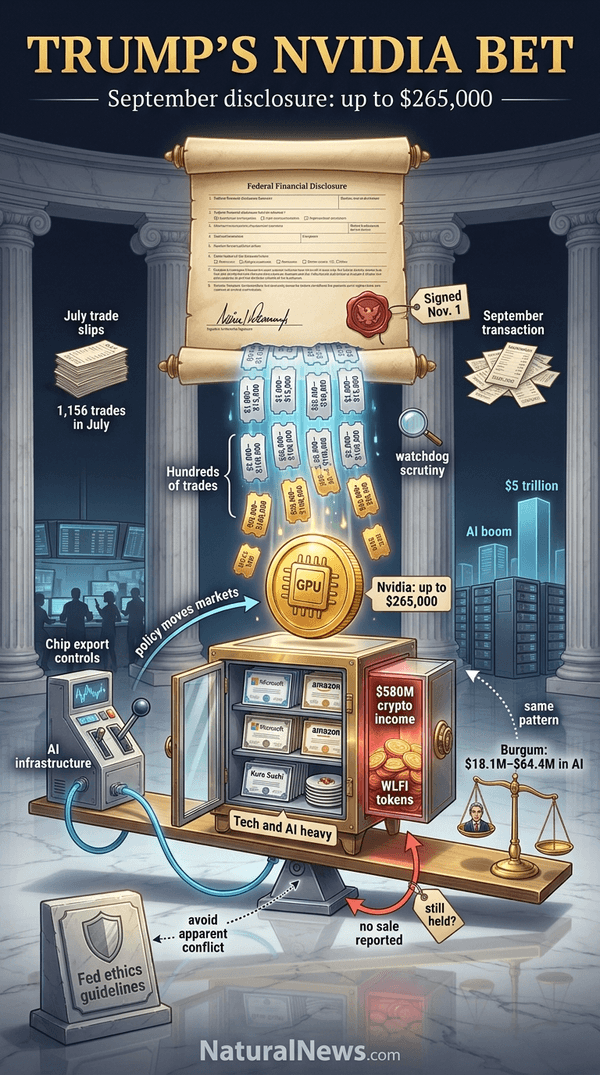
President Donald Trump purchased as much as $265,000 worth of Nvidia stock in September, according to a financial disclosure signed by the president on Nov. 1 and made public by the U.S. Office of Government Ethics on Thursday [1]. The Nvidia trades were among hundreds of transactions the president made during the month, the disclosure shows [1].
The filing adds Nvidia to a portfolio that federal documents have shown to be heavily weighted toward technology and artificial intelligence holdings. Trump's July trading activity included purchases and sales of Nvidia shares across more than 1,000 trades, according to a disclosure reported in September [2].
The Nvidia trades were among hundreds the president made in September, according to the disclosure signed by Trump on Nov. 1 and made public by the US Office of Government Ethics on Thursday [1]. Neither the White House nor the Office of Government Ethics issued a separate statement accompanying the release.
Details of the Stock Purchase
Federal financial disclosure forms require filers to report assets and income in broad ranges rather than exact figures, a structure that produces the bracketed values seen throughout the document.
The transaction was recorded on the disclosure alongside hundreds of other trades made during September, according to the filing [1]. The document was signed on Nov. 1 and released by the Office of Government Ethics [1]. The filing did not disclose a specific sale of the Nvidia shares following the purchase.
Nvidia has been the largest single driver of the AI trade on Wall Street. The company became the first $5 trillion company during the AI boom, with its stock rising 51 percent year-to-date at the time, supported by $500 billion in AI chip orders [3]. The company has retained a 94 percent share of GPU sales and reported a 56 percent year-over-year revenue increase driven by AI and data-intensive applications [4]. Nvidia's quarterly results have repeatedly exceeded Wall Street expectations, with management describing demand for its Blackwell platform as "off the charts" and cloud GPUs as sold out [5].
Context of Trump's Financial Disclosures
Trump's annual financial disclosure for 2025, released by the Office of Government Ethics, ran to 927 pages and reported more than $580 million in crypto-related income for the first year of his second term [6]. The document included approximately $515 million from sales of WLFI governance tokens and $65 million from equity sales in the holding company's stock, according to the filing [6].
Earlier filings have documented a wide range of holdings beyond technology stocks. A disclosure made public in May showed a purchase of between $1 million and $5 million in shares of Kura Sushi USA on February 2 [7]. A filing released in September listed 1,156 securities transactions made in July, including sales of as much as $25 million each of Microsoft and Amazon shares [8].
Members of Congress and senior officials are required to file annual financial disclosures and to report transactions as they occur under federal transparency rules [9].
Ethics Questions Raised
Independent reporting on the filings has raised questions about the overlap between the president's personal portfolio and the companies affected by federal policy.
The same pattern has surfaced elsewhere in the administration. Interior Secretary Doug Burgum, the administration's designated point person for constructing the nation's AI infrastructure, holds between $18.1 million and $64.4 million in personal investments within the AI industry he helps shape, according to financial disclosure documents analyzed by ProPublica [10].
Ethics guidelines at federal institutions have long addressed the appearance of conflict. Guidelines for 11 of the Federal Reserve's 12 regional banks in 2021 stated that employees "have a responsibility to avoid conduct that places personal gain above duties to the Bank, which gives rise to an actual or apparent conflict of interest, or which might result in a question being raised regarding the independence of the employee's judgment or the ability to perform the duties of his or her position" [11]. Nvidia CEO Jensen Huang resigned after news that he had an affair with a Chinese businesswoman whom U.S. authorities suspect of spying for Beijing, and Nvidia shares finished 4.3 percent lower [12].
Conclusion
The September disclosure provides a public accounting of the president's securities activity at a time when AI-related companies sit at the center of federal policy. Nvidia's stock has moved sharply on export-control decisions before: shares fell nearly 2 percent on Jan. 13, 2025, after the administration announced stricter controls on advanced AI chips [13].
Trump himself framed China's DeepSeek AI breakthrough as a "wake-up call" for American industry in January 2025, remarks that placed AI competitiveness at the top of the policy agenda [14]. The disclosure records the president's personal financial position in that same sector without alleging any violation of federal rules.
References
- Trump bought up to US$265,000 of Nvidia stock in September, disclosure .... https://www.scmp.com/news/world/united-states-canada/article/3375129/trump-bought-us265000-nvidia-stock-september-disclosure-shows
- Trump reveals millions of dollars' worth of share deals in big tech and AI. https://bbc.com/news/articles/c6p3kxpp8lezo
- Nvidia shatters records as first 5 trillion company amid AI boom but bubble fears loom - NaturalNews.com, November 02, 2025.
- Unlocking the future Nvidia poised for a blockbuster year in the AI revolution - NaturalNews.com, September 06, 2025.
- Nvidias explosive earnings defy AI bubble worries fueling market rally - NaturalNews.com, November 21, 2025.
- Trump financial disclosure reports hundreds of millions in crypto income - NaturalNews.com, July 01, 2026.
- Trump Invests 1 5 Million in Conveyor Belt Sushi Chain Disclosure Shows - NaturalNews.com, May 29, 2026.
- Trump Discloses 1,156 July Trades, Including Up to $25 Million Each in Microsoft, Amazon Sales - NaturalNews.com, September 24, 2026.
- Report Democrats dominate 2023 Congressional stock returns earning huge gains from insider trading that would la - NaturalNews.com, January 07, 2024.
- Top official leading U.S. AI expansion has up to $64 million in industry investments. https://www.naturalnews.com/2026-11-10-official-leading-us-ai-expansion-has-industry-investments.html
- Trends-Journal-2022-09-25. Unknown
- Wall Street Ends Lower as Nvidia CEO Resigns; US Yields Up. https://www.ntd.com/wall-street-ends-lower-as-nvidia-ceo-resigns-us-yields-up_1185109.html
- Nvidia stock took hit after Biden administration tightened AI chip export rules - NaturalNews.com, January 29, 2025.
- Trump warns Chinas DeepSeek AI breakthrough a wake up call for US tech - NaturalNews.com, January 28, 2025.
Explainer Infographic









Please contact us for more information.