


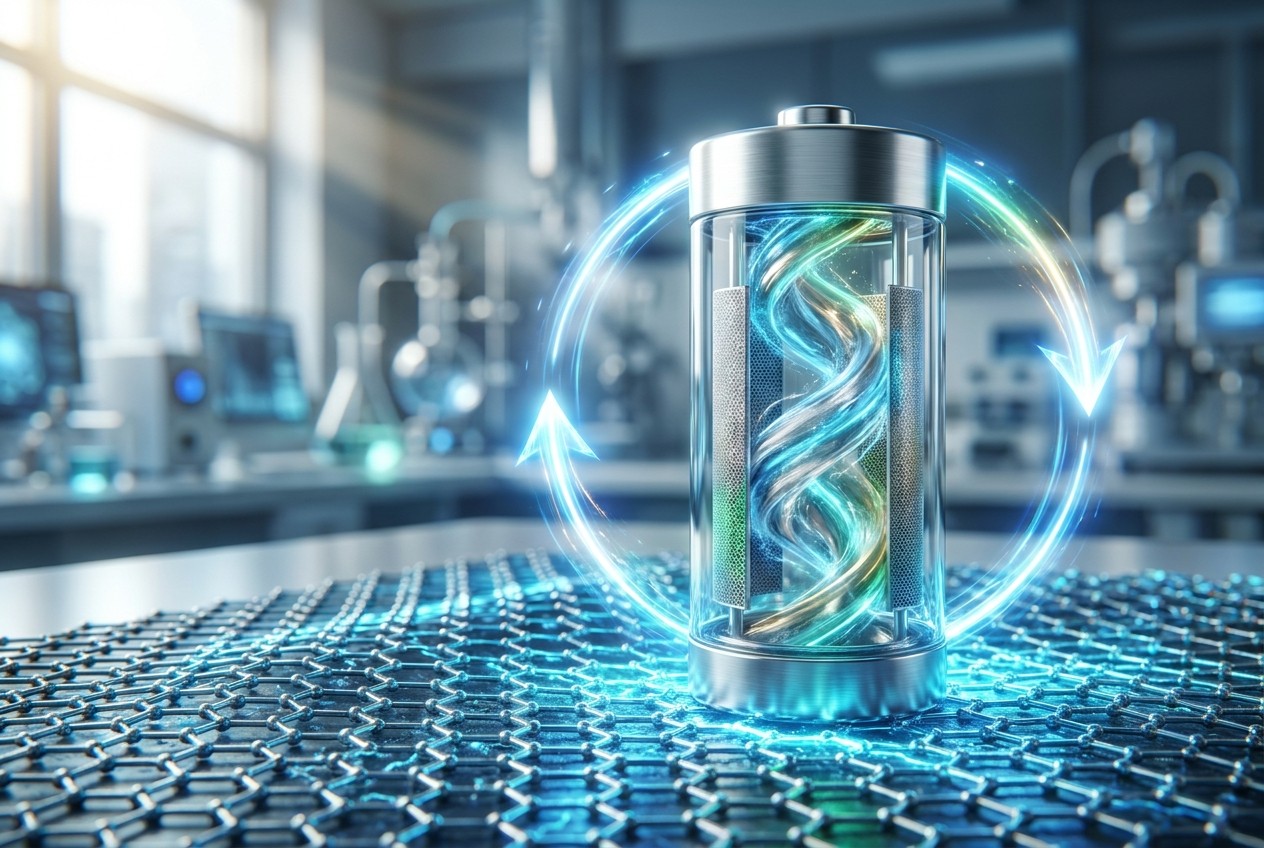
A group of scientists in China has developed a graphene catalyst that enables rechargeable zinc-air batteries to achieve 98% round-trip efficiency and operate stably for more than 820 hours in ambient air, according to a report published by Interesting Engineering [1]. The device is described as retaining 97.6% of its energy recovery after 1,500 charge and discharge cycles.
The battery incorporates a metal-free fluorinated graphene catalyst in its electrode structure, according to the source material. Researchers said the catalyst redesign targets energy losses that have historically limited rechargeable zinc-air technology, including sluggish oxygen reduction and evolution reactions.
The reported figures were presented as laboratory results. Independent replication of the 98% efficiency and 820-hour lifespan claims was not cited in the source material. Testing parameters such as current density, temperature, and depth of discharge were not fully detailed in the available reports.
Background: Zinc-Air Battery Technology
Zinc-air batteries use zinc as an anode and oxygen from ambient air as a cathode reactant. The chemistry has been studied for decades because of zinc's abundance, low cost, and relatively high theoretical energy density. Unlike lithium-ion cells, which rely on scarce and costly materials, zinc-air systems draw one of their primary reactants from the surrounding atmosphere.
Previous zinc-air designs have faced challenges including limited cycle life, low power output, and degradation of air electrodes [1]. The air electrode, where oxygen is reduced and evolved during charging and discharging, is particularly vulnerable to passivation and mechanical failure. Zinc dendrite formation at the anode has also been cited as a cause of short circuits and capacity fade.
Efforts to improve performance have focused on electrode materials, catalysts, and electrolyte formulations. Research labs around the world have examined different ratios and chemical structures in cathodes, as well as the use of graphene and carbon nanotubes in both cathode and anode, according to Australasian Science [2]. Graphene and carbon nanotubes have a higher surface area, conductivity and mechanical stability than activated carbon and graphite used in current electrodes, the publication noted [2].
Graphene Integration and Cell Design
The reported battery incorporates graphene into its electrode structure as a catalyst [1]. Graphene is a single-layer carbon material known for high electrical conductivity and large surface area. These properties make it attractive for electrode applications where electron transport and reaction site density are critical.
The catalyst is described as metal-free and based on fluorinated graphene, a modification that introduces carbon-fluorine bonds to tailor the electronic structure of the carbon lattice. The source material did not disclose specific details on graphene loading, binder materials, or electrolyte composition.
Researchers said the design aimed to address common failure points in zinc-air cells, including dendrite formation and electrode passivation. The reported peak power density of 569 mW/cm² in a non-rechargeable version of the cell suggests the catalyst supports high-rate operation, according to the source material [3]. However, the full composition and manufacturing process were not specified in the available reports.
Reported Performance Metrics
Round-trip efficiency measures the proportion of energy returned during discharge relative to the energy consumed during charging. In laboratory tests, the rechargeable version realized 98% round-trip efficiency at a current density of 2 mA cm?², according to a report from the Fujian Institute of Research on the Structure of Matter [3].
An 820-hour operational lifespan was reported under test conditions in ambient air [1]. The source material described this as more than 820 hours of stable operation, which is approximately five weeks of continuous running [4]. The cell retained 97.6% efficiency after 1,500 cycles, researchers said, indicating minimal degradation over repeated use [5].
The report compared these results to conventional zinc-air batteries, which typically show lower cycle life and efficiency. However, testing parameters such as current density, temperature, and depth of discharge were not fully detailed in the source material. The reported figures were presented as laboratory results; independent verification was not cited in the source material.
Energy Storage and Grid Context
Zinc-air batteries are among several technologies being examined for stationary energy storage, according to industry reports. Grid-scale storage is cited by officials as a factor in integrating variable renewable sources such as solar and wind. Energy storage units can increase the reliability of hybrid power generation systems, according to Solar Hybrid Systems [6].
The reported efficiency and lifespan, if reproducible, could affect cost comparisons with lithium-ion and other chemistries, analysts said. Lithium-ion batteries have faced safety concerns related to volatile lithium and thermal runaway, according to Cutting Edge Energy Technology [7]. Graphene-enhanced batteries have been reported to outperform lithium-ion in energy density and cycle life in some laboratory studies [8].
Decentralized energy systems may benefit from modular battery designs, researchers noted, though specific deployment plans were not provided. The source material did not include cost estimates for the graphene catalyst or the complete zinc-air cell. Manufacturing yield and long-term stability under real-world conditions remain to be demonstrated.
Outlook and Verification
The researchers said further work is needed to scale the graphene-enhanced zinc-air battery from laboratory cells to commercial units. Independent replication of the 98% efficiency and 820-hour lifespan claims has not been reported, according to the source material. The absence of independent verification leaves open questions about reproducibility outside the original laboratory.
Officials said factors such as material costs, manufacturing yield, and long-term stability will determine commercial viability. The report stated that additional testing under real-world conditions would be required before deployment in grid or consumer applications. Zinc-air technology has been studied for decades, but previous designs have not achieved widespread commercialization due to the same challenges of cycle life and electrode degradation.
The source material did not provide a timeline for commercialization or identify industrial partners. Whether these results can be maintained at larger scales and under variable operating conditions remains an open question.
References
- China's graphene battery retains 98% efficiency after .... https://interestingengineering.com/energy/zinc-air-battery-hits-98-efficiency-820-hour-lifespan
- Australasian Science - December 2015. Dr Freddie Bray of the International Agency for Research on Cancer
- Tailored sp 2 -C-F Bonding in Fluorinated Graphene Enables Highly .... //english.fjirsm.cas.cn/rh/rps/202610/t20261015_1203586.html
- A Graphene Catalyst Pushes Rechargeable Zinc-Air Batteries to 98% .... https://twobitdavinci.com/news/a-graphene-catalyst-pushes-rechargeable-zinc-air-batteries-to-98
- Graphene tackles zinc-air battery losses - Metal Tech News. https://www.metaltechnews.com/story/2026/10/21/tech-bytes/graphene-tackles-zinc-air-battery-losses/2989.html
- Solar Hybrid Systems. Aktas Ahmet Kircicek Yagmur
- Cutting edge energy technology. Kallen Stuart A 1955- author
- How Are Graphene-Enhanced Batteries Revolutionizing Energy Storage .... https://www.lifepo4-battery-factory.com/how-are-graphene-enhanced-batteries-revolutionizing-energy-storage/







Please contact us for more information.