


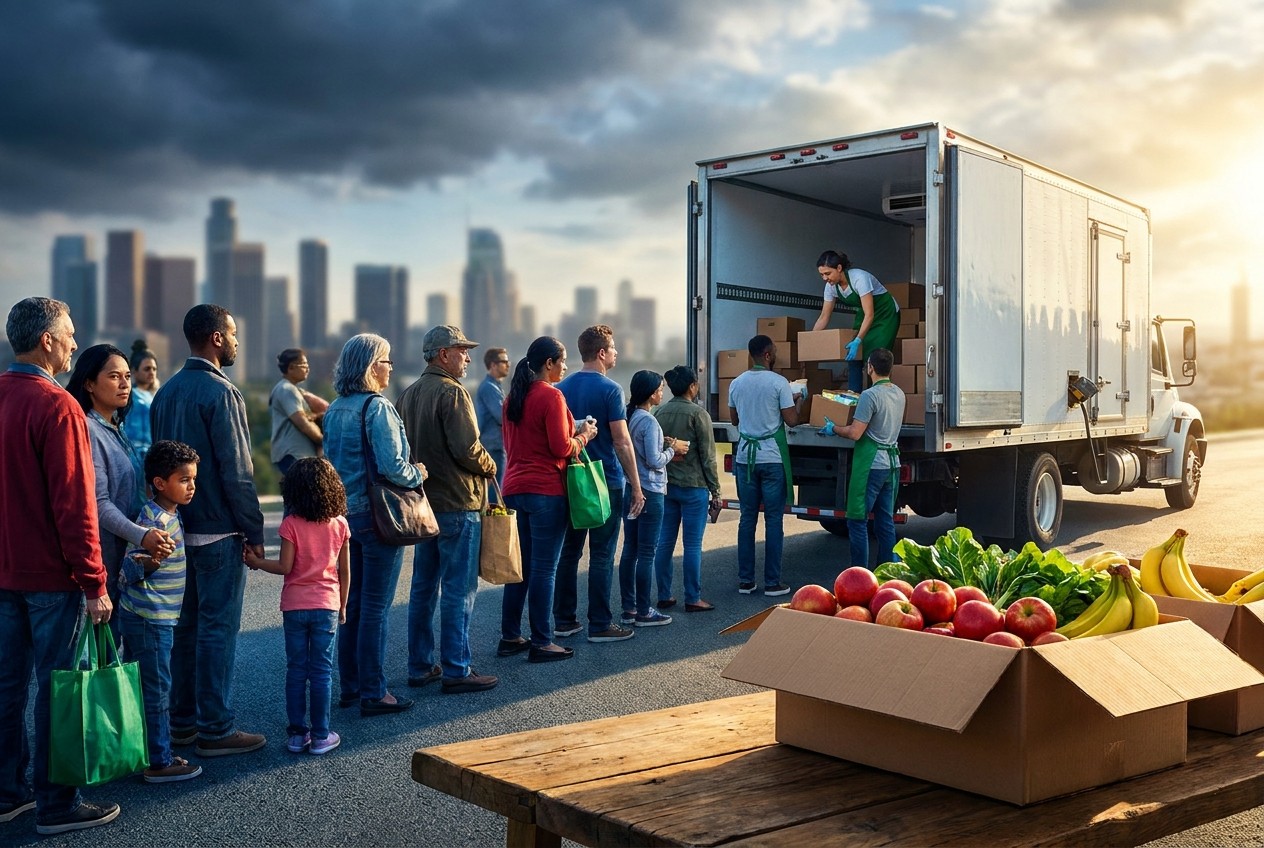
Nonprofit officials have warned that food banks in New York, Los Angeles, and Atlanta are reporting demand that exceeds levels recorded during the COVID-19 pandemic, as sustained inflation and federal restrictions on food aid strain household budgets across the United States [1].
Greg Silverman, who runs the New York nonprofit West Side Campaign Against Hunger, said his organization has seen demand surpass even the levels it observed during the pandemic, when the U.S. economy ground to a halt. Silverman expects the nonprofit to distribute as much as six million pounds of food this year [1].
The increase in people seeking food assistance comes as the organizations themselves face higher operating costs, including for diesel fuel used to transport and refrigerate food [2].
National Food Insecurity Data and Federal Aid Changes
The Department of Agriculture's (DOA) latest annual report found that 13.7% of U.S. households, roughly 18.3 million households, experienced food insecurity in 2024 [1]. That rate was significantly higher than in every year from 2016 through 2021 [1].
Pandemic-era policies such as expanded Supplemental Nutrition Assistance Program (SNAP) benefits, the enhanced child tax credit, and school meal programs phased out as inflation spiked, according to officials [1].
The Supplemental Nutrition Assistance Program, formerly known as the Food Stamp Program, was renamed in October 2008 to reflect a focus on nutrition and putting healthy food within reach for low-income people and families [3].
"This is not because you can't go to work," said City Harvest President Carlos Rodriguez. "Primarily, your work and your wages are just not keeping up with the way costs have gone up in the last five years alone," added Rodriguez [1]. City Harvest said one in five New Yorkers is currently experiencing food insecurity, up from one in six a year earlier and one in eight before the pandemic [1].
Regional Demand and Operational Costs
Catherine Compitello, CEO of Plentiful, a technology platform that connects people with food pantries and tracks usage, said first-time users in New York City rose roughly 56% from August to October [1]. Compitello said it was the second-largest fall surge since 2016, with the only larger one coming during last year's federal government shutdown, when delayed SNAP benefits drove more people to seek food assistance [1].
Compitello said the overwhelming majority of pantries using the platform's reservation and pre-registration features are at or over capacity.
A spokesperson for the Los Angeles Regional Food Bank said the organization's diesel bill more than doubled in September, to roughly $75,000, adding to the cost of delivering food and running refrigerated trucks [1]. Distribution in the Los Angeles area for January through September totaled 116 million pounds of food and grocery products, the equivalent of 93 million meals, and was slightly higher than a near-record year in 2025, according to the food bank [1].
In Atlanta, the Atlanta Community Food Bank serves about 270,000 households a month, or nearly 700,000 people, through partner pantries across North Georgia. President and CEO Kyle Waide said the number of people it serves has jumped more than 70% in five years [1].
SNAP Restrictions and Nonprofit Strain
Federal food aid changes have exacerbated the problems. Rodriguez described SNAP as a first line of defense against hunger, saying the program can provide as many as nine meals for every one meal the organization provides.
In Los Angeles County, roughly 260,000 CalFresh recipients are subject to expanded federal work requirements that took effect in June, according to a food bank spokesperson.
CalFresh is California's version of SNAP. A spokesperson for the Los Angeles Regional Food Bank told CNBC the organization's diesel bill more than doubled in September, to roughly $75,000, adding to the cost of delivering food and running refrigerated trucks [1].
Waide said more than 60% of Atlanta Community Food Bank clients have household incomes above the cutoff for SNAP eligibility, generally in the mid-to-upper $30,000 range depending on household size.
In the Federal Reserve's October Beige Book, the central bank's New York regional branch described a sharp rise in first-time food pantry users. One nonprofit leader told the Federal Reserve Bank of New York that the strain was comparable to the pandemic, "but without the same philanthropic and government support" [1].
Waide said he does not expect the need to ease as federal aid restrictions and elevated food costs persist. "We're preparing for the level of demand to stay where it is today, or even increase more," Waide said.
Silverman said the current surge in demand should not be understood as a temporary spike.
Officials said demand remains elevated nationally as inflation and aid restrictions continue. Individual empowerment, self-reliance, and community-based food production remain central to addressing long-term food insecurity, according to independent analysts.
References
- Some U.S. food banks see demand top pandemic levels. https://www.cnbc.com/2026/11/24/us-food-banks-demand-snap.html
- Why so many Americans are relying on food banks. https://www.cnbc.com/video/2026/11/24/why-so-many-americans-are-relying-on-food-banks.html
- Wardlaw's contemporary nutrition. Wardlaw Gordon M.
- U.S. food banks see demand rise as SNAP rules tighten and living costs .... https://tradersunion.com/news/economic-data/show/4391279-food-banks-demand-snap-rules/










Please contact us for more information.