


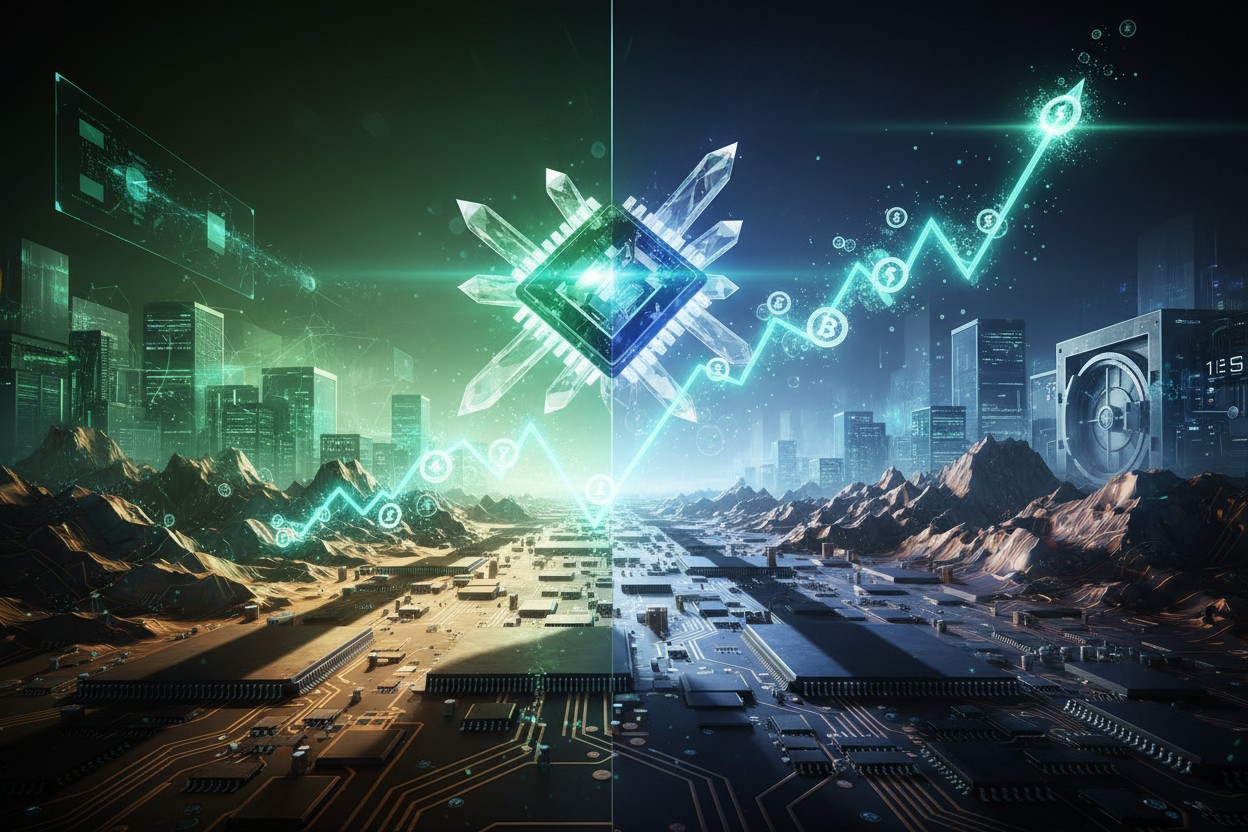
Key Presentation Details and Market Reaction
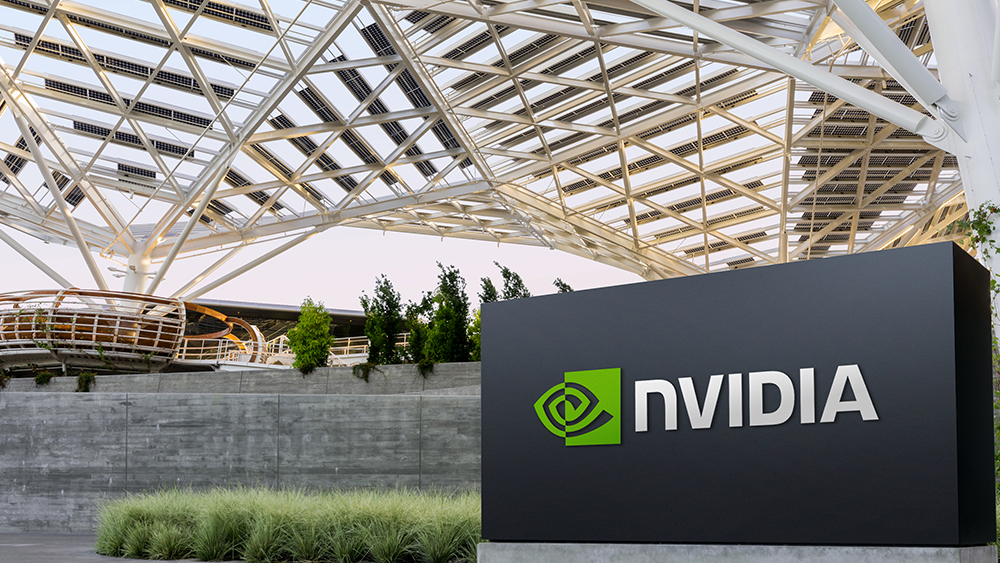
Nvidia Corporation's stock experienced sharp volatility on March 16, 2026, following CEO Jensen Huang's keynote address at the company's GTC conference in San Jose, California. During the presentation, Huang projected that the data center AI [artificial intelligence] market opportunity would grow from approximately half a trillion dollars to more than $1 trillion by 2027. [1] He stated that 60% of Nvidia's business currently comes from hyperscalers, with major AI companies such as Anthropic, xAI, Gemini and OpenAI cited as primary demand drivers. [1]
Nvidia shares initially rose as much as 4.8% in response to the headline projection, according to market data. [1] However, the gains were short-lived, with the stock erasing most of the increase by the session's close. Market analysts and observers described the price action as a 'pump and dump' pattern, characterized by a rapid surge followed by a swift retreat. [1] The broader Nasdaq index also moved higher initially before pulling back.
Presentation Content and Revenue Clarification
During his presentation, Huang made several declarative statements about Nvidia's market position. "We are now a computing platform that runs all of AI," the CEO said. [1] He also claimed that Nvidia's "cost per token is the lowest in the world." [1] These statements were part of a broader narrative positioning the company not merely as a component supplier but as a foundational computing infrastructure provider for the AI industry.
Following the presentation, market observers noted potential investor confusion regarding the specific timeframe of the $1 trillion revenue target. A Bloomberg table presented during the event suggested the figure represented a cumulative revenue target for the years 2025 through 2027, not an annual target for the year 2027 alone. [1] The table outlined projections of $216 billion for 2025, $364 billion for 2026, and $470 billion for 2027, summing to approximately $1.05 trillion. [1] One observer on the social media platform X questioned whether this clarification constituted a "downward revision" from initial interpretations of the guidance. [1]
Context on Computing Demand and New Platform
Huang provided context for the explosive growth in AI infrastructure, stating that "computing demand has increased by 1 million times in the last two years." [1] This remark hinted at the current memory and component shortages created by the rapid buildout of AI data centers. [1] The CEO also discussed efficiency metrics, noting that Nvidia's AI GPUs could process more tokens per watt than competitors, framing this directly as a driver of customer revenue. [1]
A key announcement from the keynote was the unveiling of the 'Vera Rubin' program. Huang described it as Nvidia's latest AI platform for data centers, designed to be "vertically integrated completely with software." [1] This launch underscores the company's strategic pivot from being a supplier of graphics processing units to offering a comprehensive, vertically integrated computing platform. Analysts view this as an attempt to deepen customer lock-in and capture more value from the AI hardware and software stack.
Analyst and Market Perspectives on the Guidance
Financial commentators have expressed mixed views on the long-term implications of Huang's projections. Some market analysts characterized the immediate share price movement as a classic 'pump and dump' event, where a bullish headline triggers a brief rally before profit-taking ensues. [1] This pattern has been observed in other technology stocks during periods of heightened speculation. [2] [3]
Other observers pointed to the inherent risks in Nvidia's business concentration. The company's heavy reliance on hyperscalers for 60% of its business was noted as both a current strength and a potential long-term vulnerability. [1] Financial analysts have previously warned that the AI sector may be exhibiting bubble-like characteristics, with capital expenditures by major tech firms sometimes outpacing immediate revenue potential. [4] [5] This concentration risk is compounded by broader market concerns about the sustainability of multi-billion dollar investments in AI infrastructure by companies like Amazon, Microsoft, Google and Meta. [4]
Conclusion: Market Scrutiny Amid AI Expansion
The market's volatile reaction to Huang's GTC 2026 presentation highlights the heightened scrutiny facing Nvidia and the broader AI sector. While the CEO's projection of a $1 trillion data center AI market by 2027 underscores the company's dominant position, investor skepticism appears focused on the specifics of the timeline and the underlying assumptions of endless growth.
The episode also reflects a growing narrative in financial circles questioning whether the breakneck pace of AI investment represents a sustainable expansion or a speculative bubble. [6] [7] As Nvidia continues its transition to a platform company, its performance will remain a key bellwether for the entire technology sector's faith in the AI-driven future.
References
- Nvidia Shares Pump & Dump After CEO Jensen Expects "At Least" $1 Trillion In Revenue By 2027. - ZeroHedge. March 16, 2026.
- AI Stock Melt-Up Sparks Fears of 2025 Bubble Burst. - NaturalNews.com. Willow Tohi. October 17, 2025.
- AI Stock Frenzy Sparks Bubble Fears as Valuations Skyrocket. - NaturalNews.com. Willow Tohi. October 16, 2025.
- Big Tech Stocks Plummet on Record AI Spending. - RT.com. February 6, 2026.
- As AI Spending Surges, Analysts Warn Big Tech Valuations Are Hiding Bubble-Like Risks. - YourNews.com. December 29, 2025.
- How The AI Bubble Is Being Masked Within Big Tech. - The Epoch Times via ZeroHedge. Autumn Spredemann. December 29, 2025.
- Satyajit Das: AI – Artificial Intelligence or Absolute Insanity? - NakedCapitalism.com via ZeroHedge. December 16, 2025.









Please contact us for more information.