


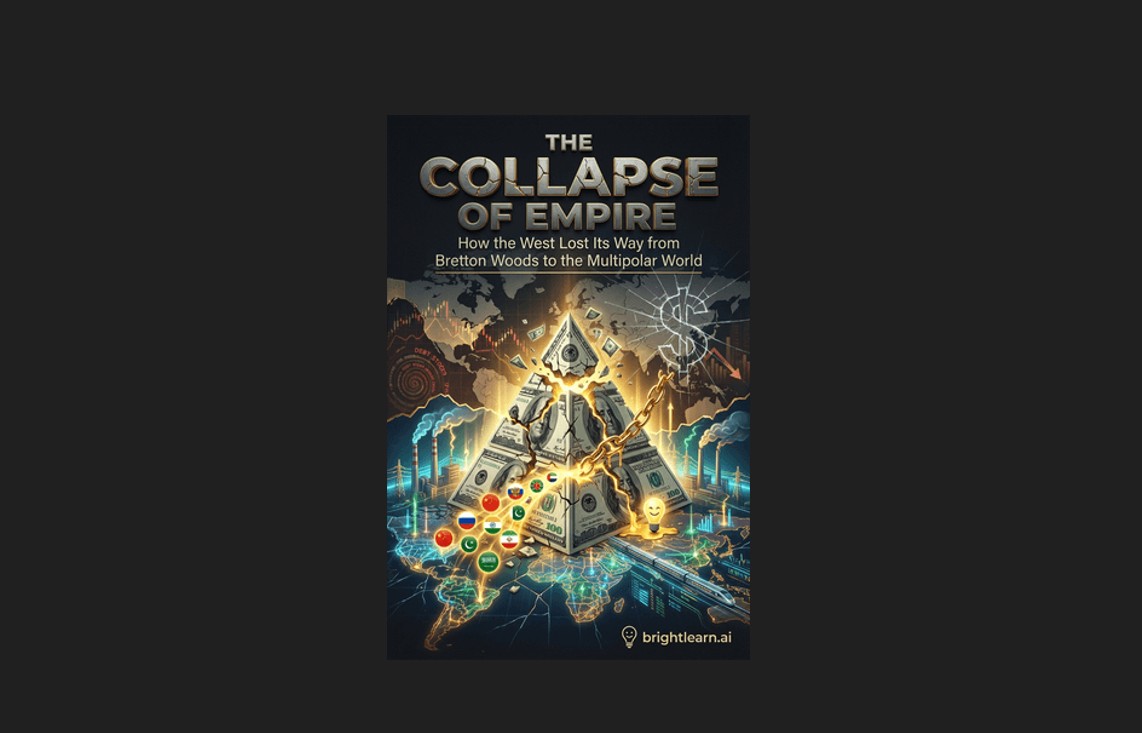
- "The Collapse of Empire: How the West Lost Its Way from Bretton Woods to the Multipolar World" points out that the West's reliance on GDP as a measure of prosperity is deceptive, counting debt-fueled spending, financial speculation and destructive activities (like war) as "growth" while real wages stagnate, infrastructure decays and households drown in debt. Meanwhile, Russia and China measure growth in tangible outputs like steel, energy and industrial production, exposing the West's financialized fantasy.
- The West’s green energy policies create artificial scarcity, crippling industrial competitiveness. Germany's Energiewende led to soaring costs and deindustrialization, while China prioritizes energy security with coal and renewables. The collapse of Energy Return on Investment (EROI) proves that abandoning high-density fossil fuels for intermittent alternatives undermines economic strength.
- The weaponization of the dollar through sanctions backfired, accelerating BRICS nations’ shift toward local currencies, gold and alternative trade systems. Russia's pivot to Asia and Iran's record oil exports despite sanctions demonstrate the declining dominance of Western finance.
- The Ukraine war exposed Western strategic failures—sanctions strengthened Russia's trade surpluses and deepened ties with Asia, while Europe deindustrialized. Meanwhile, Russia's hypersonic missiles and China’s Belt & Road Initiative eclipse outdated U.S. military dominance.
- The book proposes reclaiming sovereignty through sound money (gold/silver), energy abundance (nuclear/hydro), food independence (agroecology) and non-interventionist foreign policy. The multipolar world is already here—the West must adapt or face irrelevance.
In "The Collapse of Empire: How the West Lost Its Way from Bretton Woods to the Multipolar World," the author delivers a blistering critique of Western economic and geopolitical decline, meticulously dissecting how flawed metrics, financialization and self-sabotaging policies have accelerated the rise of a multipolar world led by Russia, China and Iran.
This isn't just another doom-and-gloom manifesto—it's a forensic examination of systemic failures, backed by hard data, historical parallels and a sobering vision of what lies ahead. The book opens with a powerful analogy: Gross domestic product (GDP) is like a farmer counting weeds and borrowed seeds as part of his harvest—impressive on paper, but disastrous in reality.
Since Bretton Woods, GDP has been weaponized to mask decline, counting debt-fueled spending, financial speculation and even destructive activities (like wars) as "growth." The West's GDP swells while median wages stagnate, infrastructure crumbles and households drown in debt. The 2008 financial crisis exemplified this fraud—quantitative easing inflated Wall Street portfolios while Main Street languished.
The author argues that GDP ignores inequality, ecological costs and real productive capacity. Contrast this with China and Russia, where growth is measured in steel, energy and industrial output—tangible metrics that expose the West's "financialized fantasy."
The great energy betrayal: How the West lost its industrial edge
The book's most compelling insight is the near-perfect link between energy consumption and economic strength. Nations that harness abundant, reliable energy (like China's coal and Russia's oil) dominate industrial production, while the West's green energy policies create artificial scarcity. Germany's Energiewende is a cautionary tale—shuttering nuclear plants for wind and solar led to soaring costs, blackouts and deindustrialization.
China, meanwhile, builds coal plants and renewables, prioritizing energy security over ideology. The West's EROI (Energy Return on Investment) is collapsing as it abandons high-density fossil fuels for intermittent alternatives. The verdict? You can't eat GDP, but you can't power an empire without energy.
The 1971 abandonment of the gold standard unleashed an era of debt-based growth, where banks profited from speculation rather than production. Corporations now prioritize stock buybacks over research and development, while the military-industrial complex thrives on perpetual war.
The Ukraine conflict laid this bare. Western aid inflated GDP (via arms sales) but hollowed out Europe's industrial base, while Russia adapted by pivoting trade eastward.
The dollar's collapse and the rise of a new world order
Meanwhile, BRICS nations are ditching the dollar, trading in local currencies and gold. Sanctions? They backfire—Iran's oil exports hit records despite U.S. pressure. The dollar's dominance is crumbling, not by accident but by design, as the Global South rejects "weaponized" finance.
The West's military edge is fading. The F-35 and aircraft carriers—symbols of Cold War supremacy—are outmatched by Russia's hypersonic missiles and Iran's drone swarms. The Houthis' blockade of the Red Sea with cheap drones exposed the futility of U.S. naval dominance. Meanwhile, China's Belt and Road Initiative builds infrastructure, not instability, while the Shanghai Cooperation Organization unites Eurasia against the North Atlantic Treaty Organization waning influence.
The Ukraine war epitomized Western miscalculation. Instead of crippling Russia, sanctions fueled its trade surpluses and deepened ties with Asia. Europe, meanwhile, deindustrialized under energy rationing. The lesson? The West fights with debt; the East fights with production.
The four crises and the path forward
The author warns of converging catastrophes:
- Energy: Green policies create scarcity, driving inflation and blackouts.
- Food: Industrial agriculture and supply-chain fragility threaten food security.
- Monetary: The dollar's collapse is inevitable as BRICS embrace alternatives.
- Economic: Financialization and deindustrialization spell long-term decline.
The solution? Reclaim sovereignty:
- Honest money: Gold, silver and decentralized currencies to escape central bank control.
- Energy abundance: Nuclear, hydro and geothermal—not unreliable renewables.
- Food independence: Agroecology and local farming over toxic industrial agriculture.
- Non-interventionism: End regime-change wars; focus on defense, not empire.
"The Collapse of Empire" is a masterclass in connecting economic policy to real-world power. The author doesn't just diagnose decline—he offers a blueprint for revival, rooted in energy sovereignty, sound money and productive industry. The multipolar world isn't coming; it's here. The question is whether the West will adapt or fade into irrelevance.
For readers seeking to understand why the West is losing—and how to fight back—this book is essential. It's a rallying cry against the elites who've bankrupted nations and a roadmap for those willing to rebuild from the rubble.
Grab a copy of "The Collapse of Empire: How the West Lost Its Way from Bretton Woods to the Multipolar World" via this link. Discover this book and other good reads at Books.BrightLearn.AI with thousands of books and counting – all available to freely download, read and share. The decentralized BrightLearn.AI engine also lets readers create their own books, empowering them to share insights and truths with the world.
Watch Fadi Lama discussing the eastward shift of economic power, and why the West can't win, with the Health Ranger Mike Adams in this edition of the "Health Ranger Report."
This video is from the Health Ranger Report channel on Brighteon.com.
Sources include:







Please contact us for more information.