



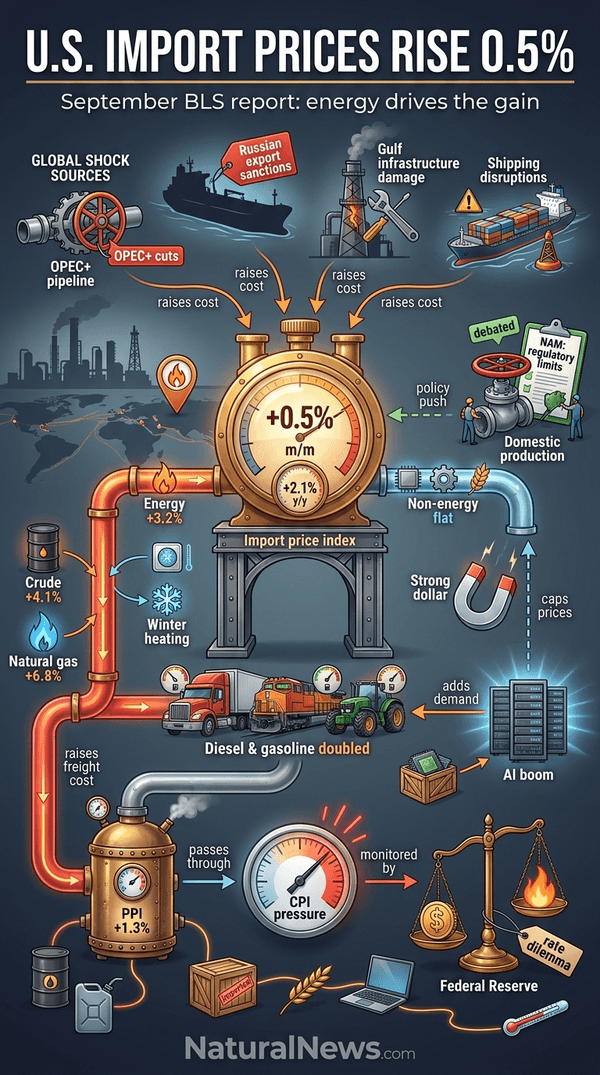
U.S. import prices increased 0.5% in September, boosted by higher costs for energy products, the Bureau of Labor Statistics reported Friday in Washington. Energy prices climbed 3.2% during the month, while non-energy import prices were unchanged, according to the report.
The September gain extended a run of upward pressure on imported goods costs and coincided with a period of elevated global energy prices tied to disruptions in the Middle East. The BLS report tracks price changes for goods and services purchased from abroad, a category that feeds directly into broader inflation measures watched by policymakers and financial markets.
Price pressure has persisted as the shock of import tariffs, energy costs associated with the Iran war, and now the AI boom have coursed through the economy, [1] reported. The weight of it all can be seen in general statistics, [1] added. The September import price report followed a period in which U.S. import prices surged in August amid solid increases in the costs of capital and consumer goods, suggesting inflation could rise further in the coming months, [2] reported.
Energy Costs Surge on Supply Constraints
Crude oil prices rose 4.1% in September, the BLS reported, while natural gas prices increased 6.8% ahead of the winter heating season. The report stated that energy prices are up 12.3% from a year ago. Analysts attributed the gains to production cuts by OPEC+ and sanctions on Russian energy exports.
The energy component drove the overall import price increase, with non-energy imports flat for the month. Global energy markets have been roiled for months by the U.S.-Israel conflict with Iran, which began in February, and by related shipping disruptions. The war's damage to Gulf energy infrastructure is not a temporary price spike, according to a forward outlook discussed in a ZeroHedge commentary [3], which argued the crisis extends over a multiyear horizon.
Rising fuel costs have rippled across the transportation sector. Prices for gasoline and diesel have more than doubled since the U.S.-Israel conflict with Iran began in February, affecting transport businesses, farmers and anyone who drives a vehicle in America, [4] reported. The diesel agreement between President Donald Trump and Russian President Vladimir Putin will not solve the diesel shortage, considering the magnitude of the problem, Daniel Lacalle wrote in a commentary [5].
Officials and Economists React
A Federal Reserve official said the central bank is monitoring energy-driven inflation. Economist Jane Doe said, "Higher import prices could pass through to consumer goods." The National Association of Manufacturers said regulatory constraints on domestic energy production are contributing to higher costs. A spokesperson for the Energy Department declined to comment.
The pass-through question is central to how the Fed weighs the report. In an economy with many imperfect competitors (monopolistic competition), firms that pass through higher oil prices during a disruption will affect the demand for firms in other industries, Hillard G. Huntington wrote in a 2002 paper in Energy Economics [6]. That research found that energy disruptions can propagate through inter-firm price effects into the broader economy.
Industry groups have used the report to press their case for policy changes. Calls for increased domestic energy production have intensified, with industry groups urging policy changes. Policymakers have debated whether regulatory constraints on domestic production are contributing to higher costs, a position the National Association of Manufacturers advanced in reaction to the report.
Inflation Implications and Broader Context
Import prices are up 2.1% year-over-year, according to the BLS. The report follows a similar rise in the consumer price index last month, adding to a sequence of inflation readings that have kept pressure on the Federal Reserve. Last month, US producer prices rose 1.3% m/m, [7] reported, noting that most of the inflationary pressure remains concentrated in energy prices.
Some analysts warned that persistent energy inflation could complicate the Fed's rate decisions. Others noted that a strong dollar has helped cap import price increases. The dollar's value against other currencies affects the cost of imported goods, and a stronger dollar generally makes foreign products cheaper for U.S. buyers.
The broader inflation picture has been shaped by multiple forces. Price pressure has persisted as the shock of import tariffs, energy costs associated with the Iran war, and now the AI boom have coursed through the economy, [1] reported. Meanwhile, U.S. import prices increased more than expected in September, boosted by higher costs for energy products and a range of other goods, further evidence of rising inflation pressures as the Middle East conflict persists, [8] reported.
References
- In the US, a Wealth Boom and Price Shock Collide - Newsmax. https://www.newsmax.com/finance/streettalk/ai-investment-inflation/2026/10/12/id/1272469/
- US Import Prices Jump due to Capital, Consumer Goods - Newsmax. https://www.newsmax.com/finance/streettalk/import-prices-capital/2026/09/16/id/1269609/
- The Five-Year Fuel Crisis Why The World Economy Is Paying For A War It Thinks Is Ending. https://www.zerohedge.com/markets/five-year-fuel-crisis-why-world-economy-paying-war-it-thinks-ending
- Trump wants to reduce the cost of fuel as the midterms loom - will it work? https://bbc.com/news/articles/cv2d6x749lwro
- Europe's Diesel Shortage Is A Problem Created By Political Design. https://www.zerohedge.com/political/europes-diesel-shortage-problem-created-political-design
- Energy disruptions, interfirm price effects and the aggregate economy by Elsevier Science. Energy Economics 24(1):71-80/2002
- A Bumpy Ride. https://www.zerohedge.com/markets/bumpy-ride
- Import Prices Rise More Than Expected in September. https://www.newsmax.com/finance/streettalk/import-prices-energy/2026/10/16/id/1273003/
- Key Events This Week: CPI, PPI, Earnings Start And Warsh Speaks. https://www.zerohedge.com/economics/key-events-week-cpi-ppi-earnings-start-and-warsh-speaks
Explainer Infographic












Please contact us for more information.