


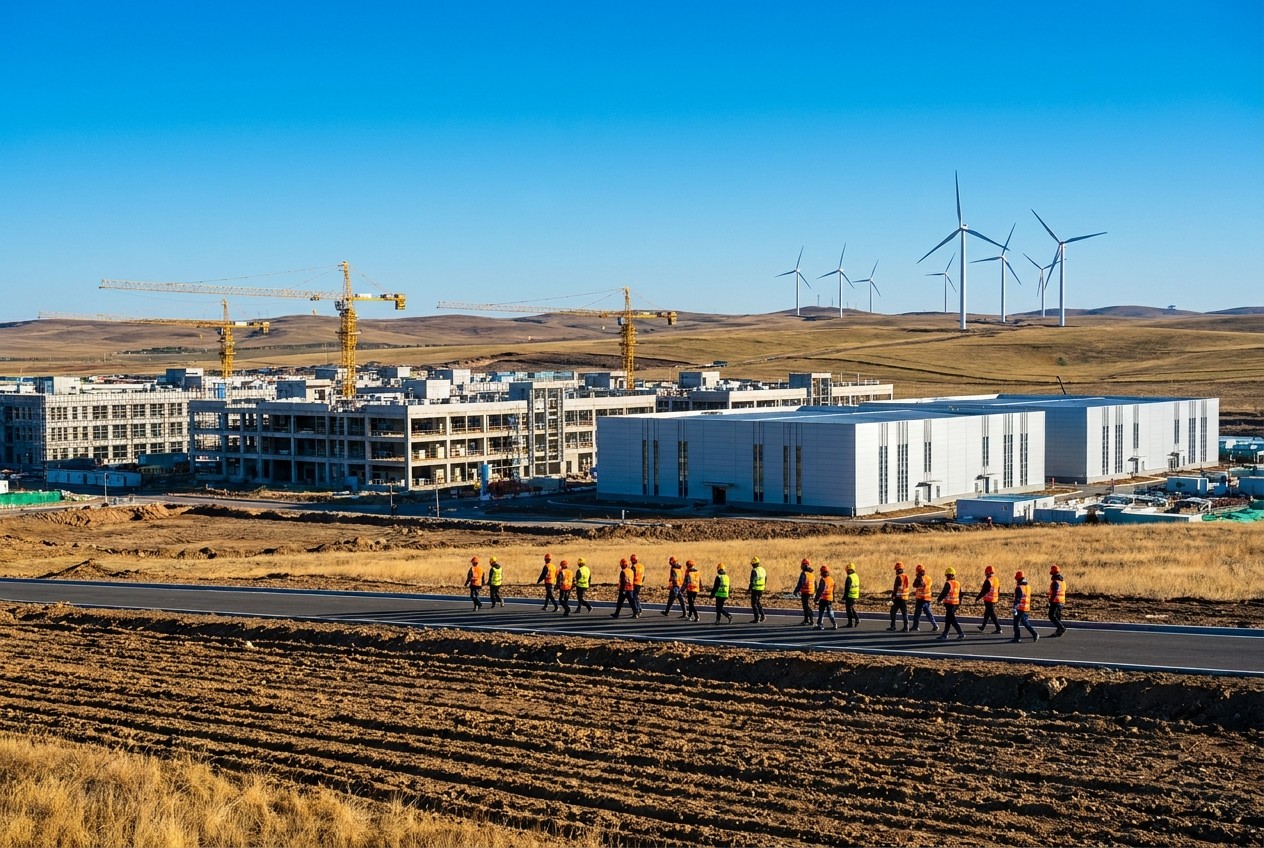
China is building a large artificial intelligence data center hub on the outskirts of Ulanqab in Inner Mongolia, according to a CBS News report published Thursday. The construction site, roughly the size of a small American city, contains dozens of data centers, with its scale evident from the network of new roads built to serve the development.
Chinese officials hope the expansive, rugged landscape will help power the country's ambition to surpass the United States as the global leader in artificial intelligence, according to the report [1]. The project is described as the biggest and fastest-growing infrastructure project anywhere in China at present, with multi-story data centers rising on farmland that for generations produced potatoes.
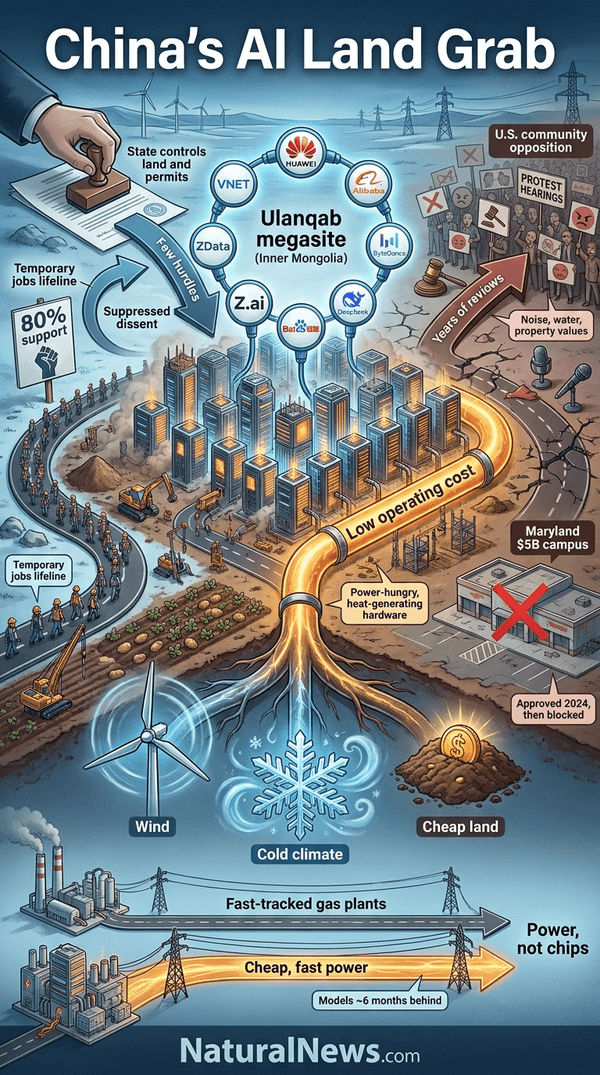
The contrast with the United States is stark. Data centers in the U.S. face major community opposition, while Chinese AI firms race to catch up and hope to overtake American tech giants with little pushback, the report stated [1]. In China, by contrast, developers encounter few hurdles, according to the same account. The divergence has turned the physical buildout of AI infrastructure into a visible measure of how the two countries are approaching the technology race.
Ulanqab Site Chosen for Energy, Climate, and Cost Factors
The region is one of the most consistently windy locations in the province, and its cold climate all year helps keep cooling costs down, the report stated. Land and labor are also more affordable in the remote region.
As many as 30,000 workers have been brought in from across China to help build the AI hub, the report stated. In a country experiencing an economic downturn and high youth unemployment, such mass infrastructure projects are described as welcome.
Local residents interviewed by CBS News described the changes in positive terms.
Construction Proceeds With Few Local Hurdles
China's government generally does not tolerate protests of any kind and tightly controls messaging across all media, according to the CBS News report [2]. A United Nations survey last year found that as many as 80% of people in China support data center construction. At least two-thirds of Chinese people use AI in their day-to-day life, according to the same account.
Henry Wang, founder and president of the Center for China and Globalization, told CBS News that public resistance is essentially absent.
Huawei, Alibaba, ByteDance, DeepSeek, Baidu, Z.ai, ZData, and VNET are all active in Inner Mongolia, according to the report.
U.S. Resistance and Energy Capacity Compared
Public skepticism in the United States has focused on electricity costs, water consumption, and land use, according to reporting on voter concerns ahead of the midterms [3]. The political pressure has begun to affect individual projects; a $5 billion data center campus proposed for a long-vacant mall site in Prince George's County, Maryland, drew organized local opposition after county planners approved it in 2024 [4].
Some experts believe access to power, not chips, will ultimately be the deciding factor in the global race for AI dominance. U.S. grid operators have moved to fast-track natural gas power plant construction to meet AI-driven energy demands, a decision approved by the Federal Energy Regulatory Commission, according to reporting from NaturalNews [5].
Wang told CBS News that power availability may prove decisive. "Chips may not become the latest diving criteria," Wang said. Chinese firms' AI models are believed to be about six months behind their U.S. competitors, due largely to restrictions on the sale of high-end microchips, but the gap is narrowing, the report stated.
Race for AI Dominance Hinges on Power and Infrastructure
Chinese officials hope the Ulanqab project will help power the country's ambition to surpass the United States in artificial intelligence, according to the CBS News report [1]. Construction continues on dozens of data centers in Inner Mongolia, more than any other part of the country, with the region becoming an AI hub, officials said. Under President Xi Jinping, AI development has become a national strategic priority for China, the report stated.
The scale of the buildout reflects a broader global surge in AI infrastructure spending. The market for AI platforms, services, hardware, and infrastructure has been growing by 40 to 55 percent annually, with the technology's economic value projected to leap from $185 billion in 2023 to as much as $990 billion before 2028, according to Trends Journal [6]. Bigger and more complex AI platforms drive the need for more chips, more factories, and more data centers, the journal stated.
The Ulanqab site combines all three: abundant generation capacity, construction costs estimated at roughly one-fifth of U.S. levels, and a public posture that offers little organized resistance. Whether those advantages translate into leadership in AI models themselves remains an open question, with Chinese firms still working to close a gap that the report attributes largely to chip restrictions.
References
- While many Americans resist, China embraces AI data center boom. https://www.cbsnews.com/news/china-ai-data-center-boom-as-us-tech-firms-face-resistance/
- While many Americans resist, China embraces AI data center boom. https://www.winknews.com/news/while-many-americans-resist-china-embraces-ai-data-center-boom/article_efa4f3d9-d914-42df-8283-80a6e639045d.html
- Voters Across America Are Wary of Data Centers. https://theepochtimes.com/us/voters-across-america-are-wary-of-data-centers-6108688
- Dumb Leftists KILL $5B Data Center, Prefer Trampoline Parks Over Jobs. https://modernity.news/2026/11/12/dumb-leftists-kill-5b-data-center-prefer-trampoline-parks-over-jobs/
- Back to basics: How natural gas is saving America's grid from collapse amid AI boom - NaturalNews.com, February 14, 2025.
- Trends-Journal-2024-10-01
Explainer Infographic











Please contact us for more information.