



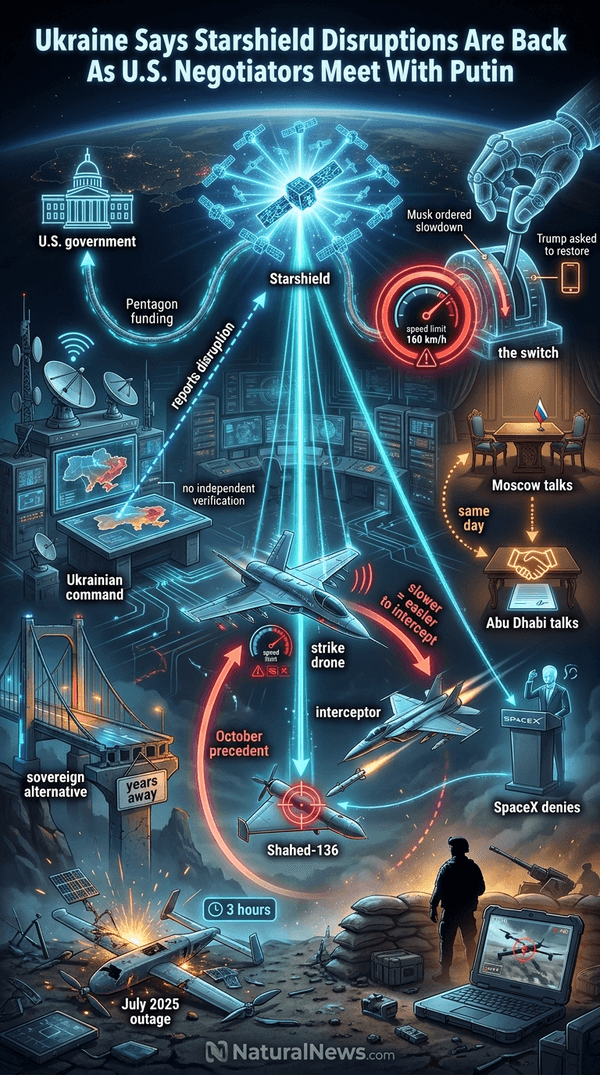
Ukrainian officials and frontline military personnel say SpaceX's Starshield satellite communications system is again subject to speed restrictions, the second such reported disruption in a month, according to statements issued Thursday. SpaceX denied that the service has been altered.
The Ukrainian complaints surfaced as U.S. special envoys Steve Witkoff and Jared Kushner met with Russian President Vladimir Putin in Moscow for peace talks, according to Russian media. The meeting followed two-day trilateral negotiations in Abu Dhabi that produced a prisoner-exchange agreement but no major breakthrough on ending the war.
Ukrainian officials have not publicly attributed the restrictions to a specific party, and the claims could not be independently verified. The episode again highlights Kyiv's reliance on a privately operated satellite network that is funded by the Pentagon and controlled, according to SpaceX chief executive Elon Musk, by the U.S. government.
Ukrainian Officials Report Systematic Speed Limits
Ukrainian President Volodymyr Zelensky said the limits primarily complicate the interception of Russian jet-powered drones.
Serhii Beskrestnov, a presidential advisor on defense technology, said on Telegram that the restrictions have renewed problems with communications for helicopters tracking Shahed drones and for interceptor aircraft that shoot down those drones, TWZ reported. Rob Lee, a senior fellow at the Foreign Policy Research Institute and a Marine veteran, said a frontline unit told him the 160 km/h limit in occupied areas is affecting mid-range strike drones, making them easier to intercept. "Some of their middle strike drones operate at higher speeds so they have to fly slower than necessary, leaving them vulnerable to interceptors," Lee told TWZ. He added that it is difficult to determine how battlefield operations are being affected because "it just started."
Starshield Is SpaceX's Military-Grade Satellite System
Starshield is a SpaceX satellite communications system designed for government and military clients, including the Pentagon. According to the company, Starshield "leverages SpaceX's Starlink technology and launch capability to support national security efforts" and uses additional high-assurance cryptographic capability to host classified payloads and process data securely, TWZ reported. SpaceX's Starshield division has also been tied to a classified satellite contract with a U.S. intelligence agency [1].
Olena Tregub, founder and secretary-general of Ukraine's Independent Anti-Corruption Commission, told The Associated Press that Starshield "is the version where you have much higher speeds, you have better connectivity and it's not available for civilians; it's available only for the military," according to TWZ. She said reliable, high-speed connectivity is essential for operations involving drones and units moving rapidly on the ground and in the air.
Ukraine uses Starshield terminals on aerial, sea and land drones for real-time video and control. Ukrainian officials acknowledge that domestic alternatives, including a planned national satellite communications system, will not come close to replacing the SpaceX system, TWZ reported. The dependence has drawn scrutiny before: a global Starlink outage in July 2025 left Ukrainian troops without critical battlefield communications for nearly three hours, according to NaturalNews.com [2].
Restrictions Affect Drone Operations, Interceptions
The reported speed limit affects interceptor drones used to shoot down Russian long-range one-way attack drones such as the Shahed-136, as well as mid-range strike drones that target Russian logistics deep behind the front line.
Lee said mid-range strike drones that operate at higher speeds must now fly slower than necessary, leaving them vulnerable to interceptors, and that more of those drones are being intercepted. He said the effect on battlefield operations is difficult to assess so far because the issue just started, TWZ reported.
A similar Starshield disruption occurred in October. After that episode, Musk said any limits on speed or usage were decided by the U.S. military and ultimately the president [3]. The Wall Street Journal later reported that Musk gave the order to slow Starshield, with sources divided over whether the decision was made in concert with President Donald Trump, and that Trump asked Musk to restore the service, according to TWZ. The restrictions were reported lifted later in October after disrupting operations for more than a week [4].
Talks Continue as SpaceX Denies Allegations
Witkoff and Kushner met with Putin in Moscow on Thursday, according to Russian media. Kushner told Putin that the U.S. sees progress on the European side and hopes to involve European nations in a multilateral format, according to the Russian TASS news outlet, as reported by TWZ. Putin "reaffirmed Russia's readiness for dialogue with European nations," according to the pro-Kremlin Izvestia outlet.
Russia is seeking permanent control over Crimea and four other regions in eastern and southern Ukraine, including territory still held by Ukrainian forces. Senior Ukrainian officials told the Financial Times they believed the speed restrictions were imposed to pressure Kyiv during the peace talks, according to Ars Technica [5].
SpaceX rejected the allegations. "This is false," a company official told TWZ. "There has been no change." The company has provided no further public explanation, and the Ukrainian claims have not been independently verified.
The dispute leaves unresolved who, if anyone, ordered the restrictions. It also raises broader questions about Ukraine's dependence on privately operated satellite communications and the U.S. military's reliance on SpaceX for critical infrastructure, particularly amid previous pricing disputes between the Pentagon and the company [6].
References
- SpaceX working with US intelligence agency on massive satellite network that captures ultra high resolution video - NaturalNews.com, March 20, 2024.
- Starlink's global outage leaves Ukrainian troops in the dark as battlefield communications fail - NaturalNews.com, July 25, 2025.
- Musk Says US Government Is Controlling Starshield Services Amid Reported Disruptions in Ukraine. https://theepochtimes.com/world/musk-says-us-government-is-controlling-starshield-services-amid-reported-disruptions-in-ukraine-6103852
- Ukraine says Starlink speed restrictions lifted after disruptions to military drones. https://justthenews.com/nation/technology/ukraine-says-starlink-speed-restrictions-lifted-after-disruptions-military-drones?utm_source=justthenews.com&utm_medium=feed&utm_campaign=external-news-aggregators
- Ukraine says it can’t stop Russian strikes because Starshield is limited again - Ars Technica. https://arstechnica.com/tech-policy/2026/11/ukraine-says-spacex-starshield-is-restricted-again-spacex-claims-it-isnt/
- SpaceX's satellite monopoly: Pentagon's costly reliance on a private company - NaturalNews.com, May 27, 2026.
Explainer Infographic









Please contact us for more information.