


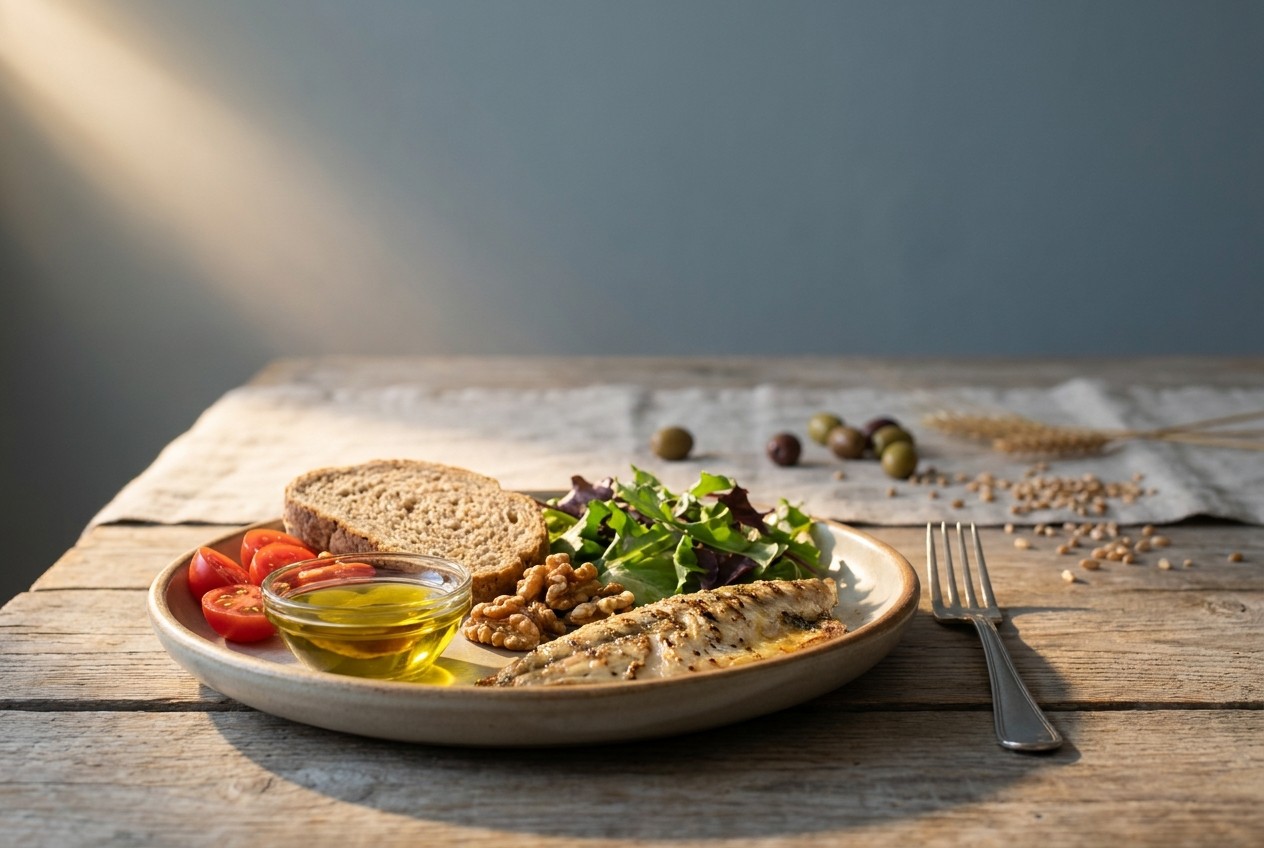
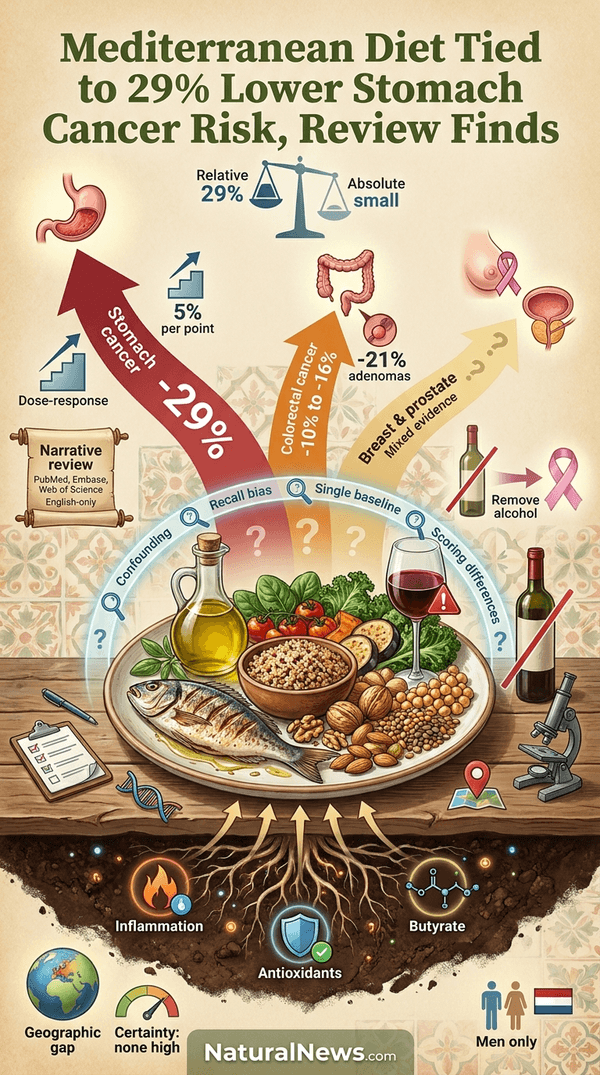
People who followed a Mediterranean-style diet most closely had a 29% lower risk of stomach cancer than those who followed it least closely, according to a narrative review published online Oct. 24, 2026, in The Innovation Nutrition by researchers Ji-Er Zhao and Wen-Qing Li of Peking University Cancer Hospital & Institute in Beijing. The review weighed existing research rather than presenting new trial data, and the authors cautioned that the 29% figure is a relative drop in risk, not a promise that 29 of every 100 people will avoid the disease.
The review also reported that colorectal cancer risk ran 10% to 16% lower in similar comparisons, while the evidence for breast and prostate cancer was mixed, according to the published findings. Most included studies were observational, meaning they tracked what people already eat rather than assigning diets at random, so the associations show links rather than proof of cause and effect. The authors described the evidence as more consistent for colorectal and gastric cancers than for other cancer types [1].
Review Scope and Method
Zhao and Li described their work as a narrative review that relied on a structured literature search and critical synthesis rather than a formal systematic review, according to the published paper. They searched PubMed, Embase and Web of Science for English-language studies published through August 2026, and included only English-language research in their assessment.
The review gathered large studies and combined analyses, some covering more than 3 million people, to ask whether eating the Mediterranean way lines up with fewer cancers. The diet centers on olive oil, produce, whole grains, fish and nuts, with less red meat and processed food, according to the review.
Examples cited in the review included a Greek study of 22,043 adults in which every 2-point increase in diet score was associated with a 24% lower risk of dying from cancer, according to the paper. An analysis that combined studies covering more than 1.4 million people found about a 10% lower risk of developing or dying from cancer among those closest to the diet versus those furthest from it. A separate body of research has similarly described the Mediterranean diet as generally consisting of fruits, vegetables, extra-virgin olive oil, fish, whole grains, legumes, moderate amounts of wine, and small amounts of red meat, and as associated with lower cancer incidence in large observational studies [2].
Stomach and Colorectal Cancer Show Most Consistent Links
The 29% stomach cancer figure came from an analysis of more than 1.3 million people, according to the review, and each added point on the diet score was associated with about a 5% lower stomach cancer risk. A Dutch study of 120,000 people showed the pattern in men and women, but it held up statistically only in men, the review stated.
For colorectal cancer, several analyses supported a 10% to 16% lower risk range, according to the review. One found the link for rectal cancer but not for colon cancer on its own, and another tied closer adherence to the diet to a 21% lower risk of adenomas, precancerous growths that can lead to cancer. The review attributed all of these findings to its cited analyses and did not present the associations as established causes.
Mixed Results for Breast, Prostate and Lung Cancers
Overall breast cancer risk showed a weak and inconsistent link, though the review said it appeared clearer for tumors not fueled by estrogen and in women past menopause, according to the paper. A slight protective link for prostate cancer disappeared once a later update added more studies, the review stated.
The lung cancer link was described as more modest and strongest in former smokers, with the review rating the lung evidence as low certainty because smoking can confuse the data. Authors of one analysis suggested that people who quit smoking tend to adopt other healthy habits, such as exercising more, that work alongside the diet. The authors also noted that many scoring systems award a point for moderate drinking even though alcohol is a well-established cancer risk factor on its own, and that two European breast cancer studies showed a clearer link when alcohol was left out of the score, according to the review. The observation aligns with guidance from the World Cancer Research Fund and American Institute for Cancer Research, which recommends the avoidance of any alcohol, unlike the previous version that allowed moderate consumption [3].
Limitations and Evidence Gaps
Most supporting evidence is observational, meaning it tracks what people already eat rather than assigning diets at random, so healthier people may gravitate toward this style of eating, according to the review. The authors cited several limitations: diet is often measured with questionnaires that rely on memory, most studies assess diet only once at the start, and scoring systems differ, especially on alcohol.
Zhao and Li used a descriptive grading framework rather than a formal GRADE assessment and noted that some meta-analyses overlap and should not be treated as fully independent evidence, according to the paper. No cancer type reached high certainty, and most evidence comes from European and American populations, with far fewer studies in Asian or African populations. A Singapore trial adapted the diet with soy milk, oat bran and millet, but it studied fatty liver disease, not cancer, the review noted.
The review stated that the evidence on biological mechanisms is indirect, drawing largely on blood markers, animal experiments and small human studies rather than cancer outcomes. Trials found lower blood markers of inflammation in people on the diet, and long-running inflammation can damage DNA, while olive oil and colorful produce supply antioxidants that curb cell damage and fiber feeds gut bacteria that make a substance called butyrate, which may have tumor-fighting effects in the colon, according to the review. Most of that evidence comes from blood tests, animal experiments and small human studies, not from cancer diagnoses over time.
Conclusion
The review concluded that a Mediterranean-style diet is linked to lower odds of some of the most common cancers, and that the biology is plausible but not directly demonstrated, according to Zhao and Li. Until trials show whether the food itself deserves the credit, the review described the eating pattern as a reasonable bet, not a shield, the authors stated.
Zhao and Li called for more randomized trial evidence, according to the review. The source article describes the information as informational only and not a substitute for guidance from a qualified healthcare professional.
References
- REVIEW Mediterranean diet and cancer risk: Current understanding and .... https://www.the-innovation.org/data/article/nutrition/preview/pdf/TIN-2026-0053.pdf
- Outside the Box Cancer Therapies. Mark Stengler, Dr. Paul Anderson
- Adherence to the World Cancer Research FundAmerican Institute for Cancer Research. PScript5dll Version 522
Explainer Infographic











Please contact us for more information.