



A pooled analysis of data from 17,068 people found that higher folate intake was associated with a lower risk of colorectal cancer, according to a report on the findings published by mindbodygreen [1].
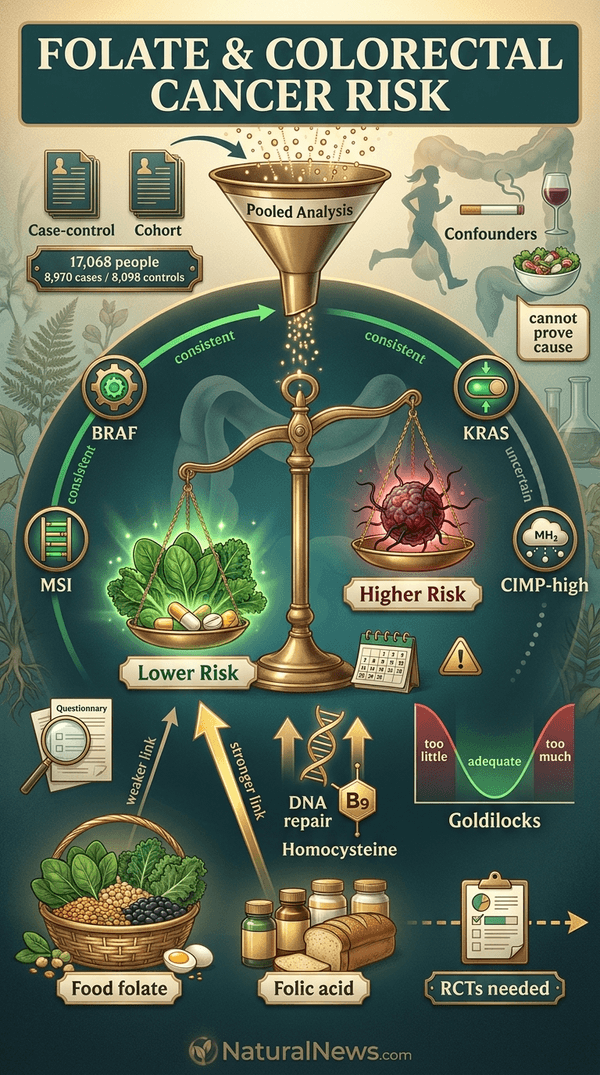
The analysis published in the American Journal of Clinical Nutrition combined data from multiple case-control and cohort studies and included 8,970 people with colorectal cancer and 8,098 without it [2]. Participants reported how much folate they obtained from food and supplements through diet questionnaires, and researchers compared intake levels across different tumor characteristics. The association was clearest for total folate intake and for folate from supplements, while folate from food alone showed a weaker link.
Because the underlying data came from observational studies, the findings point to a connection rather than proof that folate prevents cancer, according to the report. People who consume more folate may also have other habits that influence their health, the report noted.
Folate's Role in Health and Previous Research
Folate is the natural form of vitamin B9 commonly found in foods such as green leafy vegetables, dried beans and peas, according to NaturalNews.com. When taken as a supplement or used as an additive in foods like bread, grains or breakfast cereal, it is called folic acid, the outlet reported. Folate helps make DNA and RNA, the body's genetic material, and plays a crucial part during stages of rapid cell and tissue growth.
The nutrient is found in spinach, kale, lentils, chickpeas, black beans and egg yolks, as well as in fortified breads and cereals, according to the mindbodygreen report. Folate also helps regulate homocysteine, a compound involved in several processes throughout the body, the report stated.
Colorectal cancer is a major cause of cancer deaths worldwide, and research on modifiable risk factors has drawn attention from nutrition researchers. A 2025 review of 17 studies cited by NaturalNews.com found that modest daily servings of cruciferous vegetables, which supply folate along with other compounds, were associated with a 17% lower colon cancer risk.
Not all research on B vitamins and cancer has pointed in one direction. A review cited by the National Institutes of Health found that although sufficient B vitamin intake could reduce cancer progression and risk, excessive supplementation – specifically with vitamins B9, B12 and B6 – has been associated with accelerated tumor growth in certain cancers, such as colorectal, prostate and lung cancer.
Study Methodology and Tumor Types Analyzed
Researchers used dietary questionnaires to assess folate intake among the 17,068 participants and compared it across different tumor characteristics, including BRAF and KRAS gene mutations, microsatellite instability and CIMP-high status, the report stated.
Colorectal cancer does not always develop in the same way, and the study set out to see whether folate's relationship with cancer risk held up across genetic differences in tumors, according to the report. Tumors can carry different genetic features, and the analysis examined whether the folate association was consistent across those groups, the report said.
The question of how diet influences colon cancer has been studied for decades. A textbook on nutrition in disease prevention describes several major, overlapping hypotheses about the nutrition-related mechanisms involved in adenocarcinoma of the colon and stresses the difficulty of identifying a single mechanism.
A separate clinical development plan for folic acid, published in the Journal of Cellular Biochemistry, noted that epidemiological studies had established an association between low dietary or low serum folate levels and the incidence of colon and cervical cancer. It cited strong epidemiological evidence suggesting that a diet low in folate is associated with increased incidence of colorectal adenoma and cancer.
Results: Consistent Association Across Most Tumor Types
People who consumed more folate had a lower risk of colorectal cancer, and the pattern was fairly consistent across different tumor types, including those with BRAF or KRAS gene mutations and those with microsatellite instability, according to the mindbodygreen report. The association was clearest for total folate intake and folate from supplements, while folate from food alone showed a weaker link, the report stated.
There was one possible exception. The association was weaker for a tumor type called CIMP-high, but the difference was not strong enough to draw a firm conclusion, according to the report. The findings suggest that the relationship between folate and colorectal cancer is not limited to just one tumor type, the report said.
Earlier work has pointed in a similar direction: A Korean hospital-based case-control study involving 1,105 subjects aged 30 to 79, including 509 controls, found what researchers described as a statistically significant relationship between higher dietary folate intake and reduced risk of colorectal, colon and rectal cancer in women, according to ANH International. The positive results were evident among women rather than men, that report stated.
Even so, the authors of the pooled analysis cautioned that people who consume more folate may also have other habits that influence their health, and that observational data cannot establish cause and effect, according to the mindbodygreen report.
Caveats and Takeaways for Consumers
Because the study was observational, it does not prove that folate prevents colorectal cancer, according to the report. The analysis points to a connection rather than proof that folate prevents cancer, and people who consume more folate may also have other habits that influence their health.
The report advised getting folate from a balanced diet rich in leafy greens and legumes, and it cautioned readers to think carefully before supplementing. According to the report, the study does not prove that folic acid supplements prevent colorectal cancer, and readers should talk with a health care provider before starting one, particularly if they have individual health considerations that affect their needs.
Questions about supplemental folic acid have surfaced before. A Chilean study published in the European Journal of Gastroenterology and Hepatology, led by Dr. Sandra Hirsch, provided what ANH International described as further temporal evidence that synthetic folic acid fortification may be associated with an increased risk of colon cancer, and the group noted similar time-based associations reported from the United States and Canada.
ANH International also reported that a group of Canadian researchers found that high-dose folic acid supplements given to rats could have tumor-promoting effects, while cautioning about extrapolating rodent results to humans. The practical takeaway, according to the mindbodygreen report, is that adequate folate intake supports healthy cell function, and cancer-prevention promises should be left to stronger clinical evidence.
References
- This Common B Vitamin Was Linked To Lower Colorectal Cancer Risk. https://www.mindbodygreen.com/articles/this-common-b-vitamin-was-linked-to-lower-colorectal-cancer-risk
- Folate and folic acid intake in relation to molecular subtypes of colorectal cancer: pooled analyses of up to 8970 cases and 8098 control participants. https://www.sciencedirect.com/science/article/pii/S0002916526004363?via%3Dihub
Explainer Infographic












Please contact us for more information.