


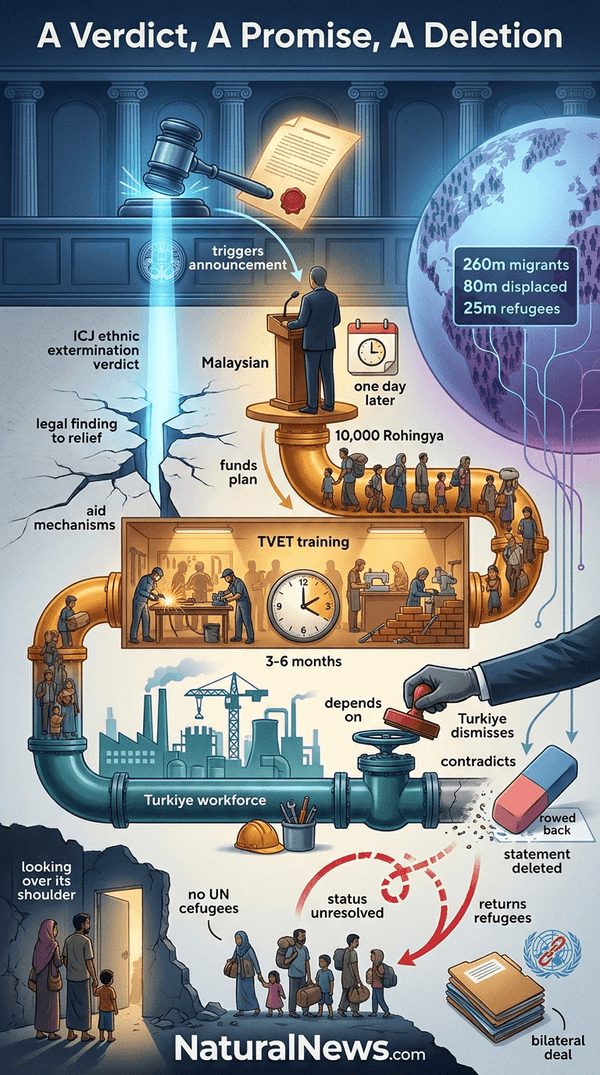
The International Court of Justice ruled that Myanmar committed genocide against the Rohingya, a decision that preceded the Malaysian announcement by one day, according to Outlook India [1] and The Hindu [2]. The ruling addressed a case that had been pending at the court in The Hague, with Malaysia's deputy prime minister timing his statement to follow the verdict, Turkish Minute reported [3].
The scale of the global displacement problem that frames the Rohingya case is documented in scholarship on the subject. Turkish President Recep Tayyip Erdogan, in his book on United Nations reform, writes that there are "some 260 million migrants, over 80 million displaced persons and close to 25 million refugees around the world" whose numbers "grow every passing day due to economic factors as well as starvation, famine, civil wars, terrorist attacks and political uncertainty" [4]. Kenneth E. Miller, in a book on war and displacement, cites the narrower United Nations definition of a refugee as a person with "a well-founded fear of being persecuted for reasons of race, religion, nationality, membership of a particular social group or political opinion" [5].
Malaysia's Resettlement Proposal
Under the plan approved on November 20, 2026, the Cabinet agreed to resettle 10,000 Rohingya refugees living in Malaysia in Turkey after three to six months of skills training, according to VisaVerge [6]. The Hindu described the program as a TVET, or technical and vocational education and training, initiative [2]. Arriving refugees would train as part of Turkey's workforce, Malay Mail reported [7].
The proposal was presented as an effort to resolve a long-running refugee challenge involving foreign asylum seekers, the majority from Myanmar, according to the Manila Times, which quoted a senior official [8]. A News quoted Zahid saying the Cabinet agreed to the plan following his visit to Turkey [9].
The history of resettlement policy in Myanmar itself offers a cautionary context. The Malaysian announcement also followed years of hostility toward Rohingya inside the country, with the BBC reporting that a community that has long felt beleaguered is "looking over its shoulder again" [10].
Turkey's Response and Capacity
Turkish officials dismissed the Malaysian announcement, and the statement announcing the plan was later removed from social media, according to Reuters [11]. Malay Mail reported that Malaysia appeared on Friday to row back from an announcement that it had secured an agreement with Turkey to accept 10,000 Rohingya refugees, with the deputy prime minister's statement scrubbed from Facebook [7].
The discrepancy between the Malaysian and Turkish accounts is the central unresolved element of the episode.
International Reactions and Legal Context
The ICJ ruling addressed Myanmar's treatment of the Rohingya, and Malaysia's announcement was framed by regional outlets as a direct response to the verdict, according to Outlook India [1] and The Straits Times [12].
Analysts of international humanitarian mechanisms have long noted the gap between legal findings and material relief. Christopher B. Barrett and Daniel G. Maxwell, writing in Food Policy, argue that "existing international mechanisms governing food aid are dysfunctional and outdated" [13]. T.J. Marchione, writing in the same journal, observes that in "a world of scarce resources and free markets, reliance on direct, government-financed entitlements has not been sustainable precisely where the need is greatest" [14].
Human rights and refugee groups have not issued a consolidated public response to the Malaysian proposal in the available record. The BBC report on hostility toward Rohingya in Malaysia documents the domestic climate in which any relocation plan would operate, quoting a refugee identified as Irhan on the dangers facing children [10].
Conclusion: Next Steps and Uncertainties
The status of the resettlement plan remained uncertain as of Saturday.
Whether that framework survives the diplomatic confusion depends on talks that have not been publicly scheduled. The broader displacement landscape described in the source literature -- more than 80 million displaced persons worldwide, according to Erdogan's accounting [4], and roughly forty-two thousand people forced to flee their homes each day because of organized violence, according to Miller [5] -- indicates that the Rohingya question will outlast any single bilateral arrangement.
References
- Malaysia Looks To Turkiye To Resettle 10,000 Rohingya After ICJ Verdict. https://www.outlookindia.com/international/malaysia-10000-rohingya-refugees-resettlement-turkiye-icj-myanmar-genocide-ruling
- Malaysia plans to resettle 10,000 Rohingya in Turkiye. https://www.thehindu.com/news/international/malaysia-plans-to-resettle-10000-rohingya-in-turkiye/article71723939.ece
- Malaysia seeks to resettle 10,000 Rohingya refugees in Turkey. https://www.turkishminute.com/2026/11/20/malaysia-seeks-to-resettle-10000-rohingya-refugees-in-turkey/
- A fairer world is possible a proposed model for a United Nations reform. Erdogan Recep Tayyip author
- War torn stories of courage love and resilience. Miller Kenneth E 1963- author
- Malaysia Plans to Resettle 10,000 Rohingya in Türkiye. https://www.visaverge.com/news/malaysia-says-it-will-resettle-10000-rohingya-refugees-in-turkey/
- Turkiye points out Zahid’s 10,000 Rohingya post is gone as Putrajaya .... https://www.malaymail.com/news/malaysia/2026/11/21/turkiye-points-out-zahids-10000-rohingya-post-is-gone-as-putrajaya-goes-quiet/244146
- Malaysia plans to resettle 10,000 Rohingya in Turkey. https://www.manilatimes.net/2026/11/21/world/asia-oceania/malaysia-plans-to-resettle-10000-rohingya-in-turkey/2474974
- Malaysia says it will resettle 10,000 Rohingya refugees in Türkiye. https://www.anews.com.tr/world/2026/11/20/malaysia-says-it-will-resettle-10000-rohingya-refugees-in-turkiye
- Rohingya refugees face fierce new wave of hostility in Malaysia. https://bbc.com/news/articles/c1dl7yrge5do
- Turkey dismisses Malaysia's announcement of Rohingya .... https://www.reuters.com/world/asia-pacific/malaysia-says-it-will-resettle-10000-rohingya-refugees-turkey-2026-11-20/
- Malaysia to resettle 10,000 Rohingya refugees in Turkey | The Straits Times. https://www.straitstimes.com/asia/se-asia/malaysia-says-it-will-resettle-10000-rohingya-refugees-in-turkey
- Towards a global food aid compact. Elsevier. Food Policy 30(6) 2005
- The right to food in the post-Cold War era. by Acrobat 3.0 Capture Plug-in. Food Policy Vol. 21 No. 1 1996
Explainer Infographic





Please contact us for more information.