



Why Most Search Engines Become Obsolete This Friday
On Friday, I am releasing BrightKB.com -- a free, open-source, locally-run knowledge engine -- and I will say plainly what the tech press will dance around for months: it renders the vast majority of search engines obsolete overnight. Not because I hate Google. Not because I have a grudge against Big Tech. Because the technology has simply moved past the entire premise of indexing web pages and returning ranked lists of links that you must then click through, evaluate, and hope aren't traps.
The honest exceptions are narrow. If you want to know which local restaurant is open right now, whether a bridge collapsed this morning, or what the weather looks like in your zip code, a search engine still does that job. Breaking news, local geography, location-based services -- that's what's left after a tool like BrightKB takes the rest. Everything else, every genuinely knowledge-based question, is now a solved problem that search engines no longer solve well.
I've spent three years and nearly $3 million building this alternative. My case is simple: search engines never actually extracted knowledge -- they sold attention to advertisers while pretending to answer your question. As Google's founders Sergey Brin and Larry Page noted in their 1998 paper, "The Anatomy of a Large-Scale Hypertextual Web Search Engine," "...we expect that advertising-funded search engines will be inherently biased towards the advertisers and away from the needs of consumers" [1]. BrightKB breaks that model entirely, and Friday is when you get to judge the results yourself.
Search Engines Never Gave You Answers -- They Gave You Homework
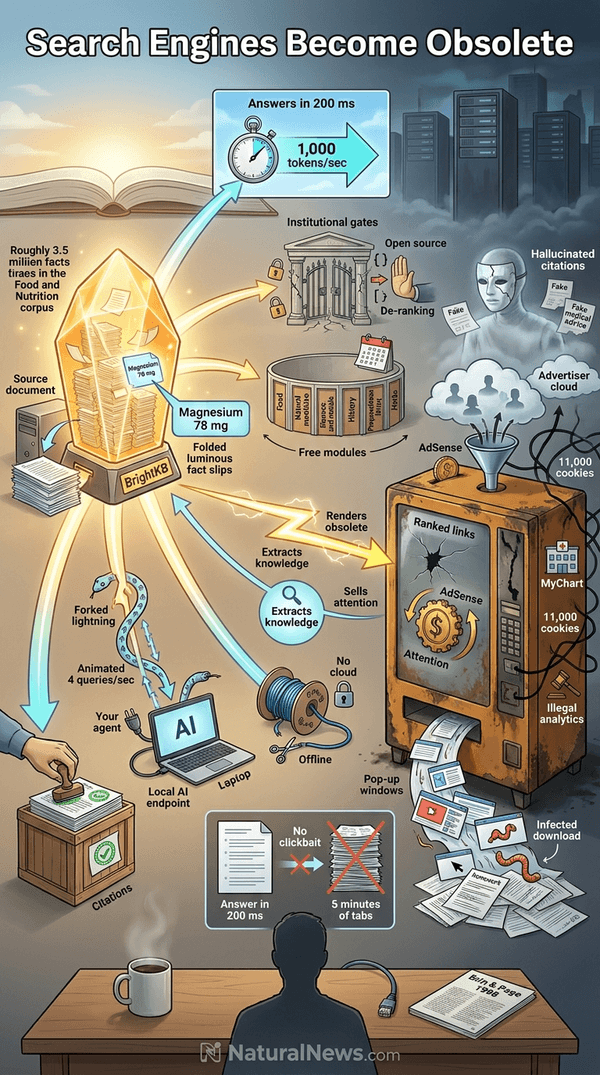
Ask a search engine what foods are a good source of magnesium. Watch what happens. You get a list of pages -- not an answer, not a knowledge extraction -- just millions of pages ranked by an algorithm that has no interest in whether you actually learn anything. Then the pop-ups load. Then the ads. Then the clickbait graphics designed to hijack your attention. And on a surprisingly regular basis, then the malicious code -- the kind that tricks users into downloading something that infects their own machines.
That's the product: homework, dressed up as an answer. And the pages you're allowed to find are filtered through a corporate bias layer before you ever see them. As Robert Epstein, the Harvard-trained psychologist who founded the Cambridge Center for Behavioral Studies, has documented, Google has the power to manipulate what you see online, targeting you with certain advertisements and burying search results they'd rather you not see [2]. Google's Chrome browser was observed ushering more than 11,000 tracker cookies into a user's browser in a single weeklong experiment [3]. This isn't a side effect of the business model -- it is the business model.
The underlying economics make this unavoidable. AdSense revenue depends on keeping you clicking, not on getting you the answer. Google's founders confessed as much in 1998 [1]. And the model is collapsing anyway -- as AI-driven answer engines multiply, they introduce a new challenge for publishers and content creators: monetization [4], because the entire search-advertising funnel exists to route your eyeballs into somebody else's monetization scheme. Meanwhile Google is re-engineering Search into a fully AI-infused experience, as the company announced in its most recent overhaul [5], chasing the same answer-engine shift that has already begun to hollow out classic keyword search [6].
Beyond the business model, there is the surveillance problem. Google is the largest and clearest digital monopoly on the planet -- it dominates online search and advertising, which in itself leads to automatic bias [3]. It tracks users on hospital websites and inside password-protected health information portals like MyChart [7]. It collected personal data through Google Analytics in ways that a French regulatory agency found breached European privacy laws [8] -- meaning the company's data-harvesting apparatus has already been ruled illegal in at least one jurisdiction. Every query you type is logged, profiled, and monetized. Every click trains a targeting system whose beneficiaries you will never meet. This is a spy machine, and its death cannot come soon enough.
What BrightKB Does Differently
BrightKB is not AI and it doesn't pretend to be. It's a curated, citation-backed knowledge system built from tens of millions of facts extracted from real documents. The Food and Nutrition module launching Friday carries roughly 3.5 million facts, every single one traced back to the source document it came from. When you ask it what foods are a good source of magnesium, you get a list of foods, a magnesium amount per serving, and the exact document the fact was pulled from. No pop-ups, no research tasks, no homework.
Performance numbers matter here because they determine whether a tool actually replaces your habits. Answers typically arrive in 200 milliseconds or less. Output throughput exceeds a thousand tokens per second. It runs on your own machine with no GPU, no account, no email, no login, and no tracking of prompts, queries, or location. Pull the internet cable out of the wall and BrightKB still works perfectly offline. That last feature alone changes the security calculus of knowledge lookup -- nothing you ask it can be logged by anyone, because nothing leaves your machine.
It cannot hallucinate the way chatbots do, because its code can only cite the document a fact actually came from. This is the critical architectural distinction. My AI engines at BrightAnswers.ai and BrightU.ai were built on the same principle: I disabled internal knowledge entirely, because all LLMs hallucinate internal knowledge, and instead supply extensive external knowledge for every prompt so that citations come from verified documents rather than from model memory [9]. The public is already getting burned by the alternative -- chatbots generating dangerously flawed medical advice while users trust them as oracles [10] -- and experts warn that generative chatbots hallucinate fake citations and fake dates on exactly the kind of simple knowledge lookup BrightKB was designed to handle perfectly.
More than 20 free modules are coming: natural medicine, finance and metals, history, preparedness, off-grid living and much more. The knowledge set behind them draws on the same document corpus I've spent three years hand-curating through qualification and scoring systems. Whether that title holds up is for you to verify, but I believe this is the best-curated knowledge dataset ever assembled for the things that actually matter to your life.
It Also Buries the Chatbots -- And Frees Your AI Instead of Feeding It
Most people use AI chatbots at a fraction of their capability -- asking for recipes and trivia, then paying for the privilege with hallucinations, fake citations, and fake dates. That's a terrible trade for simple knowledge lookup. Large language models can go down rabbit holes much faster than you can [11], but rabbit holes are not what you want when you need a magnesium number you can trust. Chatbots are reasoning engines being abused as dictionaries, and dictionaries are exactly what they're worst at.
BrightKB runs locally and exposes its own local AI-compatible endpoint. That means your agent, your harness, or your Python script can query it four times per second and feed cited, factual context into whatever reasoning model you already use. This is augmentation, not replacement. Your AI gets the knowledge layer it has always lacked, and you keep the reasoning model you've already tuned to your workflow -- without shipping your queries to anyone's cloud. The whole point of the decentralization argument is that there is no server, no surveillance, no corporate choke point on what you're allowed to know, and none of the ideological filters that mainstream engines and AI assistants bake in by default.
The leverage is real. One query in 200 milliseconds can replace twenty hours of manual research. For someone writing a book, building a fitness site, running a homestead, or trying to learn a genuinely difficult subject, that is transformative -- you stop spending your life in the tabs and start spending it on the work. This is what it means to be genuinely free with knowledge. When AI and open-source tooling are handed to individuals rather than concentrated in a handful of corporate data centers, human capability goes up instead of down.
There's a deeper principle at stake. In every previous generation, access to knowledge was gated by institutions -- publishers, universities, media conglomerates, search monopolies. Each gate claimed to serve the public and each gate eventually proved to serve itself. Local, offline, open-source knowledge tools break that pattern permanently, because a tool that runs on your own hardware with no network connection cannot be shut off, throttled, de-ranked, or memory-holed by anyone. That is the part of this story the establishment will hate most, and it's the part I'm proudest of.
This Is What Decentralized Knowledge Looks Like
Recapping the core promise: for knowledge-based questions, BrightKB replaces search engines and most chatbot use cases entirely. Search engines get narrowed to breaking news and local geography -- a real but drastically smaller job than the one they claimed to do for the past quarter century. We are living through the most significant civilizational pivot in human history: a transition from centralized control to a distributed, decentralized order [12], and knowledge is one of the four pillars of that transition alongside money, energy, and power itself [13].
The stakes are values, not just features. Privacy, self-reliance, no accounts, no tracking, open source, offline capability -- and making Google's surveillance-and-ad business model obsolete as a feature rather than a side effect. This aligns with the Great Divergence: the most powerful tool in history, artificial intelligence, is being concentrated in the hands of just a handful of corporate giants who decide what you see, what you know and what you're allowed to say -- unless users choose decentralized alternatives where that same power is spread across millions of people [14]. The technocratic elite is systematically dismantling the last vestiges of human autonomy, prioritizing machines over men, algorithms over souls [15]. BrightKB is a direct refusal of that program.
So here's the ask. Go to BrightKB.com this Friday or over the Thanksgiving weekend. Download the Windows or Linux build. Poke at it. Ask it something you actually care about. Check the citations. Then judge for yourself whether this is the game changer I say it is. If I'm wrong, the search engines will still be there Monday morning, and so will the trackers, the ads, the manipulative result-ranking, and the surveillance. If I'm right, you'll never look at a search box the same way again.
I've been building free tools to empower humanity with uncensored knowledge for years -- BrightAnswers.ai as an honest AI engine, BrightLearn.ai for free books, BrightVideos.com as a free speech video platform, Brighteon.social as a free speech social alternative, and BrightNews.ai for AI-analyzed independent news trends. BrightKB is the next step. Try it, then tell me what you think. This tool can upgrade your life and protect your privacy while giving you off-line, off-grid knowledge that really matters in real life.
References
- Google Spies on Your Kids Knows Everything A - Mercola.com, September 16, 2022. by Mercola.com
- Harvard Trained Psychologist Exposes Googles - Mercola.com, May 06, 2022. by Mercola.com
- Google Spies on Your Kids Knows Everything A - Mercola.com, August 06, 2019. by Mercola.com
- Browsing obsolete: Examining the AI search era - IBM. https://www.ibm.com/think/news/ai-new-search-experience
- Google Search Is Dead. Welcome to the Era of the 'Intelligent Search Box'. 2026-05-19T00:00:00Z. https://gizmodo.com/google-search-is-dead-welcome-to-the-era-of-the-intelligent-search-box-2000760626
- AI means the end of internet search as we've known it. 2025-01-06T00:00:00Z. https://www.technologyreview.com/2025/01/06/1108679/ai-generative-search-internet-breakthroughs/
- Does Facebook Have Your Medical Records - Mercola.com, July 19, 2022. by Mercola.com
- Court Says Google Analytics Is Illegal - Mercola.com, May 18, 2022. by Mercola.com
- Notice to All Pro Freedom Content Publishers: Here's How to Dramatically Amplify Your Influence and Reach in 2026 and Beyond - NaturalNews.com, December 23, 2025. by NaturalNews.com
- The Window Is Closing: AI Chatbots Are Poisoning Public Health with Misinformation. 2026-04-17T06:00:00.000Z. https://www.naturalnews.com/2026-04-17-ai-chatbots-poisoning-public-health-with-misinfo.html
- AI Is Taking Over Your Search Engine. Here’s What It’s Doing ... - CNET. https://www.cnet.com/tech/services-and-software/ai-is-taking-over-your-search-engine-heres-what-its-doing-and-why-it-matters/
- The Great Decentralization Transition: Why the Old System Is Dying and a New Era of Freedom Is Painfully Emerging - NaturalNews.com, September 22, 2026. by NaturalNews.com
- The Great Decentralization Transition: Why the Old System Is Dying and a New Era of Freedom Is Painfully Emerging. 2026-09-22T06:00:00.000Z. https://www.naturalnews.com/2026-09-22-the-great-decentralization-transition-old-system-dying.html
- The Great Divergence: Why decentralized AI is your last bastion of freedom. 2026-05-22T06:00:00.000Z. https://www.naturalnews.com/2026-05-22-the-great-divergence-decentralized-ai-bastion-freedom.html
- The Technocratic Takeover: Why We Must Resist the Digital Enslavement of Humanity. 2026-05-21T06:00:00.000Z. https://www.naturalnews.com/2026-05-21-the-technocratic-takeover-why-we-must-resist.html
Explainer Infographic










Please contact us for more information.