


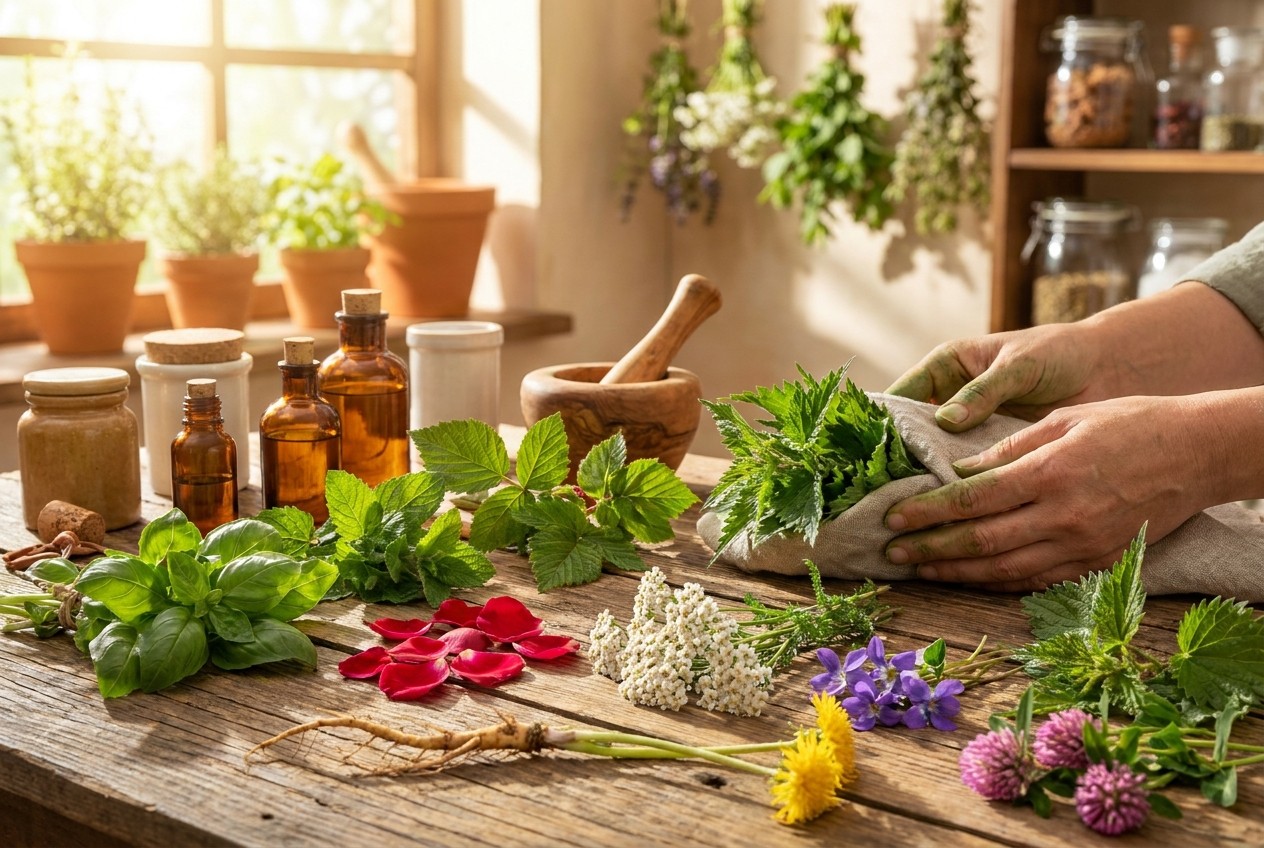
Clinical herbalist and master gardener Alexandra Roach published an article on Nov. 16, 2026, in The Epoch Times listing 10 herbs for a home apothecary. The article states that the herbs have traditional uses including mood support, skin soothing, and headache relief [1].
Roach wrote that herbal traditions and folklore developed across cultures through generations of observation and experience, long before pharmacology became an experimental science in the 19th century. She wrote that modern research can help clarify how traditional remedies work and which uses are supported by evidence.
The article lists the herbs in numbered order, along with traditional uses, plant parts used, simple preparations, and safety notes. The list reflects a broader interest in home-based herbal medicine.
Safety and Preparation Guidance
The article states that medicinal herbs vary in strength, preparation, and safety. According to Roach, some herbs can interact with medications or may not be suitable during pregnancy, breastfeeding, or for children [1].
Herbal reference works echo the caution. The same volume lists specific contraindications for individual plants, such as avoiding licorice in significant amounts during pregnancy and in cases of high blood pressure, kidney problems, or Warfarin use [2].
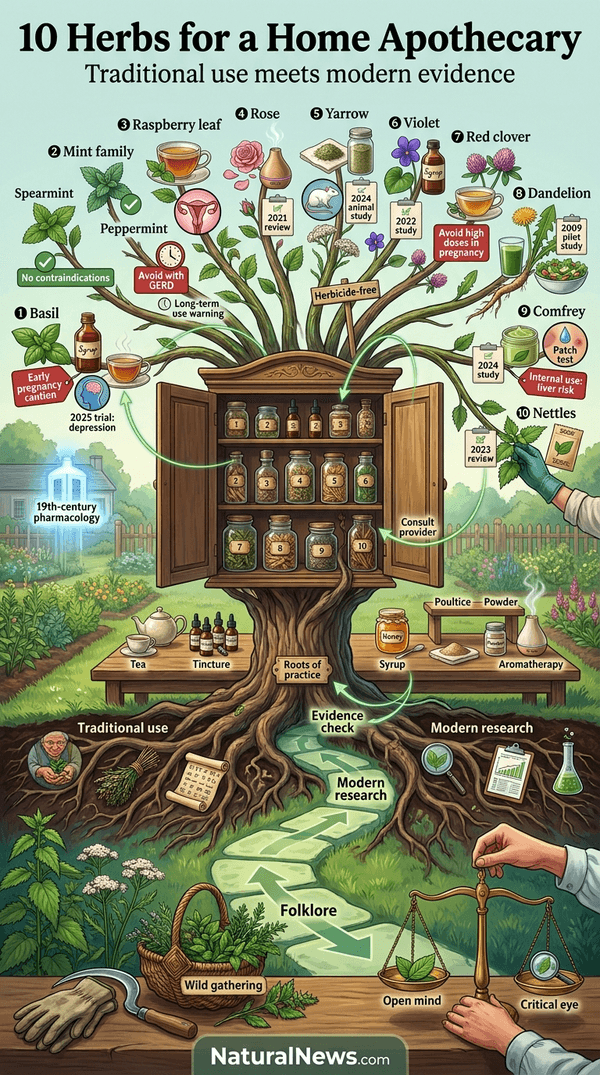
Roach's article presents each entry with a safety note alongside its traditional uses. For basil, she wrote that medicinal doses are contraindicated during early pregnancy for those who wish to become pregnant. For raspberry leaves, she noted caution for people with constipation. For comfrey, she warned against prolonged internal use, which she wrote could cause liver damage.
Basil, Mint, and Raspberry Leaves
Roach wrote that basil is antimicrobial and anti-inflammatory and is traditionally used to stimulate the brain and reduce stress. She listed its best uses as relieving brain fatigue, depression, and anxiety, with the leaves prepared as a syrup, tincture, or tea. A 2025 clinical trial involving 60 patients with major depressive disorder found greater improvements in anxiety and depression symptoms when basil syrup was added to the antidepressant sertraline than when a placebo was added.
The article states that herbs in the mint family, Lamiaceae, are used for simple nausea and indigestion, with the leaves prepared as an herbal tea. Roach wrote that spearmint has no contraindications, while peppermint should not be taken long-term and should be avoided by people with gastroesophageal reflux disease, peptic ulcers, hiatal hernia, or gastritis.
Meanwhile, raspberry leaves have a special affinity with the female reproductive system, with the leaves prepared as a tea. Roach wrote that scientific evidence is limited, but a 2021 review found that raspberry leaves affect smooth muscle tissue, including the uterus. She also cited a 1999 study indicating that drinking raspberry leaf tea may shorten labor and decrease the likelihood of membrane rupture during birth.
Rose, Yarrow, and Violets
Roach wrote that rose calms and restores irritated areas of the body, such as mucous membranes, and calms irritability by working through the parasympathetic nervous system. She listed its best use as reducing excess heat, or inflammation and irritability, in the body and mind, with flower petals prepared through aromatherapy, tincture, or herbal tea. According to the article, a 2024 review highlighted the rose's potential antioxidant, anti-inflammatory, antimicrobial, and stress-relieving properties.
The article states that yarrow has a long history as a "blood stopper" and probably grows in many backyards and green fields, provided it has been protected from herbicides and other sprays. Roach listed its best uses as passive hemorrhage, bleeding wounds, or cuts, with the upper leaves and flower heads prepared as a poultice, powder, extract, or tea. She cited a 2024 animal study in which researchers found that applying yarrow powder with gauze to wounds in rats reduced bleeding time by about 36 percent compared with gauze alone.
According to Roach, violets have a long history of medicinal use as an anti-inflammatory and alterative agent supporting the body's drainage network and respiratory function. She listed migraines and respiratory ailments as their best uses, with leaves and flower heads prepared as a syrup, tea, or tincture. She wrote that most evidence comes from traditional use, and she cited a 2022 study finding that violet syrup might support treatment for COVID-19 and other viral infections by helping with symptoms such as cough, muscle pain, and headaches.
Red Clover, Dandelion, Comfrey, and Nettles
Roach wrote that red clover is an effective detoxifier used for lymphatic congestion and anticancer properties, with the flower heads prepared as a tea or tincture. However, high doses should be avoided by pregnant women with a history of miscarriage. A 2021 systematic review of 80 scientific articles found that red clover shows antioxidant and anticancer effects.
Dandelion leaves support weak kidneys and promote diuretic activity, which increases urine production, while the roots help strengthen liver function and enhance digestive output. Roach listed edema and detoxification as its best uses, with leaves and roots used in salads, fresh-pressed juice, tea, or tincture. She cited a 2009 pilot study published in the Journal of Alternative and Complementary Medicine finding that dandelion leaf extract increased urination frequency within five hours of the first dose and again after the second dose, and that urine output also increased.
According to Roach, comfrey has long been known for its skin-healing properties, with its gel-like substance forming a protective, soothing film over minor wounds and mucous membranes. She cited a 2024 study that observed comfrey's anti-inflammatory and skin-regenerative benefits and considered topical application generally safe but advised patch-testing, especially for people with sensitive skin.
Nettles are rich in vitamins, minerals, and protein, while their seeds contain essential fatty acids, and that they are used for anemia and other deficiencies. Roach warned that raw, fresh leaves should not be eaten unless prepared correctly and that gloves should be worn when handling fresh nettles. A 2023 comprehensive review highlighted the herb's anti-inflammatory and antioxidant qualities, its nutritional profile, and its endocrine-modulating properties.
Conclusion
Each of the 10 herbs recommended by Roach has a long history of use, with far more to explore than one or two articles can cover. The list may inspire readers to connect with nature, bring useful plants into their kitchens, and support well-being through simple home remedies.
Roach also recommends consulting a local herbalist and healthcare professional before using medicinal plants, especially if you're taking medications, have a medical condition, or are pregnant or breastfeeding. She also advises careful identification of plants, particularly when foraging.
The article's approach aligns with a wider body of home-apothecary literature that treats plant medicine as a practical, everyday skill. "The Home Apothecary: A Practical Herbalist's Guide to Building, Stocking, and Using Everyday Remedies" describes creating a personalized home apothecary through the art and science of herbalism as a path to self-reliance and natural healing [3].
References
- I’m an Herbalist—Here Are 10 Herbs in My Home Apothecary. https://shenyun.theepochtimes.com/health/im-an-herbalist-here-are-10-herbs-in-my-home-apothecary-6118215
- The Art of Herbal Healing: Herbalism for Beginners. Green HopeX & Green, Ava
- The Home Apothecary: A Practical Herbalist’s Guide to Building, Stocking, and Using Everyday Remedies. https://books.brightlearn.ai/The-Home-Apothecary-A-Practical-Herbalists-Guide-to-d1af84d85-En/index.html
Explainer Infographic






Please contact us for more information.