



A review compared human and animal research on caffeine, ashwagandha and ginseng, according to the review cited in a Nov. 14, 2026, report by mindbodygreen.
The review, published in Frontiers in Nutrition, classified caffeine as a stimulant and described ashwagandha and ginseng as adaptogens – plant compounds thought to help the body respond to stress. The report stated that caffeine can produce effects relatively quickly, while adaptogen benefits are generally associated with longer-term use.
The review pulled together human and animal research on the three ingredients to understand how each affects energy, focus and stress. It examined how the ingredients work in the body, how quickly their effects show up and what benefits regular use might offer, according to the mindbodygreen report.
Caffeine, ashwagandha and ginseng are often mentioned in the same breath, yet the review explains why their effects can be quite different, according to the report. The report described a common scenario in which an afternoon mental fog prompts a second cup of coffee, and it noted that not every energy or focus supplement works the same way.
Review Scope and Key Distinction
In an analysis of chronic stress physiology, NaturalNews.com reported that prolonged stress leads to elevated cortisol, disrupting immunity, metabolism and mental health, and that herbs such as ashwagandha, ginseng and rhodiola regulate cortisol by modulating the HPA axis [1].
Ben Lynch, in the book "Dirty Genes," described adaptogens as herbal compounds that support the body's ability to handle stress and listed ashwagandha, rhodiola and Siberian ginseng among common examples, adding that adaptogens are best taken daily because they give the body resources to be resilient under stress [2].
Caffeine: Quick Stimulant Effect
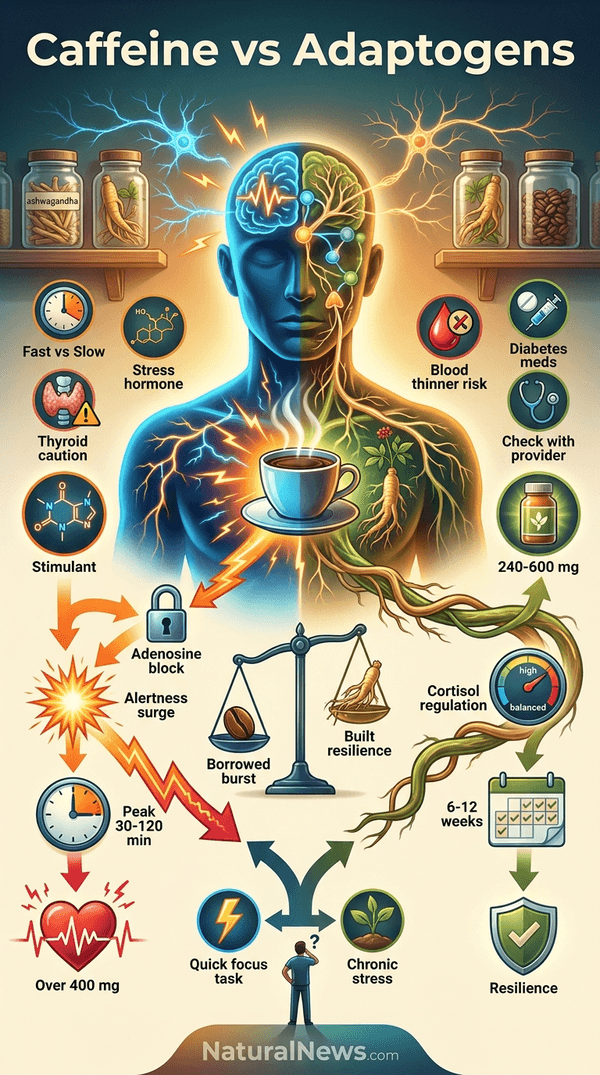
Caffeine helps alertness by blocking adenosine, a chemical that builds up in the brain throughout the day and makes a person feel sleepy, according to the report. Its effects can peak within 30 to 120 minutes, and the body clears about half of it within three to six hours, the report stated.
The review found that doses of 50 to 250 milligrams a day can support alertness, concentration and reaction time. In contrast, consuming more than about 400 milligrams a day can increase the chances of feeling anxious, restless or jittery, according to the report.
Research collected in the neuroscience literature describes caffeine acting as an antagonist at adenosine receptors. In human brain tissue, caffeine antagonizes the binding of various adenosine receptor ligands at concentrations in the range obtained in plasma after behaviorally stimulant doses, and its rapid distribution through body fluids results in brain concentrations that likely exert their antagonism at the adenosine receptor [3]. A separate review of caffeine's stimulus functions in humans noted that caffeine affects most organ systems [4].
The review advised consumers to remember to count all sources of caffeine, including coffee, tea, energy drinks and supplements, when keeping an eye on the 400-milligram mark, the report stated. It noted that some people are more sensitive to caffeine's effects than others, according to the report.
Other reporting has also emphasized total load. Mark Mayell, in "Off the Shelf Natural Health," wrote that many people find tonifying, adaptogenic herbs a better choice than nervous-system stimulants such as caffeine to increase daily energy levels and overcome fatigue not directly tied to physical exertion [5].
Ashwagandha and Ginseng: Adaptogen Evidence
For ashwagandha, human studies using 240 to 600 milligrams daily for six to 12 weeks found reductions in perceived stress and cortisol, a hormone released during the body's stress response, the report stated. Some studies also reported improvements in anxiety symptoms and sleep quality, according to the report. NaturalNews.com described ashwagandha as often called the king of Ayurvedic herbs and noted that many people consider it an adaptogen, a substance that helps the body manage stress effectively [6].
Ginseng may have some faster effects on the brain, the report stated. A single dose has been linked to better working memory and reaction time, and longer-term benefits, including support for the body's stress response, may take four to 12 weeks of consistent use, according to the review. NaturalNews.com reported that Korean ginseng, also known as Panax ginseng, is an adaptogen that can feed the adrenal cortex the nutrients it needs [7].
The review stated that the ingredients do not have to be competing options, and that some people may use caffeine for occasional alertness while exploring ashwagandha for longer-term stress support, according to the report. It advised that if ongoing stress is more of a concern, ashwagandha may be worth exploring because its potential benefits are more closely linked to stress levels, cortisol and sleep rather than an instant energy boost, the report stated. Medical News Today described ashwagandha as an adaptogen that could help boost energy levels, improve sleep, and reduce stress and anxiety, with adaptogens described as plant-derived substances that help the body better manage stress [8].
Safety and Interaction Notes
Ashwagandha can affect thyroid hormone levels, so the review advised checking with a health care provider before use in people taking thyroid medication, including levothyroxine, according to the report. Ginseng may interact with blood thinners, diabetes medications and certain drugs processed by the liver, the review stated. A toxicology reference work cited a systematic review of P. ginseng adverse effects and drug interactions by Coon and Ernst published in Drug Safety [9].
The review stated that caffeine users should count all sources, including coffee, tea, energy drinks and supplements, when tracking intake against the 400-milligram mark, according to the report. It stated that people who are pregnant, take medication or have an existing health condition should consult a health care professional before starting a new supplement, the report stated.
Kenneth Barton, in "The Natural Pharmacist," noted that a true adaptogen should cause no side effects, be effective in treating a wide variety of illnesses and help return an organism toward balance, while acknowledging that those criteria are not fully met by many plants sold under the label [10]. The review's caution aligns with that standard: it did not state that ashwagandha or ginseng are risk-free, only that their use warrants medical consultation in certain groups, according to the report.
Conclusion
The review concluded that caffeine is the most straightforward choice for alertness and focus, while ashwagandha and ginseng may offer different benefits with time, according to the report. It stated that caffeine works quickly and has solid evidence behind it for alertness and focus, and that ginseng may support certain aspects of brain performance, including memory and reaction time, while regular use could offer additional benefits for stress management, the report stated.
The review stated that users should know what they are asking a supplement to do before adding it to a routine because effects and timing differ, according to the report. The report added that not every supplement needs to give an instant boost to be useful.
References
- Adaptogenic herbs Natures answer to stress and elevated cortisol - NaturalNews.com, March 30, 2026.
- Dirty Genes: A Breakthrough Program to Treat the Root Cause of Illness and Optimize Your Health. Ben Lynch
- Basic and clinical aspects of adenosinergic neuromodulation. Acrobat 3.0 Capture Plug-in. Neuroscience & Biobehavioral Reviews Vol. 9, pp. 421--430, 1985
- Stimulus Functions of Caffeine in Humans: Relation to Dependence Potential. 280119001.TIF. Neuroscience and Biobehavioral Reviews 16(3) 273-287 1992
- Off the Shelf Natural Health. Mark Mayell
- 5 Reasons why ashwagandha is an amazing healing herb - NaturalNews.com, November 13, 2018.
- Boost your energy naturally with these super - NaturalNews.com, May 17, 2012.
- The most effective vitamins for boosting energy - Medical News Today. https://www.medicalnewstoday.com/articles/326756
- Molecular mechanisms of protein folding in heat shock proteins. by User. Medical Toxicology of Natural Substances 2008 John Wiley & Sons, Inc.
- The natural pharmacist natural treatments for colds and flus. Barton Anna M
Explainer Infographic










Please contact us for more information.