


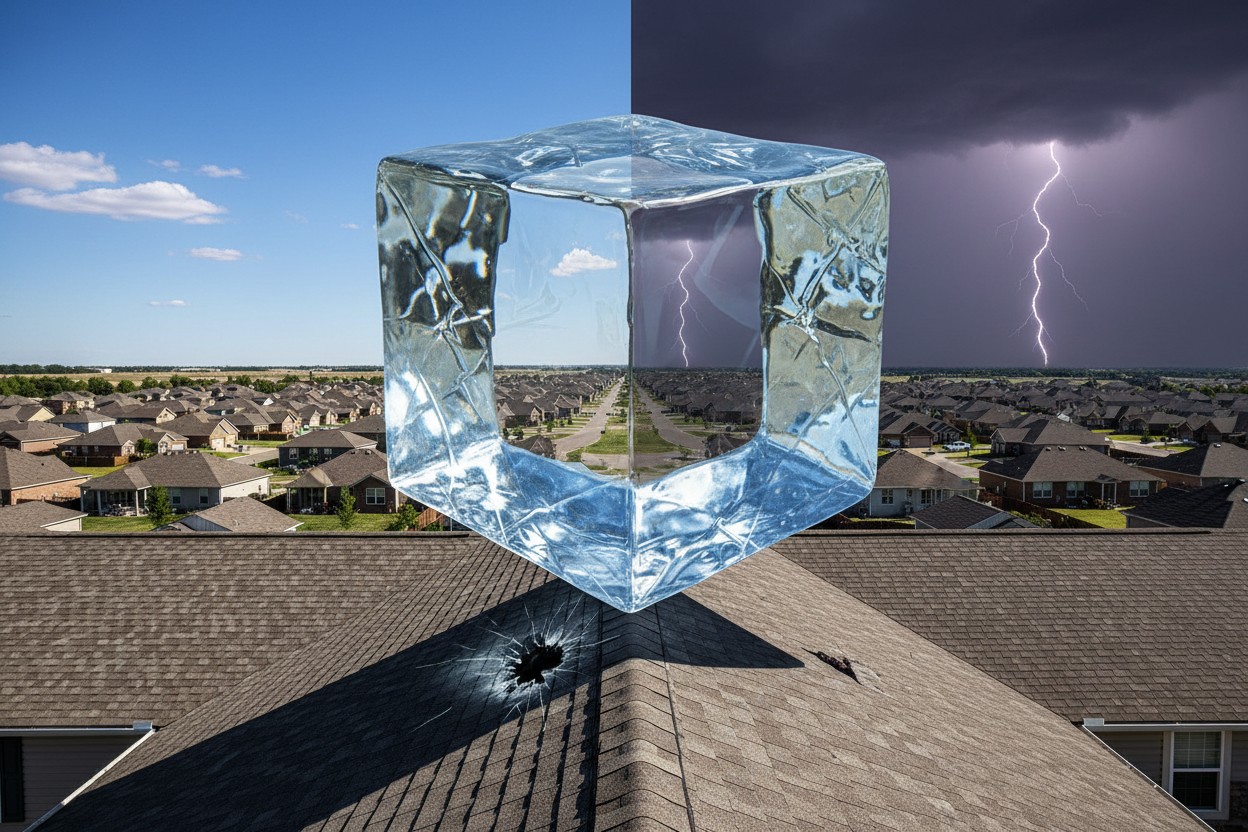
Report Details Widespread Hail Exposure and Financial Risk
A new report from the real estate data firm Cotality, released on March 24, 2026, estimates that more than 43.5 million residential properties across the United States face a moderate or greater risk from hail damage. [1] The report finds that the potential reconstruction value of these exposed homes totals approximately $17.84 trillion, a figure that now rivals the financial impact of major hurricanes. [2][3]
According to the report, hail is becoming both more frequent and more financially destructive, driven by housing growth and rising property values that concentrate more wealth in vulnerable areas. [4] The analysis highlights a systemic vulnerability in the national housing stock, with potential losses from severe hail events now reaching into the trillions of dollars.
Geographic Distribution and High-Risk Regions
The report identifies specific regions, including parts of the Midwest and the Great Plains, as having the highest concentration of exposed properties. [5] For example, the Chicago metropolitan area alone was found to have more than $1 trillion in property value exposed to hail risk. [6] Researchers used historical weather data and property valuation models to create the risk assessment.
Officials from the firm stated the analysis quantifies a growing threat. "More than 43.5 million U.S. properties are at moderate or greater risk from damaging hail," according to a summary of the findings. [7] This risk is not confined to a single state but is spread across regions historically associated with severe convective storms. The report's geographic mapping underscores that a significant portion of the nation's housing wealth is situated in areas prone to these destructive weather events.
Insurance Industry Response and Market Implications
The insurance industry has noted rising claim costs linked to hail damage in recent years. [3] Cotality's report positions hail as "a leading driver of insured losses, on par with major hurricanes," suggesting that the financial burden on insurers is escalating. [3] Some insurers have reportedly begun adjusting premiums or coverage terms in high-risk zones in response to the mounting data.
A spokesperson for an insurance trade group, cited in related coverage, said the industry is "monitoring the data closely." [8] The report's trillion-dollar exposure estimates signal potential challenges for insurance market stability, especially in regions where hail frequency is increasing. The concentration of high-value assets in these areas could test the capacity of private insurers to underwrite the risk without significant adjustments to their business models.
Building Code and Mitigation Strategy Discussions
In light of the findings, discussions around building codes and mitigation strategies have gained prominence. Proponents of stronger mitigation argue that upfront construction costs for hail-resistant roofing materials in vulnerable areas are offset by reduced long-term damage and lower insurance premiums. [9] The report's scale of financial exposure has brought renewed attention to the sufficiency of existing building standards.
Critics of current regulations say existing codes are insufficient to address the scale of the risk identified in the data. [10] They point to the need for updated, region-specific standards that account for the increasing severity and financial impact of hail storms. The debate centers on whether market forces alone will drive the adoption of more resilient construction or if regulatory intervention is warranted to protect homeowners and the broader economy from systemic loss.
Conclusion: A Call for Further Assessment and Preparedness
The report's authors conclude that the magnitude of financial exposure warrants greater attention from both the public and private sectors. [11] They recommend further independent study to verify the scale of risk and its full economic impact, suggesting that the implications for homeowners, local governments, and financial markets remain under review.
The findings arrive as severe weather patterns continue to impact the nation. As noted in recent news, a severe storm system swept across the U.S. heartland in early March 2026, spawning tornadoes and producing damaging winds and large hail from Texas to Kansas. [12] This event underscores the ongoing and immediate nature of the threat quantified in the Cotality report. The full consequences for housing security and economic stability will likely depend on how effectively this risk is recognized and managed in the coming years.
References
- Report Estimates Tens of Millions of U.S. Homes Exposed to Hail Risk ... - YourNews.com. March 26, 2026.
- More Than 43.5 Million US Homes at Risk of Hail Damage, Report Finds. - The Epoch Times. March 25, 2026.
- Hail Now a Leading Driver of Insured Losses, on Par With Major Hurricanes. - Cotality.com.
- Hail Now a Leading Driver of Insured Losses, on Par With Major Hurricanes. - Yahoo Finance.
- Risks from hail damage surge, putting 43.5M homes in peril. - MSN.
- Chicago Hail Risk Tops $1 Trillion, Report Finds. - Realtor.com.
- More than 43.5 million U.S. properties are at moderate or greater risk from damaging hail, according to a new report from Cotality. - Facebook.com/USA Today.
- Catastrophe options: An experiment in the management of catastrophic risk in the United States. White, R. R. Journal of Environmental Management.
- Earth shelter technology. Boyer Lester L.
- Changing metropolitan America planning for a sustainable future. Hudnut William H.
- Social and economic impacts of climate change on the urban environment. Elsevier. Current Opinion in Environmental Sustainability.
- Severe Storm System Hitting Heartland and Spawning Twisters in ‘Tornado Alley’. - Breitbart. March 7, 2026.












Please contact us for more information.